How far are self-healing polymers and coatings from everyday products?
Some self-healing finishes have reached real products. Nissan developed a self-healing clearcoat for several of its vehicles. In 2012 Core77 reported that small scratches heal in as little as an hour and severe ones take up to a week. A self-healing phone case using the same finish was shown as a prototype that year. A 2018 test of a later phone case used a brass brush and gave no timed or standard protocol. Concrete that heals with bacteria is in a 25-metre pilot in a Dutch rail tunnel, and the July 2024 announcement reports no test results. Measured durability, cost and recovery of strength are not shown in the sources reviewed.
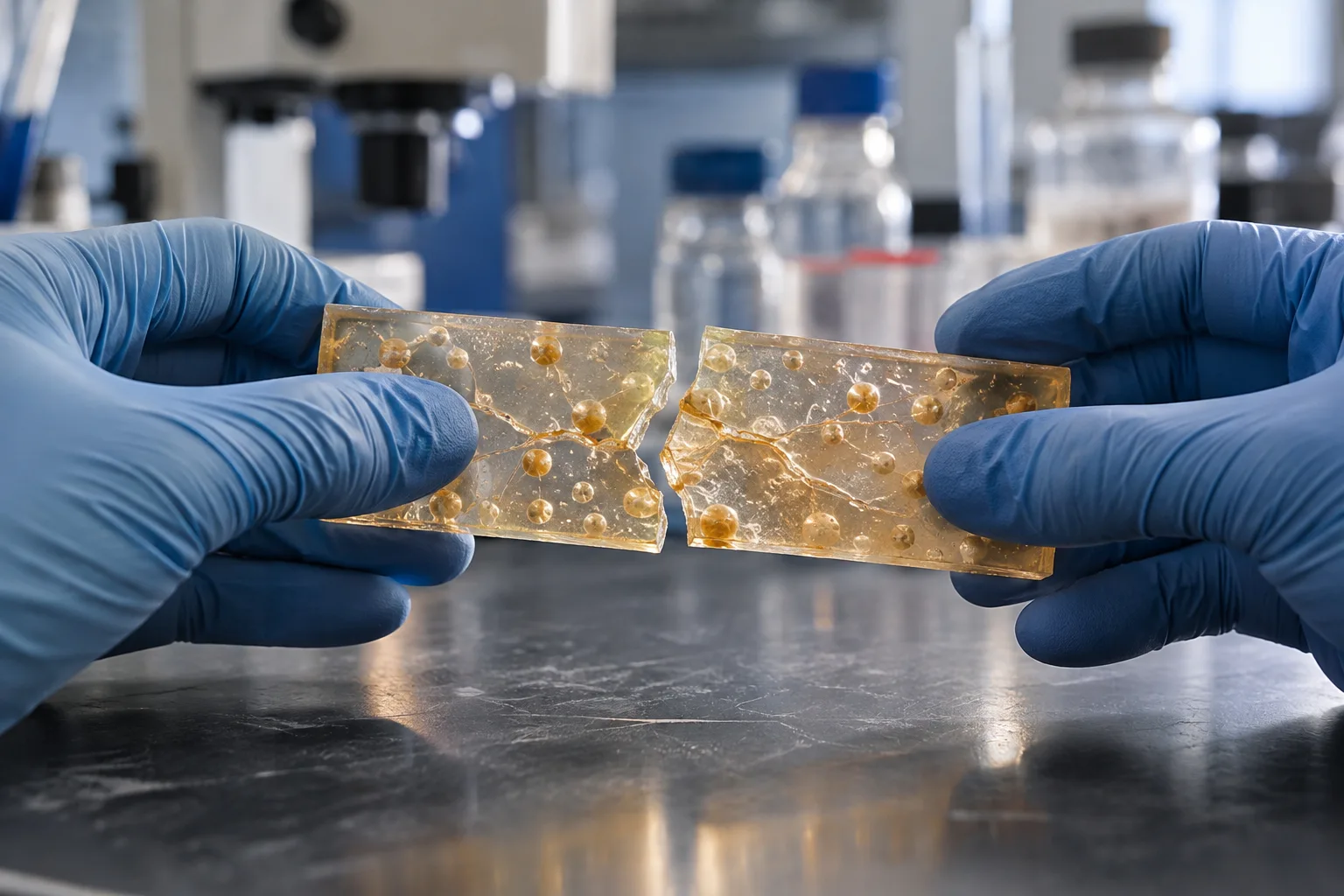
Close. Early pilots are running in the real world.
Self-healing finishes have been developed for production vehicles, but the sources reviewed give no sales figures, field-failure data or long-term durability results. Phone cases were shown as prototypes, and the one later case test found used a brush scratch test with no timed protocol. Concrete with bacteria has been placed in full-scale demonstrators, and one 25-metre wall is in a field pilot without reported results. This is a pilot stage rather than a scaling or widespread stage, because no source reviewed shows broad use with measured durability.
The tech tree
Everything recorded on Vrulum that this future needs, oldest foundations at the top and the goal at the bottom. Lines show what each step requires.
- 2012Self-healing phone case shown as a prototypeDone Unlocked.
- 2018Independent press tests of later self-healing phone casesDone Unlocked.
- 2020Bacteria-based concrete placed in full-scale demonstratorsDone Unlocked.
- 2024Field pilot of self-healing concrete in a rail tunnel wallIn progress Being researched.
- 2025Crack closure shown in a polymer-glass simulationDone Unlocked.
- Date not recordedSelf-healing clearcoat developed for vehiclesDone Unlocked.
- Date not recordedManufactured polymer part repaired with measured strength recoveryNot started Locked.
- Date not recordedIndependent durability and cost data for self-healing finishesNot started Locked.
- GoalProducts that heal their own cracksGoalRequires: Self-healing polymers, Self-healing clearcoat developed for vehicles, Self-healing phone case shown as a prototype, Independent press tests of later self-healing phone cases, Bacteria-based concrete placed in full-scale demonstrators, Field pilot of self-healing concrete in a rail tunnel wall, Crack closure shown in a polymer-glass simulation, Manufactured polymer part repaired with measured strength recovery, Independent durability and cost data for self-healing finishes. Locked.
The road so far
5 of 8 steps done, 1 in progress.
- DoneSelf-healing clearcoat developed for vehicles
Nissan's Scratch Shield finish was developed for its vehicles. TechCrunch reported in 2012 that Nissan had used the Scratch Shield paint technology in its vehicles since 2005. Core77 reported in 2012 that Nissan developed the material for the 370Z, Murano and X-Trail. The sources reviewed give no production volumes or field-failure data. [4][5]
- Done · 17 Jan 2012Self-healing phone case shown as a prototype
Nissan showed a Scratch Shield phone case in January 2012. TechCrunch reported that it was a prototype, distributed to journalists and customers, and that Nissan might commercialise it later that year. The article gives no repair times, only that the case quickly fixes fine scratches. [4]
- Done · 19 Dec 2018Independent press tests of later self-healing phone cases
BGR tested Just Mobile Tenc cases with a brass brush supplied by the maker. In most cases the scratches were gone after a short while, but in a few some were still visible after a few minutes. The article gives no timed or standard test protocol, and the sources reviewed include no standard independent test of healing speed or durability. [6]
- Done · 8 Apr 2020Bacteria-based concrete placed in full-scale demonstrators
A 2020 review of full-scale demonstrators found that adding the bacterial healing agent to repair mortar and concrete caused no observed negative effects on construction performance. The authors could not show better crack healing in those structures, because the demonstrators hardly cracked. In laboratory tests, cracks up to 0.8 mm healed, depending on the dosage of healing agent. [1]
- In progress · 16 Jul 2024Field pilot of self-healing concrete in a rail tunnel wall
ProRail, the province of Noord-Brabant and Heijmans Infra are testing 25 metres of tunnel wall at the Vijf Eikentunnel in Rijen, made with bacteria and nutrients. The operator says the bacteria become active when moisture and oxygen enter a crack and fill it with a limestone layer. The announcement describes the pilot and its aim of testing water-tightness in practice, but reports no test results. [2]
- Done · 1 May 2025Crack closure shown in a polymer-glass simulation
A Nature Communications paper reports, from numerical simulations, that controlled oscillatory deformations increase molecular mobility around a cylindrical crack in a glassy polymer and recover the properties of the pristine material. The authors describe this as a first step toward a general physical mechanism of self-healing in glasses. It is a simulation, not a tested product. [3]
- Not startedManufactured polymer part repaired with measured strength recovery
No manufactured polymer part with repeated repair and measured recovery of strength or fatigue life was found in the sources reviewed. The simulation above does not test a manufactured part. [3]
- Not startedIndependent durability and cost data for self-healing finishes
Core77 reports that repair time depends on the severity of the scratch, and it does not say what damage the coating cannot repair. No independent long-term durability test or public cost figure for these finishes was found in the sources reviewed. [5]
Why it matters
Finishes that close fine scratches could keep products looking new for longer and reduce early replacement. Cracks that affect strength are a different problem. Sealing a crack does not show that a part has regained its load-bearing capacity, so the difference matters for safety and for any product claim.
What stands in the way
- Repair time depends on scratch severity. Core77 reported in 2012 that small scratches heal in as little as an hour and severe ones take up to a week.
- The sources reviewed do not say what damage a self-healing clearcoat cannot repair, so its limits are not established.
- Concrete demonstrators in the reviewed study hardly cracked, so healing has not yet been shown in structures under real damage.
- Phone-case healing evidence in the sources reviewed is limited to a 2018 brush test by a reviewer, and no standard independent protocol was found.
- No public cost or lifetime figures for self-healing phone cases, car finishes or concrete were found in the sources reviewed.
- The polymer-glass result is a numerical simulation of a cylindrical crack, and it has not been shown in a manufactured part.
Signals to watch
- Measured results from the ProRail rail tunnel pilot at Rijen, including crack closure, water tightness and maintenance data over several years.
- Full-scale concrete demonstrators designed to crack in a controlled way, so that healing can be compared with conventional mixes under the same load.
- An independent test protocol for healing speed and repeat healing that manufacturers and reviewers use in place of brush or key scratches.
- Field data on repairs of self-healing clearcoats across several years of vehicle use, including failures.
- Polymer work that tests realistic cracks in manufactured parts and reports recovery of strength or fatigue life, not only visual closure.
Sources
- review article
Bacteria-based self-healing concrete: Evaluation of full scale demonstrator projects
Renée M. Mors, Henk M. Jonkers. RILEM Technical Letters, 8 Apr 2020. - company announcement
Bacterie maakt beton van tunnel Rijen 'zelfhelend'
ProRail, 16 Jul 2024. - peer reviewed paper
Inducing mechanical self-healing in polymer glasses
José Ruiz-Franco, Andrea Giuntoli. Nature Communications, 1 May 2025. - news
Scratch Shield: Nissan Introduces World's First Self-Healing iPhone Case
Serkan Toto. TechCrunch, 17 Jan 2012. - news
Nissan Potentially Porting "Scratch Shield" Material Over to Consumer Products
Rain Noe. Core77, 23 Jan 2012. - news
Watch This iPhone Case Heal Itself From Scratches In 20 Seconds
BGR, 19 Dec 2018.
Last reviewed 21 Oct 2026.