How far are thin-film and flexible robots from practical use?
Thin-film robots are built from flexible circuit films less than a millimetre thick and move using electrostatic forces. A 2026 laboratory prototype crept over test surfaces, passed through a 7 mm gap and ground an aluminium test plate, but it was wired to external high-voltage supplies and control hardware. Separate insect-scale crawlers have run on onboard power in the lab, though none of them are thin-film designs. The sources reviewed show no field use of thin-film robots yet.
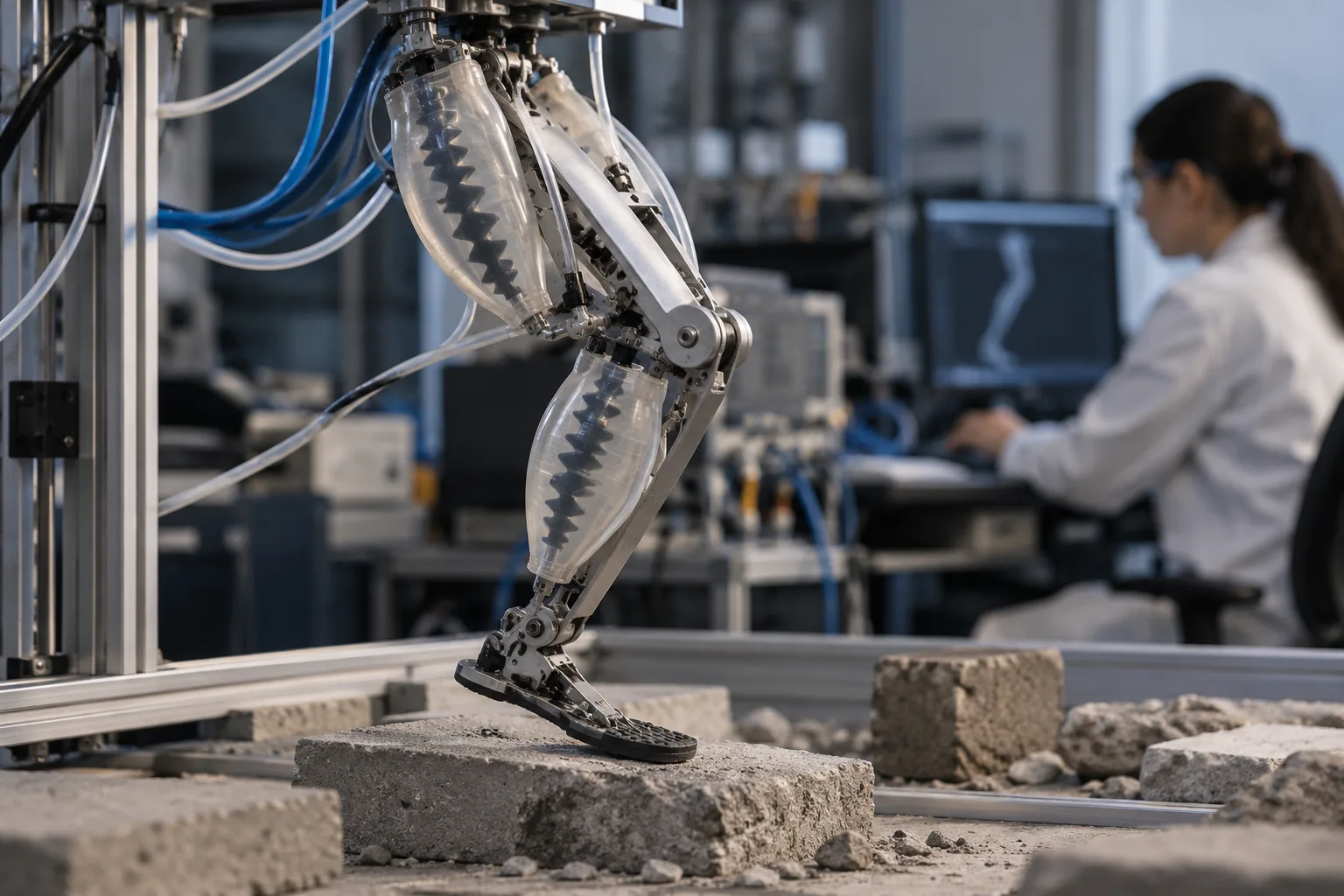
Getting closer. Prototypes exist, but not in real-world use.
Working robots have been shown in laboratory conditions. The thin-film prototype was demonstrated tethered to external high-voltage equipment, on test surfaces and workpieces, which makes it an engineering prototype. No untethered thin-film robot, field trial or industrial use has been shown, so it has not reached the pilot stage. The insect-scale crawlers that have run on onboard power are different designs, and they show that onboard power is possible at small scale, not that thin-film robots can work without a tether.
The tech tree
Everything recorded on Vrulum that this future needs, oldest foundations at the top and the goal at the bottom. Lines show what each step requires.
- 2014Artificial muscles (soft actuators)Research and prototypes Being researched.
- 2020Thin-film flexible robotsResearch and prototypes Being researched.
- 2020Insect-scale crawler with onboard fuelDone Unlocked.
- 2026Tethered thin-film robot shown on lab tasksDone Unlocked.
- 2026Untethered insect-scale piezoelectric crawlerDone Unlocked.
- Date not recordedThin-film robot carrying its own high-voltage power and controlNot started Locked.
- Date not recordedClosed-loop control on a thin-film robotNot started Locked.
- Date not recordedUse on a real structure or in the fieldNot started Locked.
- GoalRobots as thin as paperGoalRequires: Thin-film flexible robots, Artificial muscles (soft actuators), Tethered thin-film robot shown on lab tasks, Insect-scale crawler with onboard fuel, Untethered insect-scale piezoelectric crawler, Thin-film robot carrying its own high-voltage power and control, Closed-loop control on a thin-film robot, Use on a real structure or in the field. Locked.
The road so far
3 of 6 steps done.
- Done · 23 Jun 2026Tethered thin-film robot shown on lab tasks
A 970 micrometre-thick, 19.7 g electrostatic film robot adhered to test materials including paper, PLA, acrylic and wood, and passed through a 7 mm gap. It ground an aluminium plate with reciprocating grinding at 30 Hz, lowering surface roughness from Ra 0.81 to 0.46 micrometres over 10 minutes. The robot was wired to external high-voltage supplies and controller hardware. [1]
- Done · Aug 2020Insect-scale crawler with onboard fuel
RoBeetle, an 88 mg autonomous crawling robot, is powered by the catalytic combustion of methanol, using a catalytic artificial muscle. It is a different design from a thin-film robot, but it shows that a crawler this small can carry its own energy source. [3]
- Done · Jul 2026Untethered insect-scale piezoelectric crawler
A piezoelectric robot carries its own battery and runs untethered. The untethered version is 39 mm long and weighs 20.9 g, and it reached 265 mm/s under a 180 g load in the tests reported. Tests were mainly on smooth glass, and the battery lasted about 70 minutes on a 200 mAh cell, but only about 15 minutes on a 100 mAh cell. The paper's own descriptions of the battery capacity do not agree, so the runtime figures should be read with care. [2]
- Not startedThin-film robot carrying its own high-voltage power and control
The authors plan to add an onboard high-voltage amplifier, microcontroller, communication unit and power supply to remove the tether. Systems of this kind have not yet been built and shown on the thin-film robot. [1]
- Not startedClosed-loop control on a thin-film robot
The current prototype is controlled without position feedback. The authors plan to add a miniature sensor or self-sensing method to give position feedback for closed-loop control. This has not yet been shown. [1]
- Not startedUse on a real structure or in the field
The paper reports laboratory tests on test workpieces and surfaces. It reports no field trials, no operation on an in-service structure, and no repeatable industrial machining. The authors propose use inside large structures as the motivation for the work. [1]
Why it matters
Robots this thin could reach gaps and surfaces that bulky robots cannot, such as inside large structures, which could reduce the need for people to get into hard-to-reach spaces to inspect or repair them. Making such robots work untethered also raises unanswered questions about power, control and safe operation near people.
What stands in the way
- The thin-film robot is tethered. Its actuator ran at up to 450 V in most tests and 600 V in the maximum-force test, and its adhesive pads used up to ±1400 V on some materials. Onboard high-voltage electronics have not yet been built into the robot.
- Air breakdown can occur above about 500 V on aluminium, according to the authors, so high-voltage safety and insulation are central engineering problems.
- Adhesion depends strongly on the surface. Force on dusty aluminium was 0.339 N, against 3.84 N on brushed aluminium at ±450 V, and porous polyurethane gave 0.031 N at ±1400 V. Real structures may be dirty, coated or irregular, and the tests covered only the materials listed.
- Measured robot speed is far below the actuator figures. The thin-film robot moved at 27.6 mm/s in a straight line on aluminium at 80 Hz, while the 290 mm/s figure is for the actuator alone.
- Small untethered robots need onboard power, and battery mass and capacity limit their run time. The piezoelectric crawler was tested mainly on smooth glass, so its performance on rougher surfaces is not shown.
- The thin-film prototype has not been tested over long periods in the field, and no durability data from real use have been published in the sources reviewed.
Signals to watch
- A thin-film robot that carries its own high-voltage supply and controller and moves without a tether.
- Closed-loop position control with onboard sensing on a thin-film robot.
- Independent tests of electrostatic adhesion on dusty, curved, coated or wet surfaces.
- A field trial on an in-service industrial structure, or a maintenance task completed on a real structure.
- Untethered insect-scale crawlers reporting longer run times on rough surfaces, with lower mass.
Sources
- peer reviewed paper
A thin robot made of flexible electronics for in-situ machining and inspection of large structures
Huacen Wang, Yujin Dai, Ting Wang et al.. Nature Communications, 23 Jun 2026. - peer reviewed paper
An Insect-Scale Untethered Piezoelectric Robot with Multiple Biomimetic Features
Jing Li, Zhengxu Yan, Baoyi Liu et al.. Cyborg and Bionic Systems, 23 Jul 2026. - peer reviewed paper
An 88-milligram insect-scale autonomous crawling robot driven by a catalytic artificial muscle
Xiufeng Yang, Longlong Chang, Néstor O. Pérez-Arancibia. Science Robotics, Aug 2020.
Last reviewed 21 Oct 2026.