Robotic cool-roof coating applicator
This is an idea, not a product. Nothing here has been built or tested unless a linked technology profile says so.
The problem
Owners of flat roofs in hot regions may want to lower roof surface temperatures without using electricity, but painting a large roof by hand is slow and can leave uneven coverage.
The idea
A first version would be a wheeled applicator, steered remotely or by a worker on the roof, that lays a radiative cooling paint in even passes across low-slope roofs and logs the coverage it applies. It would not be fully autonomous, and it would not promise a building energy saving, because the sources show that cooling power depends strongly on climate and that durability depends on the coating itself.
Enabling technology
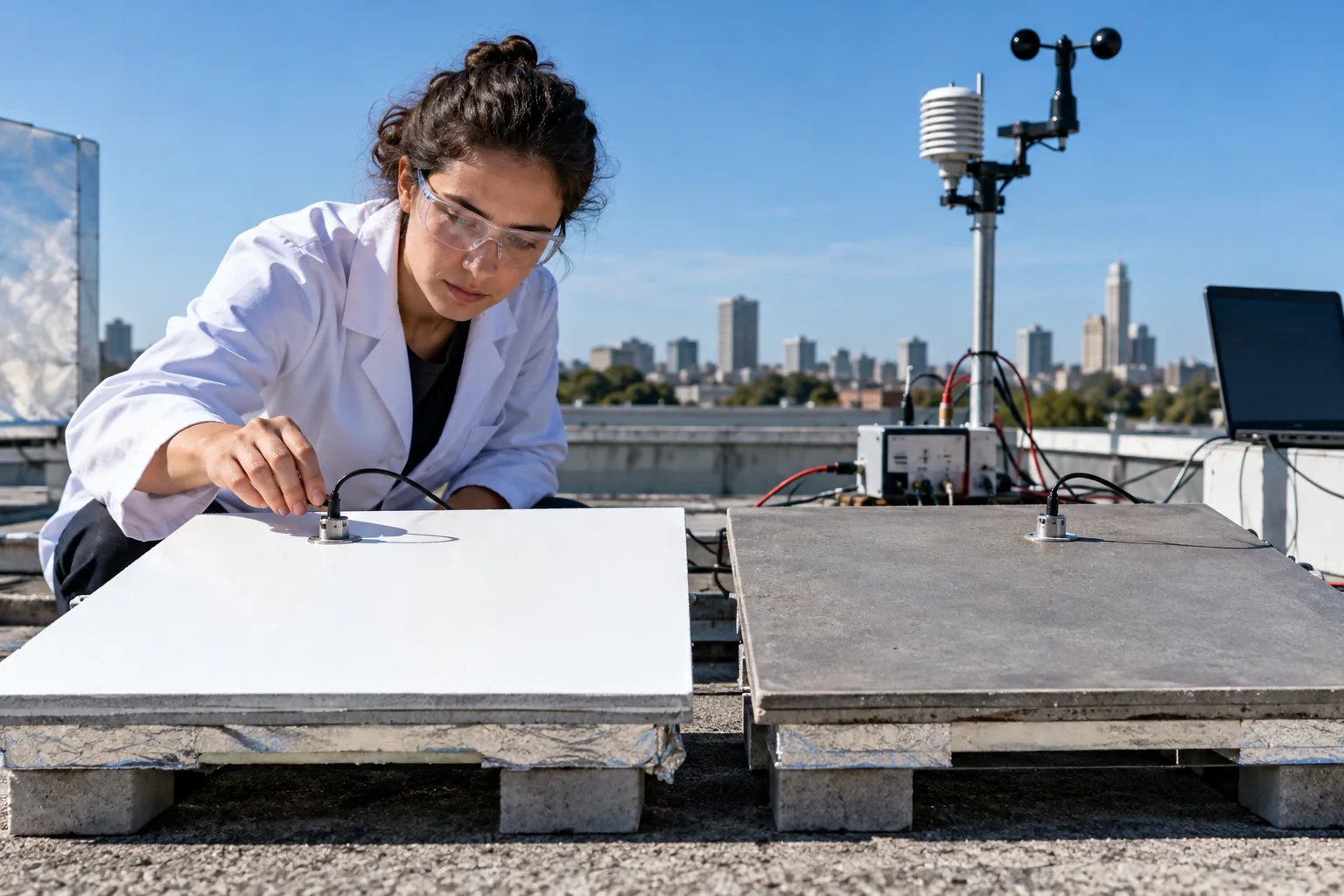
- Passive daytime radiative cooling: Passive daytime radiative cooling uses surfaces that reflect almost all sunlight while giving off heat as infrared light that escapes through the atmosphere into space. Laboratory and rooftop tests have cooled surfaces several degrees below the surrounding air in full sun without using electricity.
What stands in the way
- Coatings lose solar reflectance through ultraviolet exposure, thermal ageing, dirt and chemical attack, and small losses in reflectance cut cooling sharply, so a coating must hold up on a real roof before the applicator matters.
- Reported cooling power is modest, roughly 40 to 120 W/m², so the applicator must cover large areas evenly to make a difference to building loads.
- Very high filler loadings that make paint whiter also make it more prone to cracking or peeling, which limits how white a coating can safely be.
- Performance falls in humid or cloudy conditions, so the same applicator and coating would not give the same result in every climate.
A cheap way to test it
A bench test with no roof work and no outdoor sun. (1) Apply the coating to flat test panels, using either the applicator's pass pattern or a bench rig that copies it, then measure solar reflectance with a spectrophotometer. A university or commercial test lab can run this measurement if one is not available. Pass only if the reading is at or above the solar reflectance the paint supplier states for that batch. (2) Expose a coated panel to accelerated ultraviolet and heat ageing in a lab cabinet, with the exposure settings written down before testing starts, then repeat step 1. Pass only if the reflectance stays at or above the supplier figure. Any failure stops the project until the coating is changed. Measured cooling temperature in direct sun is left for a later stage, because it needs clear, dry weather and a site.