Neural bypass for hand function after injury
This is an idea, not a product. Nothing here has been built or tested unless a linked technology profile says so.
The problem
Some people with tetraplegia after a cervical spinal cord injury have limited arm and hand function. Non-invasive spinal stimulation has been tested for arm and hand function in a single-arm trial (see spinal-cord-stimulation), but the reviewed sources do not report a system that uses movement intent to time stimulation for a hand movement.
The idea
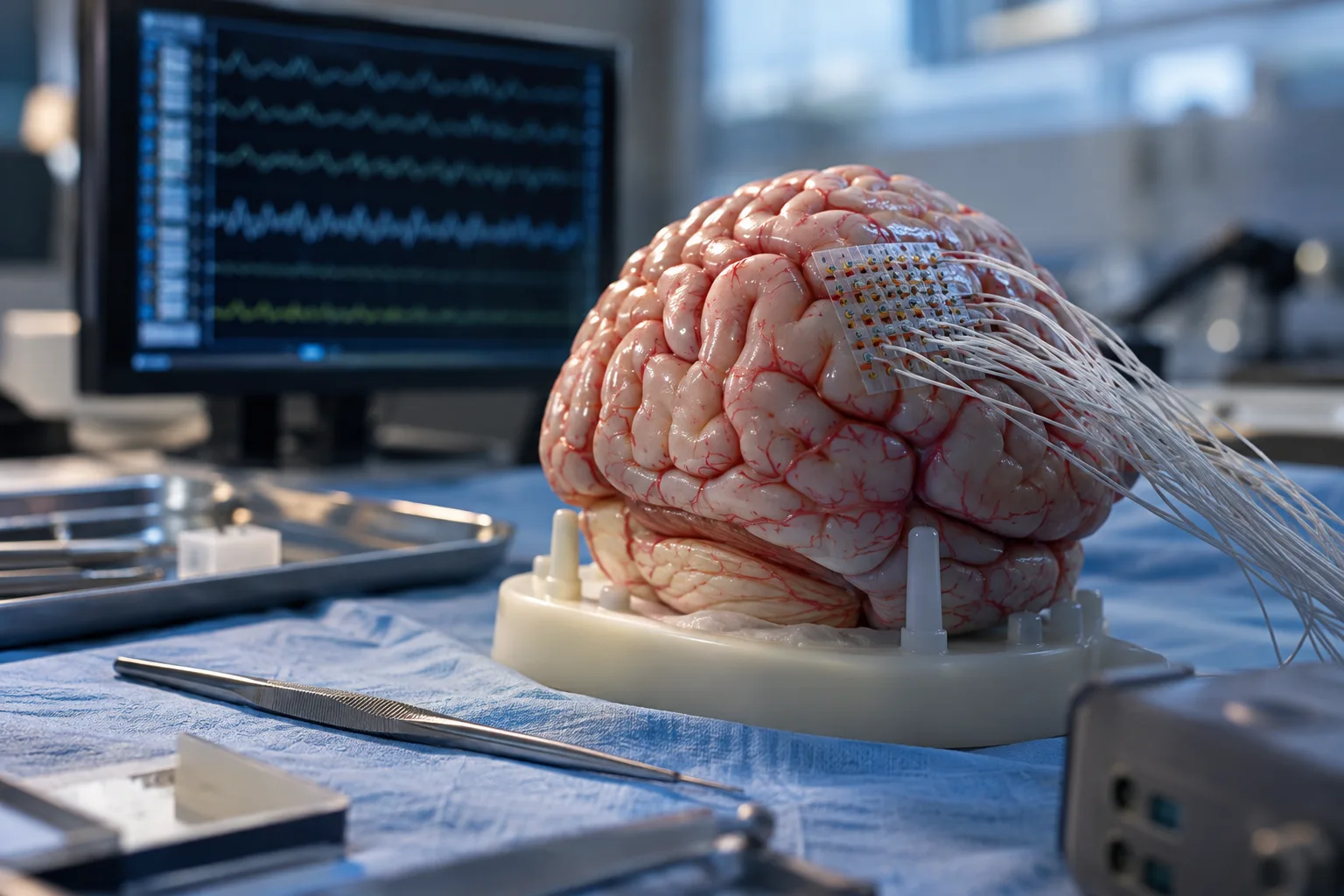
A plausible first step is a wired research prototype, not a device for everyday use. It would read movement intent from a cortical recording array (intracortical or surface), decode one of a small set of pre-set hand movements, and use the decoded output to time stimulation of the spinal cord for one hand function. The reviewed sources show intent decoding for speech and avatar control, and intent-timed stimulation for leg and trunk movement. They do not show decoding of hand movements, or intent-timed stimulation for the hand, so this link is speculative.
Enabling technology
- Brain-computer interfaces: Brain-computer interfaces read electrical activity from the brain and turn it into text, speech or device commands. Research teams have decoded attempted speech from implanted electrodes, and one company has tested an implant placed through blood vessels. A September 2026 study used electrodes on the brain's surface to control a virtual avatar in two of three people with paralysis. Only a small number of people have been studied in all of this work.
- Spinal cord stimulation for paralysis: Electrical stimulation of the spinal cord can help some people with spinal cord injury move again. Implanted epidural systems have restored walking and trunk control in very small research cohorts. A non-invasive system called ARCEX was studied in a 65-person trial, and its maker states that it is FDA cleared to improve hand sensation and strength in people with incomplete cervical spinal cord injuries.
What stands in the way
- Speech decoding from intracortical arrays has been shown in one participant with ALS (Willett and colleagues, 2023). Avatar control from surface (ECoG) signals, including body gestures, was shown in two of three participants in a 2026 study (NIH release). None of these reports decodes hand movements, so the core decoding step is unproven for this use.
- Intracortical arrays need surgery that opens the skull. The endovascular route avoids that, but the SWITCH study reports safety in four analysed patients over 12 months and does not report hand control (Mitchell and colleagues, 2023).
- The 2026 system was wired to external processing units, and the planned wireless, fully implantable version has not been shown.
- Spinal stimulation evidence comes from very small groups, with three participants in the epidural study (Rowald and colleagues, 2022). The reviewed epidural work targets leg and trunk movement, not the hand. The largest non-invasive trial was single-arm with no sham group, so the size of any benefit is uncertain (Moritz and colleagues, 2024). The mechanisms still need to be explored.
- Running two outputs at once may interfere with each other. The NIH release notes that attempting speech and gestures at the same time seemingly diminishes speech capabilities, so combining intent decoding with stimulation may need its own testing.
A cheap way to test it
Build a benchtop rig with a motorised model hand or wrist joint, a current-limited, electrically isolated stimulator connected to a saline-filled or tissue-equivalent load, and a logging system. Replay pre-recorded or simulated intent signals through the decoder and stimulation controller. Use only signals whose source and data-use terms are confirmed in writing before the test starts. Pre-register the movement sequence, the decoder accuracy threshold, and the maximum stimulation amplitude and charge before testing. Pass if the rig completes every pre-registered sequence, produces no movement that was not cued, delivers no stimulation above the pre-registered limits, and the decoder output matches the cue at or above the pre-registered threshold. Fail if any unintended movement or over-limit stimulation occurs, or if the threshold is missed on a repeat run. The test checks timing and safety logic, not decoding from brain signals. No human, animal or live neural recording is part of it, and the stimulator must not be connected to a person at any stage.