Dressing and bathing assist robot
This is an idea, not a product. Nothing here has been built or tested unless a linked technology profile says so.
The problem
People who need help with bathing or dressing may want support that reduces the physical load on a carer. Whether a robot could do this safely in a real home has not been established.
The idea
A modest first version would be a fixed or wheeled dressing aid, not a full humanoid. It would use one soft gripper on a simple arm to hold open, guide and hand over one garment at a time, such as a sock or a sleeve. A carer would stay in the room and approve each step. Bathing support would start with fetching and holding towels and supplies, with no contact with the body and no water near the electronics.
Enabling technology
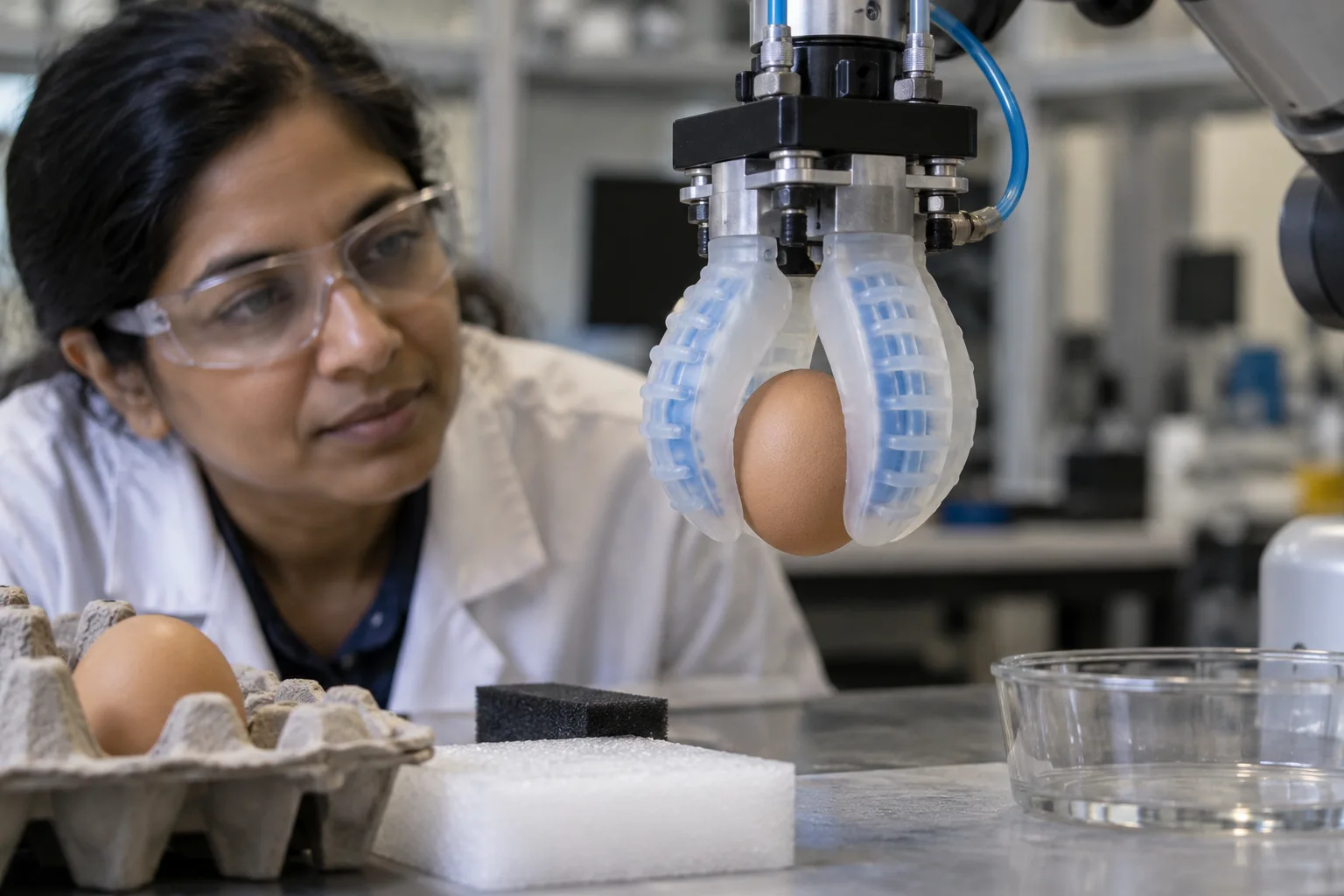
- Soft robotic grippers: Soft robotic grippers pick things up with flexible, deformable materials instead of rigid metal fingers, so they can handle delicate or oddly shaped objects. The field is active in research and prototypes, but the sources reviewed here do not show wide industrial use.
What stands in the way
- Control precision is listed as an open challenge for soft grippers (Shintake and colleagues, 2018). Guiding a garment onto a body that moves unpredictably would make precise control harder.
- Durability is a barrier. Soft materials can wear under repeated use. The strongest lab cycling result in the profiles, over a million cycles, is for a single actuator and not for a complete gripper (Mosadegh and colleagues, 2014).
- Most soft grippers are moved by air or fluid pressure, which needs pumps or valves and adds hardware to a home device.
- None of the reviewed profiles covers handling textiles. Garments deform and fold in ways the sources do not test, so dressing is a different task from grasping rigid or rounded objects.
- Touch sensing that detects slip or skin pressure is not established. Electronic-skin prototypes sense pressure in the lab, but the profile describes the field as not yet a mature product category.
- No reviewed source tests water, soap or skin exposure, so any bathing task adds conditions that have not been shown to work.
A cheap way to test it
Bench test with no people and no water near any electronics. Mount one soft gripper on a fixed arm above a table. Place three garment items (a sock, a sleeve and a waistband) on a stretchy fabric sleeve or a soft mannequin limb, with the limb fixed to the table. Run a scripted sequence in which the gripper grasps, holds open and releases each item, 20 times per item. A camera records every trial. A trial counts as a failure if the item slips or snags, or if the release needs a manual reset. Record the pass rule before the first run: each item must complete all 20 trials with no failure. Then repeat the full sequence for a fixed number of cycles set before the test, for example 500, and count failures to check for wear. Last, run one wet trial with only the fabric damp from water and mild soap, with the gripper's air supply and electronics kept covered and out of the splash zone, and apply the same pass rule. Any result other than a full pass fails the concept at this stage.