Robotic eye surgery assistant with real-time tissue mapping
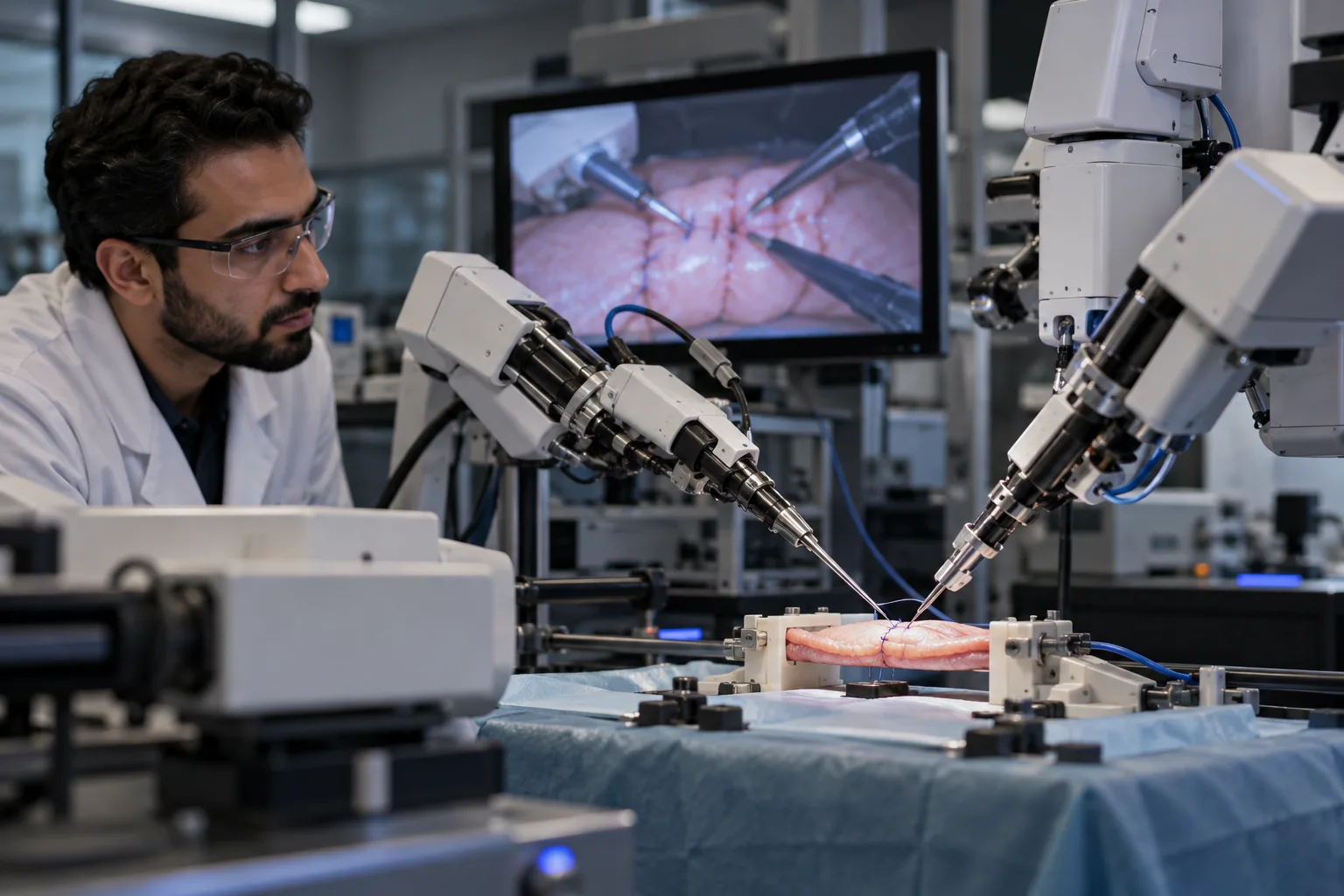
This is an idea, not a product. Nothing here has been built or tested unless a linked technology profile says so.
The problem
Eye surgery involves very fine movements close to delicate tissue, where small errors matter. Whether a robot could help with part of this work is an open question. The sources reviewed for autonomous surgical robots do not test eye surgery, so any benefit is unknown.
The idea
A first version could only be a supervised assistant, not an autonomous eye surgeon. It would carry out one narrow, repeatable step on a surgeon-approved plan, build a simple surface map of the tissue from camera images, and display that map to the surgeon. If the tissue moves beyond a set limit, it would stop and ask the surgeon for a new plan, as the STAR system does in the published pig work.
Enabling technology
- Autonomous surgical robots: Autonomous surgical robots carry out defined surgical steps, such as placing stitches, on their own after a surgeon sets up or approves the plan. Studies so far use model tissue, ex vivo tissue and a small number of pigs, and no human use is described in the sources reviewed here.
What stands in the way
- The sources reviewed for autonomous surgical robots describe phantom tissue, ex vivo tissue and a very small number of pigs (five in the STAR in vivo work). No eye tissue is described in these sources, so performance inside the eye is unknown.
- Tissue moves during surgery. In the STAR work the robot asked the surgeon for a new plan when tissue shifted beyond a set threshold, so any tissue map would need to stay accurate as the eye and its tissue move.
- The surgical step would need instruments and positioning accuracy suited to eye surgery. The cited studies do not test this scale, and the enabling technology profile gives no figures for it.
- Yang and colleagues (2017) argue that regulatory, ethical and legal questions arise as medical robots gain autonomy. These questions would apply to any eye device, and the sources reviewed do not describe a settled route.
A cheap way to test it
On a bench, using ex vivo animal eyes that were not obtained for this test (for example, eyes from an abattoir), fix each eye on a stage under a surgical microscope. Ask the robot to map a set of marked reference points on the tissue surface from camera images, and compare each mapped point with a reference measured by a calibrated microscope, within a tolerance agreed before testing. Repeat across several eyes, then nudge the stage by a pre-set amount to simulate tissue shift. Pass if the map stays within the agreed tolerance in every unshifted trial, and if the robot stops and asks for a new plan in every shifted trial above the set threshold. Fail if either condition is not met. No human trials should follow unless this test passes and a regulated route is in place.