Soft fruit picking gripper
This is an idea, not a product. Nothing here has been built or tested unless a linked technology profile says so.
The problem
Soft fruit may bruise when a rigid gripper squeezes or drops it. Whether bruising causes meaningful losses for growers or packers has not been checked for this concept. A picking aid that handles fruit more gently than rigid tools do may be worth testing.
The idea
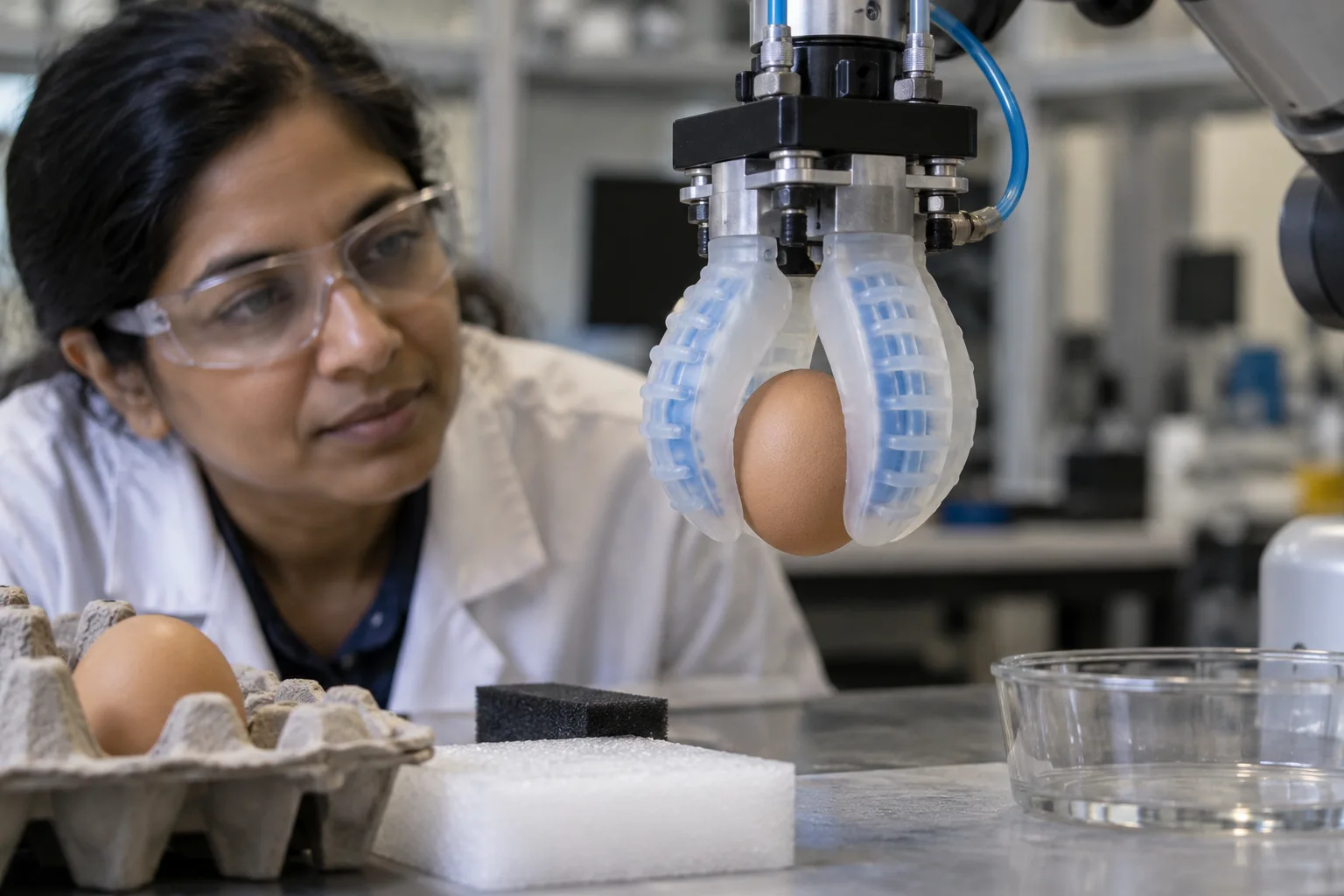
A first version would be a soft gripper head, using a vacuum-driven or pneumatic soft design of the kind shown in laboratory work, fitted to a fixed test rig rather than a full harvesting robot. On the bench it would pick up a small, sorted set of bought fruit and record the contact force and whether each fruit was lifted without slipping or marking. Fruit detection, tree-side positioning and field use would be left for later stages.
Enabling technology
- Soft robotic grippers: Soft robotic grippers pick things up with flexible, deformable materials instead of rigid metal fingers, so they can handle delicate or oddly shaped objects. The field is active in research and prototypes, but the sources reviewed here do not show wide industrial use.
What stands in the way
- Control precision is listed as an open challenge for soft grippers, so placing a fragile fruit in the same spot every time may be hard to repeat.
- Speed, robustness and miniaturisation are also listed as open challenges, while a picking gripper would need to work at harvest pace in rough conditions.
- The reported results in the reviewed sources come from the authors' own laboratory tests, so performance in cluttered orchard or packing-line settings is not established.
- Some soft designs may wear faster than rigid ones, and pneumatic designs need compressed air or other actuation hardware.
- Fruit varies in size, firmness and shape, and the reviewed sources give no shared benchmark for grip force or payload, so comparing gripper designs needs care.
A cheap way to test it
On a bench, mount a soft gripper head on a fixed positioning rig, with a load cell under a soft test surface to log peak contact force. Using bought fruit of one variety, sorted by size, pick each fruit with the soft gripper and then with a rigid two-finger gripper of similar reach as a control, in the same order. Record peak contact force, count fruit lifted without slip, and check each fruit for visible marking after a fixed holding period agreed before testing. Pass if the soft gripper's peak contact force is lower than the rigid control's on every test fruit and if it lifts at least an agreed share of fruit without slip, with both thresholds written down before any test is run. Then repeat the full sequence after a pre-set number of pick cycles to check for drift and wear. Use food-safe contact materials and clean the gripper between trials. No human trials.