Electronic skin
Also known as e-skin, artificial skin, skin-like electronics, epidermal electronics
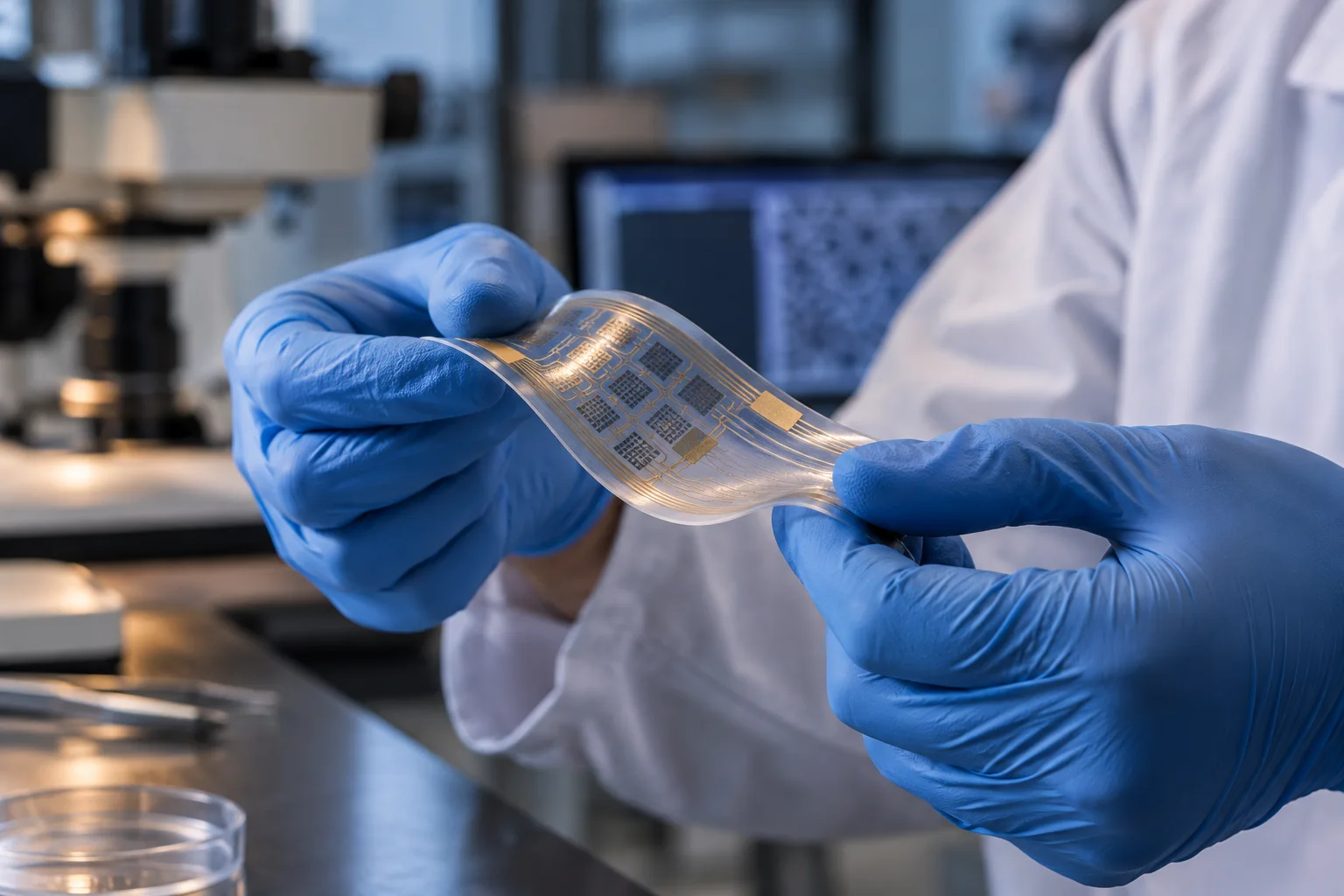
Electronic skin is a family of thin, flexible or stretchable electronic sheets that sense touch, pressure, temperature or body signals in the way human skin does. Laboratory prototypes have shown pressure mapping, skin-mounted health sensing and stretchable transistor circuits. A 2026 study used soft optical waveguides to reconstruct the three-dimensional shape of a sensing sheet, but this remains a research demonstrator rather than a ready-to-wear system.
In plain language
Human skin is soft, stretches and is packed with sensors that tell us about pressure, heat and texture. Electronic skin tries to copy this with very thin electronic layers made from plastics, rubbers or tiny wires that can bend and stretch without breaking.
Researchers want this for robots that can handle objects gently, for prosthetic limbs that can feel, and for patches that sit on the body and track health signals. So far most examples are laboratory prototypes that show one or two abilities at a time.
A 2026 study used soft optical fibres embedded in silicone to sense how a sheet bends and reconstruct its three-dimensional shape. This could eventually help track movement in rehabilitation or control a soft robot, but the demonstration used a small sheet with electronics at its edge. It has not been validated as a clinical or commercial garment.
Technical explanation
Early electronic skins combined pressure-sensitive rubber with an active matrix of transistors, so that thousands of sensing points could be read through a small number of wires. Someya and colleagues used organic field-effect transistors on plastic for this in 2004, and Takei and colleagues used ordered semiconductor nanowire arrays in 2010 to run a large-area matrix below 5 V. Mannsfeld and colleagues showed that moulding the rubber dielectric of a capacitive sensor into microstructures greatly raises its pressure sensitivity.
A second line of work focuses on mechanics. Epidermal electronics (Kim and colleagues, 2011) matched the thickness and stiffness of the outer skin so that devices stay attached by van der Waals forces alone and can record heart, brain and muscle signals. Intrinsically stretchable polymer transistors (Wang and colleagues, 2018) moved from rigid islands on rubber to circuits where the semiconductor, conductor and dielectric all stretch, reaching 347 transistors per square centimetre.
More recent work encodes sensor output in a form closer to biology. Tee and colleagues turned pressure into a train of digital pulses and used it to stimulate engineered mouse neurons in a dish, and Wang and colleagues (2023) built a monolithic soft skin that senses several stimuli, produces neuron-like pulse trains and drives an actuator in a closed loop at low voltage. Open problems include durability under repeated strain, powering and wireless data links, and stable long-term contact with living tissue.
Yu, Cao and Becker (2026) embedded 14 elastomeric optical waveguides in a 16 cm by 16 cm sheet. Their algorithm reconstructed test shapes at about 3 Hz, and physical tests on three moulds had errors of 0.28 to 0.45 cm. Simulations retained errors below 0.3 cm with up to three of the 14 waveguides disabled. Some waveguides were 1 mm thick; although the sensing surface was soft, the sheet did not stretch as a whole, and a circuit board and reconstruction software remained external. Pressure sensing was demonstrated separately and was not calibrated to report force magnitude. The authors describe physical therapy, virtual reality and soft robotics as possible uses, not validated products.
What the evidence says
Each statement is typed by the strength of its evidence and linked to the source that supports it.
Demonstrated Shown in a published experiment, test or shipping product.
A flexible active matrix of organic field-effect transistors (mobility up to 1.4 cm2/V s) combined with rubber pressure sensors captured pressure images and kept working when wrapped around a bar of 2 mm radius.
Sources: [1] · AbstractA 7 x 7 cm2 nanowire active-matrix backplane driving an 18 x 19 pixel pressure-sensor array operated below 5 V and survived more than 2,000 bending cycles to a 2.5 mm radius without loss of performance.
Sources: [2] · AbstractMicrostructuring the PDMS rubber dielectric of capacitive pressure sensors made them far more sensitive than unstructured films of similar thickness, with sensitivity tunable through the choice of microstructure.
Sources: [3] · AbstractElectronics with thickness, stiffness and mass similar to the outer skin attached by van der Waals forces alone and recorded electrical activity from the heart, brain and skeletal muscles.
Sources: [4] · AbstractA flexible organic circuit converted pressure into digital pulses at 0 to 200 Hz, and its output was used to stimulate optogenetically engineered mouse cortical neurons in vitro.
Sources: [5] · AbstractA scalable process produced intrinsically stretchable transistor arrays at 347 transistors per cm2, with mobility comparable to amorphous silicon and changing by no more than one order of magnitude over 1,000 cycles at 100% strain.
Sources: [6] · AbstractA monolithically integrated soft e-skin combined multimodal sensing, neuron-like pulse-train signalling and closed-loop actuation at low operating voltage.
Sources: [7] · AbstractA 2026 study demonstrated a soft sheet with 14 elastomeric optical waveguides that reconstructed three-dimensional surface shapes at about 3 Hz. Reconstruction errors on three physical moulds were 0.28 to 0.45 cm, and simulations retained errors below 0.3 cm with up to three of 14 waveguides disabled.
Sources: [8] · Abstract and sections 2.4–2.5The 2026 optical-waveguide sheet also demonstrated pressure response and was wrapped around an upper arm to show joint motion and external-force sensing. The authors present physical therapy, virtual reality and soft robotics as possible applications.
Sources: [8] · Abstract and section 2Proposed A design or plan that has not yet been built or tested.
Large-area organic electronic skins with touch feedback integrated with the nervous system have been proposed as a route to prosthetic limbs that can feel.
Sources: [5] · Abstract, concluding statement · medium confidenceSolar cells and wireless coils have been proposed as power sources for skin-mounted epidermal electronics.
Sources: [4] · Abstract · medium confidenceLimitations and open problems
- Stretchable organic transistors still change their electrical performance under strain; in one leading demonstration mobility varied within one order of magnitude over 1,000 cycles at 100% strain.
- Device density in intrinsically stretchable arrays (hundreds of transistors per square centimetre) is far below that of conventional silicon electronics.
- Most demonstrations show one or a few sensing functions at once; combining many sensing modes, power, processing and wireless links in one soft sheet remains difficult.
- Links between electronic skin and the nervous system have so far been shown with neurons in a dish or in animal models, not as routine use in people.
- Large-area, reliable and low-cost manufacturing of soft multilayer circuits has not yet been shown at product scale in the cited work.
- A 2026 optical-waveguide sheet used 14 fibres about 1 mm thick, an external circuit board and a MATLAB reconstruction pipeline. The authors identify thinner fibres, more layers and a faster solver as future work; the sheet itself did not stretch as a garment would.
- The 2026 sheet’s force response was a proof of concept and did not provide a calibrated force value. Shape and force sensing were not yet combined into a single measured output.
Possible future uses
Ideas, not predictions. None of these has been demonstrated.
- Prosthetic hands whose fingertips send graded touch signals directly to the wearer's nerves.
- Whole-body sensing skins for care or service robots that work closely with people.
- Skin patches that monitor several vital signs continuously for weeks without rigid components.
- Touch-sensitive surfaces for virtual and augmented reality that both sense and give feedback.
Product concepts: Flexible motion patch for sports training, Flexible temperature-history label for chilled food, Pressure sore early-warning sheet, Prosthetic hand with touch feedback
Timeline
- Jun 2004Organic transistor active-matrix pressure sensor sheet for artificial skin reported by University of Tokyo researchers. Sources: [1]
- Sept 2010Large-area nanowire active-matrix skin and microstructured rubber pressure sensors published back to back in Nature Materials. Sources: [2], [3]
- Aug 2011Epidermal electronics that match the mechanics of human skin reported in Science. Sources: [4]
- Oct 2015Organic digital mechanoreceptor converts pressure into pulse trains that stimulate engineered neurons. Sources: [5]
- Feb 2018Scalable fabrication of intrinsically stretchable transistor arrays for skin electronics. Sources: [6]
- May 2023Monolithic, low-voltage soft e-skin demonstrates a closed sensorimotor loop with neuron-like signals. Sources: [7]
- Jul 2026MIT researchers report a soft optical-waveguide sheet that reconstructs its 3D shape, senses pressure and remains functional when some fibres are damaged. Sources: [8]
Futures this could help bring about

Related breakthroughs
Glossary
- Active matrix
- A grid in which each sensing point has its own transistor switch, so many points can be read through a few shared wires.
- Organic field-effect transistor
- A transistor whose semiconductor is a carbon-based material, which can be made on flexible plastic.
- Intrinsically stretchable
- Made from materials that themselves stretch, rather than rigid parts joined by stretchy wiring.
- Charge-carrier mobility
- How easily electric charge moves through a semiconductor; higher mobility usually means faster, more efficient transistors.
- Mechanoreceptor
- A sensory cell in skin that responds to pressure or vibration.
Sources
- peer reviewed paper
A large-area, flexible pressure sensor matrix with organic field-effect transistors for artificial skin applications
Takao Someya, Tsuyoshi Sekitani, Shingo Iba et al.. Proceedings of the National Academy of Sciences, 28 Jun 2004. DOI: 10.1073/pnas.0401918101. Accessed 20 Oct 2026. - peer reviewed paper
Nanowire active-matrix circuitry for low-voltage macroscale artificial skin
Kuniharu Takei, Toshitake Takahashi, Johnny C. Ho et al.. Nature Materials, 12 Sept 2010. DOI: 10.1038/nmat2835. Accessed 20 Oct 2026. - peer reviewed paper
Highly sensitive flexible pressure sensors with microstructured rubber dielectric layers
Stefan C. B. Mannsfeld, Benjamin C-K. Tee, Randall M. Stoltenberg et al.. Nature Materials, 12 Sept 2010. DOI: 10.1038/nmat2834. Accessed 20 Oct 2026. - peer reviewed paper
Epidermal electronics
Dae-Hyeong Kim, Nanshu Lu, Rui Ma et al.. Science, Aug 2011. DOI: 10.1126/science.1206157. Accessed 20 Oct 2026. - peer reviewed paper
A skin-inspired organic digital mechanoreceptor
B. C.-K. Tee, A. Chortos, A. Berndt et al.. Science, Oct 2015. DOI: 10.1126/science.aaa9306. Accessed 20 Oct 2026. - peer reviewed paper
Skin electronics from scalable fabrication of an intrinsically stretchable transistor array
Sihong Wang, Jie Xu, Weichen Wang et al.. Nature, 19 Feb 2018. DOI: 10.1038/nature25494. Accessed 20 Oct 2026. - peer reviewed paper
Neuromorphic sensorimotor loop embodied by monolithically integrated, low-voltage, soft e-skin
Weichen Wang, Yuanwen Jiang, Donglai Zhong et al.. Science, 18 May 2023. DOI: 10.1126/science.ade0086. Accessed 20 Oct 2026. - peer reviewed paper
Toward Fully Soft and Multifunctional Shape Sensing via Optical Waveguide Arrays
Qifan Yu, Nina Cao, Kaitlyn Becker. Advanced Intelligent Systems, 29 Jul 2026. DOI: 10.1002/aisy.70488. Accessed 22 Oct 2026.
Revision history
4 changes since this profile was created.
What it took to get here
The inventions this technology was built on, oldest foundations at the top. Lines show what each one required.
- 2004Electronic skinResearch and prototypesRequires: Self-healing polymers. Being researched.