Quantum gravimetry
Also known as Cold-atom gravimeter, Quantum gravity sensor, Atom-interferometric gravity gradiometer
Quantum gravimetry uses laser-cooled atoms to measure tiny changes in gravity, which can hint at voids, water or rock structure underground without drilling. Field and airborne tests have been reported, but survey speed and the lack of head-to-head tests against conventional methods still limit practical use.
In plain language
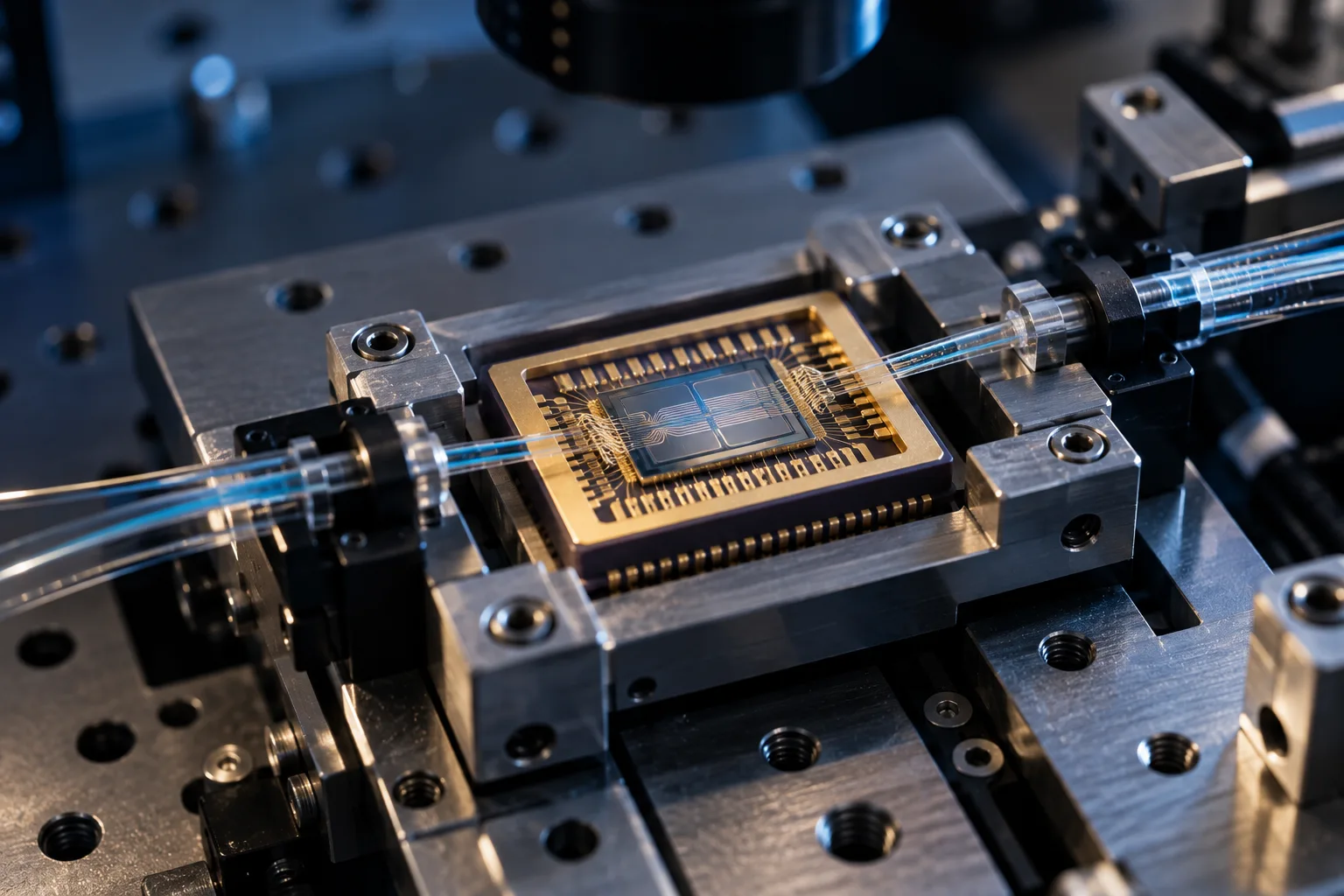
A quantum gravimeter measures how strongly the ground pulls on objects, using atoms as the measuring tool. A cloud of atoms is cooled with lasers and then allowed to fall. Laser pulses split each atom's matter wave into two paths and then recombine them, a bit like a ruler and a clock. The difference between the paths depends on acceleration, including the pull of gravity.
Gravity depends on how mass is spread out underground. A cavity, a body of water or a dense layer of rock changes the pull at the surface by a very small amount. A sensitive instrument can record that change, and scientists use it to infer what might be below. The result is not a photograph of buried objects, and a signal alone rarely says what caused it. Field tests show that these instruments can work outdoors, but they are still slow to use and not yet proven against conventional methods for every task.
Technical explanation
Atom-interferometric gravimeters use laser-cooled atoms, which are launched and then freely fall. Velocity-selective stimulated Raman transitions split and recombine the atomic matter waves, and the phase difference between the paths encodes the local acceleration. Peters, Chung and Chu (2001) describe this approach for high-precision gravity measurement, with laser-cooled caesium atoms in an atomic fountain. A gravity gradiometer uses two or more such measurements at different positions, so that the difference in gravity between them can be read out.
Stray and colleagues (2022) report a gravity-gradient sensor designed to suppress micro-seismic and laser noise, thermal and magnetic variations, and instrument tilt. In an outdoor field survey, the instrument covered an 8.5 metre line at 0.5 metre spatial resolution and reached a statistical uncertainty of 20 E. It detected a 2 metre tunnel with a signal-to-noise ratio of 8. The authors note that conventional gravimeters are limited in measurement time by the need to average out micro-seismic vibration, so reducing that noise can shorten a survey.
Airborne work has tested the approach beyond the laboratory. Bidel and colleagues (2023) compared an atom-interferometry absolute gravimeter with a LaCoste and Romberg platform gravimeter and a strapdown inertial unit in an airborne survey. The quantum instrument had measurement errors of about 0.6 to 1.3 mGal, against 3 to 4 mGal for the platform gravimeter. Güntner and colleagues (2024) describe the technical setup for mobile field measurements with an absolute quantum gravimeter, but the performance figures from that paper have not yet been checked against the full text.
What the evidence says
Each statement is typed by the strength of its evidence and linked to the source that supports it.
Demonstrated Shown in a published experiment, test or shipping product.
In an outdoor field survey, a quantum gravity-gradient sensor detected a 2 metre tunnel with a signal-to-noise ratio of 8.
Sources: [1] · AbstractIn an outdoor field survey, the Stray sensor mapped an 8.5 metre line at 0.5 metre spatial resolution and reached a statistical uncertainty of 20 E.
Sources: [1] · AbstractThe Stray team designed the sensor to suppress micro-seismic and laser noise, thermal and magnetic variations, and instrument tilt, and states that conventional gravimeter measurement time is limited by the need to average out micro-seismic vibration.
Sources: [1] · Abstract; main text · medium confidenceIn an airborne survey, the atom-interferometry absolute gravimeter had measurement errors of about 0.6 to 1.3 mGal, compared with 3 to 4 mGal for a LaCoste and Romberg platform gravimeter.
Sources: [3] · Abstract · medium confidenceQuantum-sensor airborne results agreed with marine, land and altimetry-derived gravity data, with standard deviations and means of the differences at or below 2 mGal.
Sources: [3] · Abstract · medium confidenceAn atom-interferometry gravimeter measures local gravitational acceleration using laser-cooled caesium atoms in an atomic fountain and velocity-selective stimulated Raman transitions.
Sources: [4] · AbstractProposed A design or plan that has not yet been built or tested.
The Stray authors propose uses in mapping aquifers, archaeology, soil property assessment and energy, transport and utilities infrastructure.
Sources: [1] · AbstractBidel and colleagues suggest that absolute airborne gravimetry with a quantum sensor is particularly interesting for shallow water, mountainous areas and linking ground and satellite measurements.
Sources: [3] · Abstract · medium confidenceLimitations and open problems
- Gravity measurements show mass differences, not images. Different underground structures can produce similar signals, so results depend on survey design, assumptions and complementary data.
- Survey time is limited by the need to average out ground vibration (Stray and colleagues, 2022), which can make large surveys slow and costly.
- The airborne results (Bidel and colleagues, 2023) were checked against reference gravity data, but they are a research demonstration. The sources reviewed do not show them as a GPS-free navigation product.
- The Stray design needed active suppression of laser, micro-seismic, thermal, magnetic and tilt effects (Stray and colleagues, 2022), which points to the engineering effort needed to take cold-atom instruments outside a laboratory.
- The sources reviewed do not include blinded trials that compare quantum and conventional gravimeters on known underground targets. Detection rate, false-positive rate and total survey cost against conventional methods are therefore not yet established.
Possible future uses
Ideas, not predictions. None of these has been demonstrated.
- Pre-construction surveys for voids, utilities and tunnels beneath roads and railways. The Stray team proposed infrastructure risk reduction, but the sources do not show this at production scale.
- Repeated absolute gravity surveys to track groundwater storage, if precision and survey speed reach hydrological requirements.
- Soil property mapping, such as telling dry soil from saturated soil, which the Stray team suggested for agriculture and civil engineering.
Product concepts: GPS-free underground position reference
Timeline
- Feb 2001Peters, Chung and Chu publish high-precision gravity measurements using atom interferometry in Metrologia. Sources: [4]
- Feb 2022Stray and colleagues publish a quantum gravity-gradient sensor that detects a 2 metre tunnel in an outdoor field survey in Nature. Sources: [1]
- 11 Apr 2023Bidel and colleagues publish an airborne survey comparing an atom-interferometry absolute gravimeter with classical instruments in the Journal of Geophysical Research: Solid Earth. Sources: [3]
- Sept 2024Güntner and colleagues publish a technical account of mobile field measurements with an absolute quantum gravimeter in IEEE Instrumentation & Measurement Magazine. Sources: [2]
Futures this could help bring about
Glossary
- Gravimeter
- An instrument that measures local gravitational acceleration.
- Gravity gradiometer
- An instrument that measures spatial differences in gravity.
- Atom interferometry
- A technique that splits and recombines matter waves to measure phase changes caused by acceleration or other effects.
- Absolute measurement
- A measurement referenced to a physical standard rather than only a relative change from an earlier reading.
Sources
- peer reviewed paper
Quantum sensing for gravity cartography
Ben Stray, Andrew Lamb, Aisha Kaushik et al.. Nature, Feb 2022. DOI: 10.1038/s41586-021-04315-3. Accessed 21 Oct 2026. - other
Mobile Field Measurements with a Quantum Gravimeter: Technical Setup and Performance
Andreas Güntner, Marvin Reich, Julian Glässel et al.. IEEE Instrumentation & Measurement Magazine, Sept 2024. DOI: 10.1109/MIM.2024.10654726. Accessed 21 Oct 2026. - peer reviewed paper
Airborne Absolute Gravimetry With a Quantum Sensor, Comparison With Classical Technologies
Y. Bidel, N. Zahzam, A. Bresson et al.. Journal of Geophysical Research: Solid Earth, 11 Apr 2023. DOI: 10.1029/2022JB025921. Accessed 21 Oct 2026. - peer reviewed paper
High-precision gravity measurements using atom interferometry
A. Peters, K. Y. Chung, S. Chu. Metrologia, Feb 2001. DOI: 10.1088/0026-1394/38/1/4. Accessed 21 Oct 2026.
Revision history
3 changes since this profile was created.