How far are passive daytime radiative cooling coatings and films from routine use on roofs and buildings?
Surfaces that reflect sunlight and send heat out to space have been shown to fall below air temperature in direct sun since 2014. Measured tests so far have been short and have mostly run at one site or on small samples. Companies sell cooling panels, roofing and films, and SkyCool says more than 30 sites use its technology. Routine use on building roofs is not yet shown. The main open questions are how the surfaces hold up over years of dirt, ultraviolet light and humidity, and whether savings measured on real buildings match what is expected.
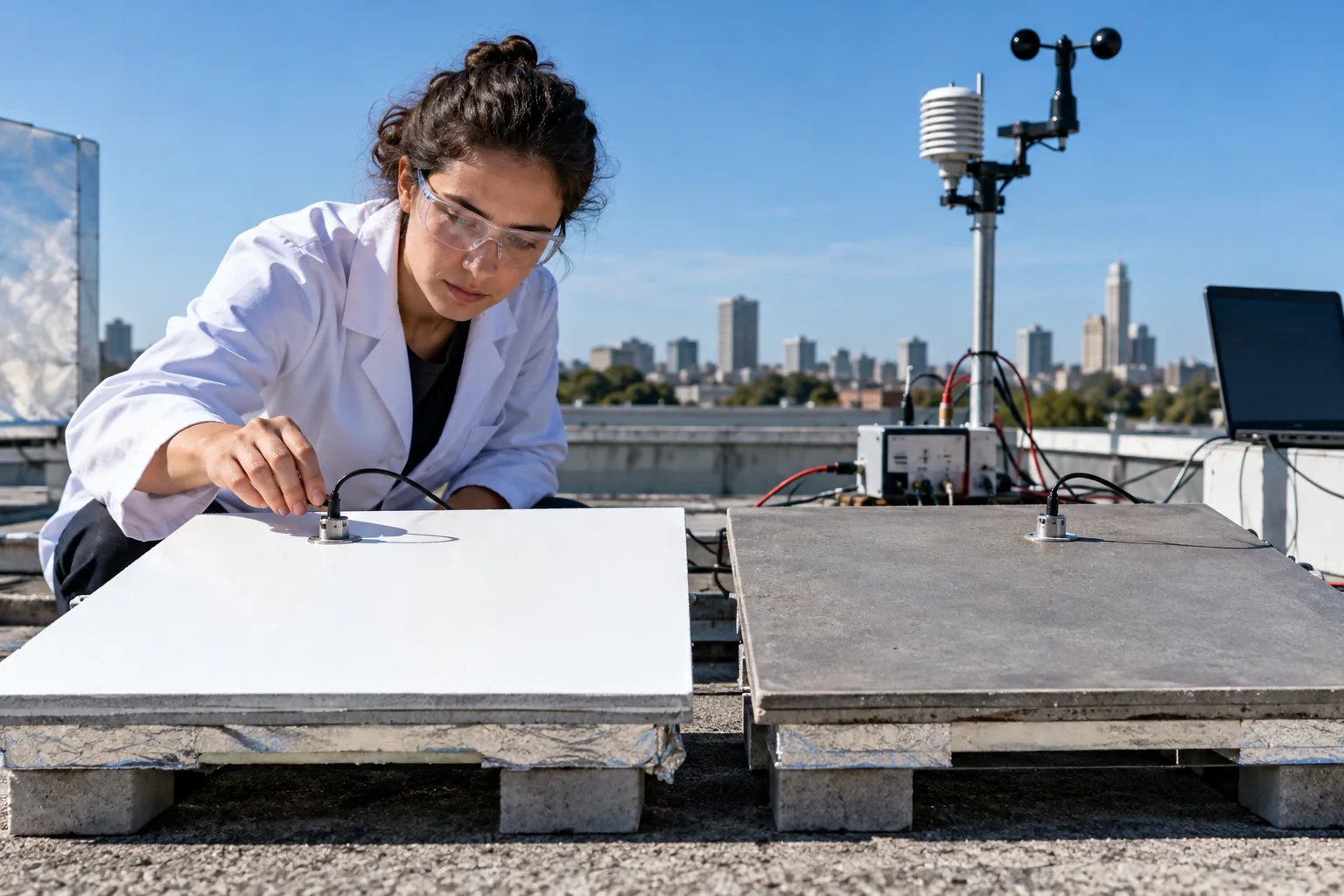
Close. Early pilots are running in the real world.
Cooling below air temperature in direct sunlight has been shown in the lab and in short outdoor tests. Commercial products are sold. SkyCool states that more than 30 sites use its technology, but that figure is not independently verified. Routine use on building roofs has not been shown, and the sources reviewed contain no measured energy savings for whole buildings. Durability data cover about six months at one site, so the stage is pilot rather than scaling.
The tech tree
Everything recorded on Vrulum that this future needs, oldest foundations at the top and the goal at the bottom. Lines show what each step requires.
- 2014Cooling below air temperature in direct sunlightDone Unlocked.
- 2022Durability against dirt, ultraviolet light and weatheringIn progress Being researched.
- 2024Performance in humid airIn progress Being researched.
- Date not recordedCommercial products sold and installedIn progress Being researched.
- Date not recordedMeasured energy savings on full buildingsIn progress Being researched.
- Date not recordedRoutine use on roofs and buildings across climatesNot started Locked.
- GoalBuildings cooled without using powerGoalRequires: Passive daytime radiative cooling, Cooling below air temperature in direct sunlight, Commercial products sold and installed, Measured energy savings on full buildings, Durability against dirt, ultraviolet light and weathering, Performance in humid air, Routine use on roofs and buildings across climates. Locked.
The road so far
1 of 6 steps done, 4 in progress.
- Done · Nov 2014Cooling below air temperature in direct sunlight
Raman and colleagues reported a seven-layer photonic surface that cooled to about 4.9 °C below ambient air in direct sunlight above 850 W/m², in a rooftop test. [1]
- In progressCommercial products sold and installed
SkyCool Systems sells a refrigeration panel and a roof product, and says 30+ sites use its technology. The company gives no numeric energy savings or cooling capacity. A Target manager's testimonial on the page describes one CO2 refrigeration site in Texas that did not go supercritical in one summer. The distributor Fellers lists a 3M cooling film for vehicles, rail and equipment, with over 85% solar reflectivity and 91% emissivity. The listing gives no test conditions. [4][5]
- In progressMeasured energy savings on full buildings
The sources reviewed contain no measured energy savings from full building installations. The SkyCool page gives no savings figures. [4]
- In progress · 16 Aug 2022Durability against dirt, ultraviolet light and weathering
Song and colleagues reported that a coating lost 0.4% solar reflectance after simulated soiling equal to three years, and 0.5% after 1,000 hours of ultraviolet exposure at 60 °C. Over six months of outdoor exposure in Chengdu (April to November 2021), it lost 0.4% in washed areas and 1.7% in unwashed areas. White paint lost 7.6% and 12.9% over the same outdoor period. The outdoor data come from one site. [2]
- In progress · 25 May 2024Performance in humid air
Hong and colleagues reported that a conventional porous polymer coating lost its radiative cooling at 45% relative humidity. Adding 5% fumed silica by mass kept cooling working up to about 60% relative humidity. The tests were on three clear-sky days in Suwon, South Korea. [3]
- Not startedRoutine use on roofs and buildings across climates
The sources reviewed do not show routine use on building roofs across humid, cloudy or dusty climates, or a multi-year record of cooling on a large building stock. [3][2]
Why it matters
Cooling is energy-intensive, so a surface that cools a building without power would reduce the electricity that air conditioning uses. It could also help cool roofs and pavements in cities. Any gain depends on the surface staying reflective for years, so durability matters as much as the first measurement.
What stands in the way
- Humidity can cut cooling. In the study reviewed, a conventional porous polymer coating lost its cooling at 45% relative humidity.
- Dirt and ultraviolet light reduce reflectance over time, and cooling depends on reflectance. The outdoor data reviewed cover about six months, so longer losses are not yet known.
- Most measured results come from days or months at one site, not the multi-year record that building owners need.
- Measured energy savings for full buildings are not in the sources reviewed.
- Cleaning matters. In the 2022 outdoor test, washed areas lost 0.4% reflectance and unwashed areas lost 1.7%. The 3M film listing advises washing the roof at least four times a year.
Signals to watch
- Published multi-year outdoor data for a roof coating or film in a humid climate.
- Measured energy savings on whole buildings, reported with the weather and baseline used.
- Independent test results for commercial products, with the test conditions stated.
- Building codes or utility programmes that credit radiative cooling in cooling-load calculations.
- Shared test methods for reflectance, emittance and cooling power across labs and vendors.
Sources
- peer reviewed paper
Passive radiative cooling below ambient air temperature under direct sunlight
Aaswath P. Raman, Marc Abou Anoma, Linxiao Zhu et al.. Nature, Nov 2014. - peer reviewed paper
Durable radiative cooling against environmental aging
Jinlong Song, Wenjie Zhang, Zhenyu Sun et al.. Nature Communications, 16 Aug 2022. - peer reviewed paper
Humidity-tolerant porous polymer coating for passive daytime radiative cooling
Dongpyo Hong, Yong Joon Lee, Ok Sung Jeon et al.. Nature Communications, 25 May 2024. - company announcement
SkyCool Systems: products and installations
SkyCool Systems, 2026. - company announcement
3M Cooling Film 6.6 Mil Heat Rejecting Film
Fellers (distributor of 3M products), 2026.
Last reviewed 21 Oct 2026.