How far are we from brain implants that let people who cannot speak communicate by voice?
Since 2023, small clinical studies have used implanted electrodes to decode attempted speech in people who cannot speak intelligibly because of ALS or paralysis. The reported rates reach 62 to 78 words per minute, and in 2025 one participant spoke through a synthesised voice with a reported delay of about 25 milliseconds. Each study involved one participant, and the accuracy and speed figures come from different tasks, vocabularies and amounts of training. The sources reviewed do not report approval for routine use. The main gaps are replication in more people, open-ended conversation, and long-term safety and usability.
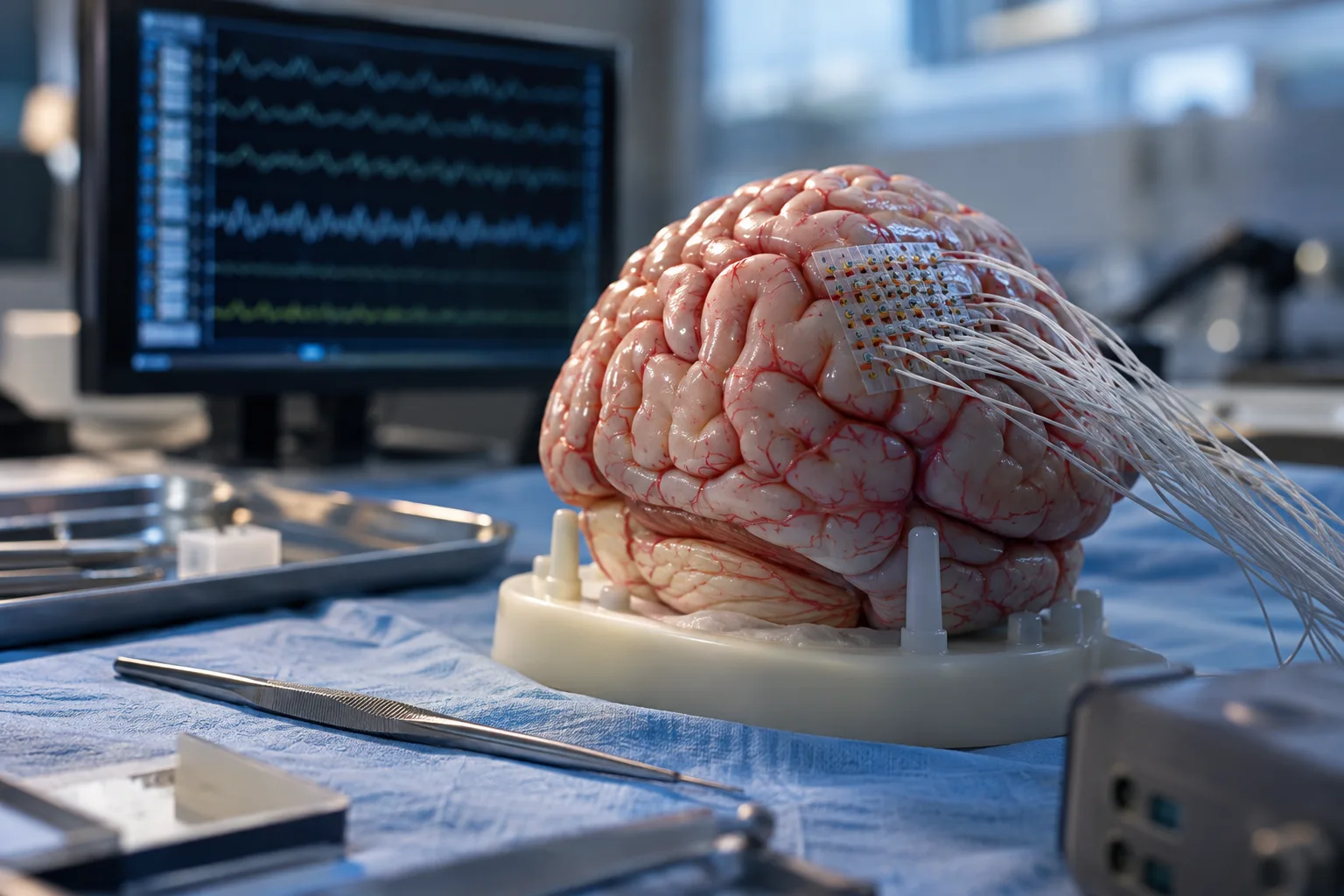
Getting closer. Prototypes exist, but not in real-world use.
Working speech decoders have been shown in people with paralysis or ALS in several published studies from 2023 to 2025. These are research systems built around experimental implants, with one participant in each of the cited studies. Each system needs calibration and attempted-speech training data before use. The sources reviewed do not report that any of these devices is approved or sold. The stage is engineering prototype: the function is shown in people, but not yet as a routine, supported product. The reported word rates come from different tasks and vocabularies, so they are not directly comparable.
The tech tree
Everything recorded on Vrulum that this future needs, oldest foundations at the top and the goal at the bottom. Lines show what each step requires.
- 2023Decoding attempted speech into text in one personDone Unlocked.
- 2023Decoding speech from the brain surface at conversational speedDone Unlocked.
- 2024Accurate speech decoding that holds over monthsDone Unlocked.
- 2025Real-time synthesised voice with intonationDone Unlocked.
- Date not recordedReplication in more people, including other causes of speech lossNot started Locked.
- Date not recordedApproved for routine clinical useNot started Locked.
- GoalGiving people back their voice with brain implantsGoalRequires: Brain-computer interfaces, Decoding attempted speech into text in one person, Decoding speech from the brain surface at conversational speed, Accurate speech decoding that holds over months, Real-time synthesised voice with intonation, Replication in more people, including other causes of speech loss, Approved for routine clinical use. Locked.
The road so far
4 of 6 steps done.
- Done · Aug 2023Decoding attempted speech into text in one person
Willett and colleagues reported a speech-to-text interface using intracortical microelectrode arrays in one participant who can no longer speak intelligibly because of ALS. Attempted speech was decoded at 62 words per minute. The word error rate was 9.1% on a 50-word vocabulary and 23.8% on a 125,000-word vocabulary. [1]
- Done · Aug 2023Decoding speech from the brain surface at conversational speed
Metzger and colleagues used high-density surface recordings of the speech cortex in one clinical-trial participant with severe limb and vocal paralysis. Large-vocabulary text decoding reached a median of 78 words per minute, with a median word error rate of 25%. The team also drove a facial avatar and synthesised speech. The authors report that the decoders reached high performance with less than two weeks of training. [2]
- Done · 15 Aug 2024Accurate speech decoding that holds over months
Card and colleagues reported a 45-year-old man with ALS and severe dysarthria, implanted with four microelectrode arrays (256 intracortical electrodes) in the BrainGate2 trial. On the first day of use, with about 30 minutes of calibration data, accuracy was 99.6% on a 50-word vocabulary. On the second day, after about 1.4 more hours of training, accuracy was 90.2% on a 125,000-word vocabulary. The authors report 97.5% accuracy sustained over 8.4 months after implantation, and self-paced conversation at about 32 words per minute over more than 248 cumulative hours. [3]
- Done · Jun 2025Real-time synthesised voice with intonation
Wairagkar and colleagues reported a brain-to-voice neuroprosthesis in one man with ALS and severe dysarthria, decoded from 256 microelectrodes, with closed-loop audio feedback. The participant could change intonation and sing short, simple melodies. The UC Davis press release reports that neural signals were turned into audible speech in about one-fortieth of a second (25 milliseconds), and that listeners could understand almost 60% of the synthesised words, compared with 4% when he was not using the system. The abstract does not give these two figures, so they rest on the press release. [4][5]
- Not startedReplication in more people, including other causes of speech loss
The 2025 study involved one participant with ALS, and the press release identifies this as a key limitation. The sources reviewed do not report a study in more people, or in people whose speech loss has another cause such as stroke. [4][5]
- Not startedApproved for routine clinical use
The studies reviewed were clinical research trials, including BrainGate2 (Card and colleagues) and a clinical trial (Metzger and colleagues). The sources reviewed do not report regulatory approval, routine clinical use or sale of a speech implant. [3][2]
Why it matters
For someone who has lost the ability to speak, text or synthesised voice can be the main way to take part in family life, work and care decisions. Text misses prosody and the experience of hearing one's own voice as one speaks, and the 2025 study frames a synthesised voice as a way to restore these. A direct neural route could, in principle, offer a faster or more natural alternative. The studies also show what is hard about this: each has tested one participant, and the wider benefit to people's lives has not been measured in the studies reviewed.
What stands in the way
- Each published study has tested one participant, so results may not hold for people with other causes of speech loss or different levels of paralysis.
- Most accuracy figures come from prompted or cued tasks. The sources reviewed give no accuracy figure for open-ended conversation with a large, changing vocabulary that is comparable with the prompted figures.
- Current systems use implanted electrodes, surgery and external equipment. The sources reviewed do not establish long-term infection risk, device lifetime or maintenance across many people.
- Set-up and calibration need attempted-speech training data, and the sources reviewed do not show routine use at home without researcher help.
- The studies reviewed are clinical research trials, so an approval pathway, a manufacturing route and payment for surgery and care would all need to be settled before routine use.
Signals to watch
- Speech decoding replicated in a larger group of participants, including people with speech loss after stroke.
- Accuracy and speed reported on open-ended conversation, not only on fixed phrases or cued tasks.
- Trial results that report adverse events and device lifetime over several years.
- Use of speech implants outside research settings, with the participant carrying out set-up and daily use with little researcher help.
- A regulatory submission or approval for a speech neuroprosthesis.
Sources
- peer reviewed paper
A high-performance speech neuroprosthesis
Francis R. Willett, Erin M. Kunz, Chaofei Fan et al.. Nature, Aug 2023. - peer reviewed paper
A high-performance neuroprosthesis for speech decoding and avatar control
Sean L. Metzger, Kaylo T. Littlejohn, Alexander B. Silva et al.. Nature, Aug 2023. - peer reviewed paper
An Accurate and Rapidly Calibrating Speech Neuroprosthesis
Nicholas S. Card, Maitreyee Wairagkar, Carrina Iacobacci et al.. New England Journal of Medicine, 15 Aug 2024. - peer reviewed paper
An instantaneous voice-synthesis neuroprosthesis
Maitreyee Wairagkar, Nicholas S. Card, Tyler Singer-Clark et al.. Nature, Jun 2025. - university press release
First-of-Its-Kind Technology Helps Man with ALS 'Speak' in Real Time
Newswise, Jun 2025.
Last reviewed 21 Oct 2026.