How far are robots from carrying out surgery on their own?
Surgical robots in hospitals today are steered by a surgeon at a console. Research robots have now carried out single surgical steps by themselves. In 2022, a robot called STAR joined pig small intestine in four pigs of a five-pig study, after a surgeon had exposed the tissue and approved the plan. In 2025, a research team reported a robot that completed one phase of gallbladder removal on eight pig gallbladders taken out of the animal. No study of an autonomous surgical robot in people is described in the sources reviewed, and no regulator has set out a route for approving one.
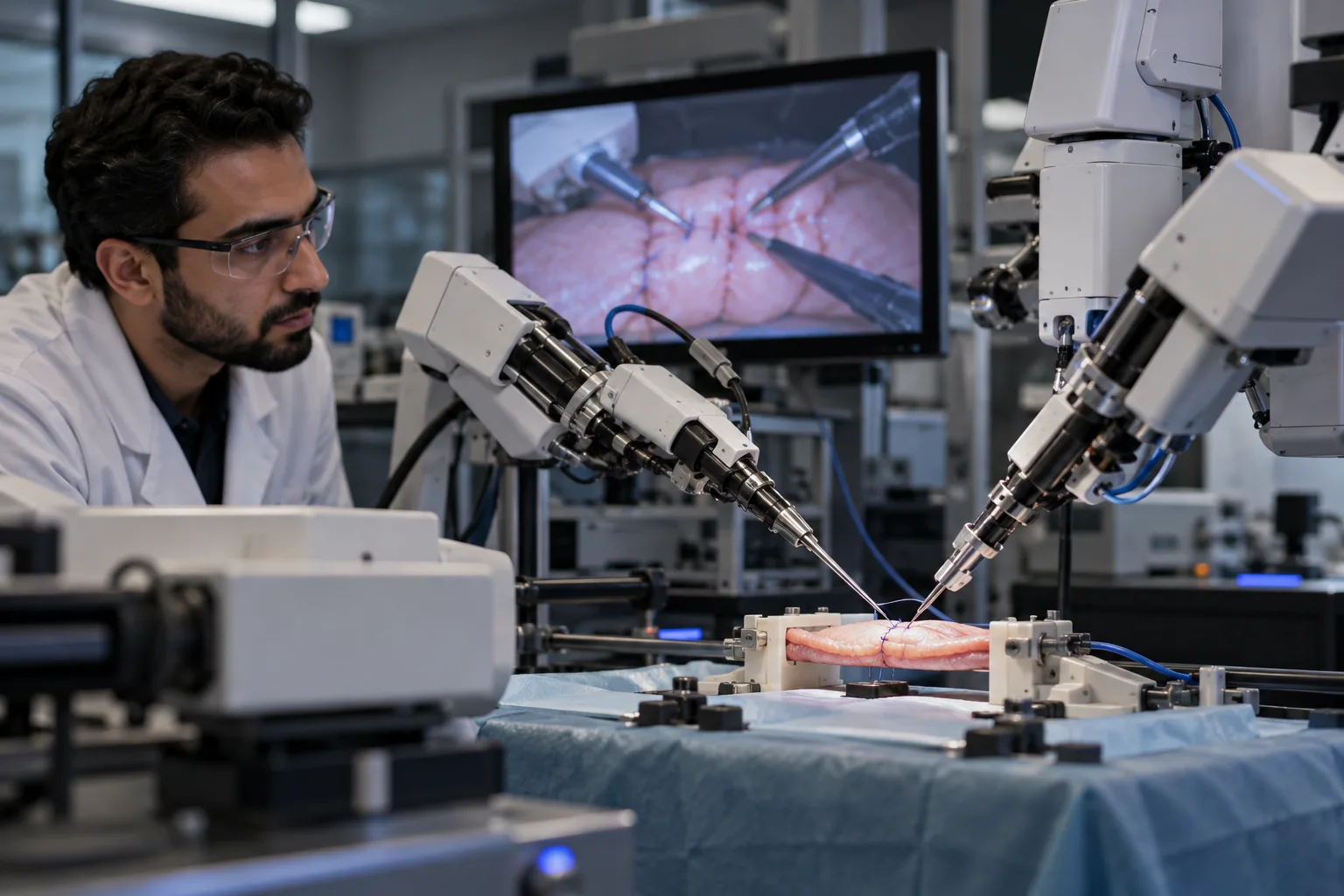
Getting closer. Prototypes exist, but not in real-world use.
Research robots have been tested in live pigs on one procedure, a join of small intestine in four pigs, and on one phase of gallbladder removal in pig tissue taken out of the animal. Neither has been tested in people, and no regulator has a pathway for approving a robot that carries out surgery without a surgeon controlling it. The stage is engineering prototype: working systems have been tested in realistic settings, but none has reached clinical use.
The tech tree
Everything recorded on Vrulum that this future needs, oldest foundations at the top and the goal at the bottom. Lines show what each step requires.
- 2022Autonomous stitching in phantom tissueDone Unlocked.
- 2022Autonomous join of small intestine in live pigsDone Unlocked.
- 2025Autonomous phase of gallbladder removal in pig tissueDone Unlocked.
- Date not recordedAutonomous complete operation in living animalsNot started Locked.
- Date not recordedRegulatory pathway for autonomous surgical robotsNot started Locked.
- Date not recordedFirst study of autonomous surgery in peopleNot started Locked.
- Date not recordedRoutine clinical use of autonomous surgical stepsNot started Locked.
- GoalRobot surgeons that operate on their ownGoalRequires: Autonomous surgical robots, Autonomous stitching in phantom tissue, Autonomous join of small intestine in live pigs, Autonomous phase of gallbladder removal in pig tissue, Autonomous complete operation in living animals, Regulatory pathway for autonomous surgical robots, First study of autonomous surgery in people, Routine clinical use of autonomous surgical steps. Locked.
The road so far
3 of 7 steps done.
- Done · Jan 2022Autonomous stitching in phantom tissue
Saeidi and colleagues report that their autonomous system was more consistent and accurate than expert surgeons' manual technique and robot-assisted surgery in phantom tissue. The abstract gives no figures for these comparisons. [1]
- Done · Jan 2022Autonomous join of small intestine in live pigs
The STAR robot joined pig small intestine using keyhole surgery in five pigs. A surgeon exposed the tissue and approved the robot's plan. STAR operated on four pigs, and a surgeon used manual laparoscopy on the fifth. The robot asked the surgeon whether to make a new plan when the tissue moved beyond a set threshold. [1][2]
- Done · 9 Jul 2025Autonomous phase of gallbladder removal in pig tissue
The SRT-H system performed one phase of gallbladder removal without human intervention on eight unseen pig gallbladders taken out of the animal. The paper describes step-level autonomy in ex vivo experiments on cholecystectomy, and its abstract reports a 100% success rate across these eight gallbladders. A news report says the robot took longer than a human surgeon, though its results were comparable to an expert surgeon's. The work covers one phase of the operation. [3][4][5]
- Not startedAutonomous complete operation in living animals
The sources reviewed do not describe a robot carrying out a full operation on its own in living animals. The SRT-H authors say they want to extend the work from one phase to a complete autonomous operation. [5]
- Not startedRegulatory pathway for autonomous surgical robots
FDA issued draft guidance on robotically assisted surgical devices on 25 September 2026. Law-firm analysis reads its scope as covering systems that a qualified practitioner controls, and does not read it as covering fully autonomous robots. A 2024 review of FDA-cleared surgical robots found 86% at autonomy level 1 and none at levels 4 or 5. [6][7][8]
- Not startedFirst study of autonomous surgery in people
No study of an autonomous surgical robot in people is described in the sources reviewed. The published autonomous work uses phantoms, live pigs and pig tissue. [1][3]
- Not startedRoutine clinical use of autonomous surgical steps
No autonomous surgical robot is described as approved or in routine clinical use in the sources reviewed. Yang and colleagues (2017) argue that regulatory, ethical and legal questions arise as surgical robots gain more autonomy. [9][8]
Why it matters
Robots that carry out routine steps consistently could help with repeatable operations. Each step towards autonomy also raises questions about who is responsible when a robot decides how to act inside a patient. Those questions need answers before any robot is trusted with a whole operation.
What stands in the way
- No study of an autonomous surgical robot in people is described in the sources reviewed. The autonomous work so far uses phantoms, live pigs and pig tissue taken out of the animal.
- No regulatory route is set for a robot that carries out surgical steps without a surgeon controlling it. Law-firm analysis reads the FDA's 2026 draft guidance as not covering fully autonomous robots.
- Liability is unresolved. When a robot makes a decision during an operation, it is not settled who is responsible for that decision, and Yang and colleagues (2017) argue these legal questions need attention as autonomy grows.
- Robustness to tissue movement and unexpected anatomy. In the STAR work the robot asked the surgeon whether to make a new plan when tissue moved beyond a set threshold, and the SRT-H work covers a narrow task.
- Speed and scope. In the gallbladder work the robot was slower than a human surgeon, and its authors plan to extend the work to a complete autonomous operation.
Signals to watch
- A peer-reviewed study in which a robot completes a whole operation on its own in living animals.
- Independent research groups reproducing autonomous surgical steps, in living animals or on other procedures.
- A study of autonomous surgical steps in people, with defined human supervision and stopping rules.
- Final FDA guidance, or a separate pathway, that names fully autonomous surgical robots.
- Published comparisons of autonomous and surgeon-led steps on time, complications and tissue outcomes.
Sources
- peer reviewed paper
Autonomous robotic laparoscopic surgery for intestinal anastomosis
H. Saeidi, J. D. Opfermann, M. Kam et al.. Science Robotics, Jan 2022. - government report
Robot performs soft tissue surgery with minimal human help
National Institute of Biomedical Imaging and Bioengineering (NIH), 20 Apr 2022. - peer reviewed paper
SRT-H: A hierarchical framework for autonomous surgery via language-conditioned imitation learning
Ji Woong (Brian) Kim, Juo-Tung Chen, Pascal Hansen et al.. Science Robotics, 9 Jul 2025. - preprint
SRT-H: A Hierarchical Framework for Autonomous Surgery via Language Conditioned Imitation Learning
Ji Woong Kim, Juo-Tung Chen, Pascal Hansen et al.. arXiv, 15 May 2025. - news
Autonomous gallbladder removal: Robot performs first realistic surgery without human help
Tech Xplore, 9 Jul 2025. - government report
Robotically-Assisted Surgical Devices-Premarket Submissions; Draft Guidance for Industry and Food and Drug Administration Staff; Availability
Federal Register (US Food and Drug Administration), 25 Sept 2026. - other
FDA Proposes Premarket Framework for Robotically Assisted Surgical Devices
Brendan Carroll, Perham Gorji, Jong Ho Philip Won. Alston & Bird LLP, 13 Oct 2026. - peer reviewed paper
Levels of autonomy in FDA-cleared surgical robots: a systematic review
Audrey Lee, Turner S. Baker, Joshua B. Bederson et al.. npj Digital Medicine, 26 Apr 2024. - review article
Medical robotics: Regulatory, ethical, and legal considerations for increasing levels of autonomy
Guang-Zhong Yang, James Cambias, Kevin Cleary et al.. Science Robotics, 15 Mar 2017.
Last reviewed 21 Oct 2026.