Fusion energy
Also known as Nuclear fusion, Fusion power
Fusion energy joins light atoms to release energy, the process that powers the Sun. Laser experiments at the US National Ignition Facility have produced more fusion energy than the laser energy delivered to the target, and magnetic machines have set energy records. No fusion plant yet supplies net electricity to a grid.
In plain language
Fusion is the reaction that powers the Sun. Two light atoms, usually forms of hydrogen, are heated and pushed together until they join into a heavier atom and release energy. On Earth the fuel has to be heated into a hot gas called plasma and kept away from the walls of the machine, which is the hard part.
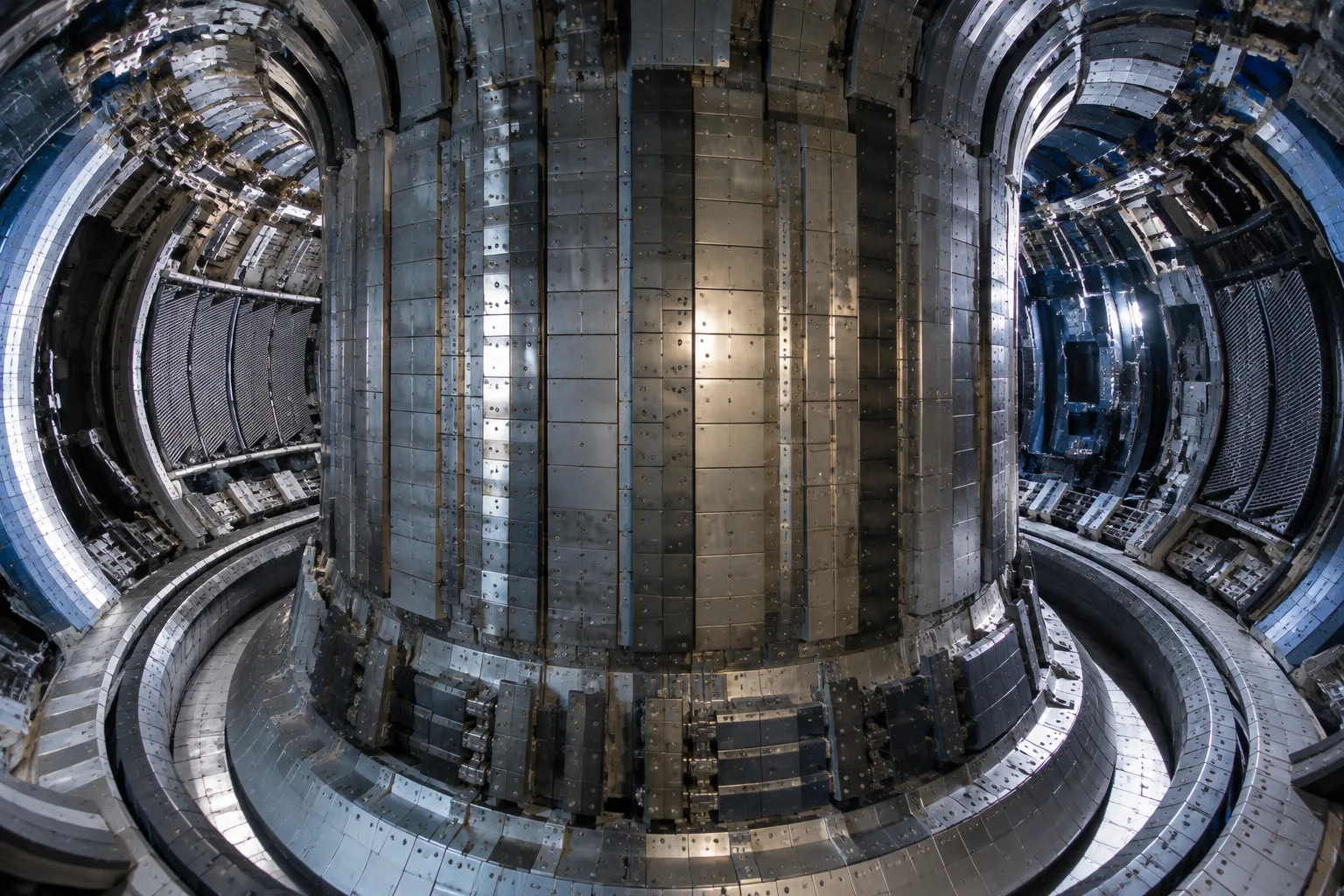
There are two main approaches. Tokamaks use strong magnetic fields to hold plasma in a ring, as the JET facility in the UK did before its final experiments in 2023. Laser facilities, such as the National Ignition Facility in the US, heat and squeeze a small fuel capsule. In 2022 the National Ignition Facility reached ignition, where fusion heating outweighs the cooling of the plasma. In December 2022 it went further and released more fusion energy from the fuel target than the laser energy delivered to it. In April 2025 one shot produced 8.6 megajoules of fusion energy from 2.08 megajoules of laser energy on the target. These are experiments on single shots at a research facility, not electricity, so fusion is not yet a source of power.
Technical explanation
The Lawson criterion is a test of whether fusion heating can overcome the losses from a plasma. In a 2022 experiment on the National Ignition Facility, H. Abu-Shawareb and colleagues reported that the Lawson criterion was exceeded and that ignition was achieved. Ignition here means that fusion heating overcomes the processes that cool the plasma, creating a self-reinforcing rise in temperature. The same paper is reported to give a target gain of 0.72, with 1.37 MJ of fusion output from 1.92 MJ of laser energy, which is below scientific breakeven. These figures could not be confirmed against the abstract during review, so they are marked as unverified.
A later National Ignition Facility shot, on 5 December 2022, is a separate experiment. LLNL's record lists it at 3.15 MJ of fusion yield from 2.05 MJ of laser energy on target, with no target gain stated. A 2024 Physical Review Letters paper, titled 'Achievement of Target Gain Larger than Unity in an Inertial Fusion Experiment', is titled as reporting target gain above one. Target gain is measured against the laser energy on the target, and does not include the electricity used to run the laser or the wider facility. LLNL's record lists eleven ignition results through 20 June 2026. The April 2025 result gave 8.6 MJ ± 0.45 MJ from 2.08 MJ on target, a target gain of 4.13. The June 2026 result gave 7.9 MJ ± 0.4 MJ, with a target gain of about 3.8.
Magnetic confinement follows a different route. In its final deuterium-tritium campaign, JET produced a single pulse of about 5 seconds that released 69 MJ of fusion energy. The shot was made on 3 October 2023, and UKAEA and the Max Planck Institute for Plasma Physics announced the result on 8 February 2024. JET was a research facility, so this figure describes energy from one pulse, not electricity supplied to a grid.
Plant designs are at an earlier stage. A June 2026 overview in the Journal of Plasma Physics describes the ARC version 3A design. Its design calculations project about 1.13 GW of fusion power and at least 400 MW of net electrical output. These are nominal design targets from modelled analysis, not measured outputs. Medium-fidelity models predict fusion power of roughly 600 to 1300 MW, and the overview excludes detailed engineering and economic analysis from its scope.
The next large step is ITER. Its 2024 revised baseline moves the start of research operations with deuterium-only plasmas to 2034 and deuterium-tritium operations to 2039, four years later than the previous plan. The IAEA's World Fusion Outlook 2025 counts more than 160 fusion devices that are operational, under construction or planned. Whether these machines lead to electricity on a grid is still an open question.
What the evidence says
Each statement is typed by the strength of its evidence and linked to the source that supports it.
Demonstrated Shown in a published experiment, test or shipping product.
The National Ignition Facility achieved ignition in a 2022 experiment reported in Physical Review Letters.
Sources: [1] · Title; APS page summary ('a laser-fusion scheme has achieved ignition')JET released 69 MJ of fusion energy in a single pulse of about 5 seconds on 3 October 2023, during its final deuterium-tritium campaign.
Sources: [4], [5] · Announcement; UKAEA page (DTE3 campaign); IPP page (shot date) · medium confidenceThe earlier ITER plan envisaged first plasma as early as 2025, and the 2024 baseline gives 2034 as the start of scientific operation.
Sources: [6] · AnnouncementOn 5 December 2022 the National Ignition Facility produced 3.15 MJ of fusion yield from 2.05 MJ of laser energy on target, a ratio above one. A 2024 Physical Review Letters paper, titled 'Achievement of Target Gain Larger than Unity in an Inertial Fusion Experiment', reports target gain above one.
Sources: [2], [3] · LLNL ignition milestone table; APS page titleOn 7 April 2025 the National Ignition Facility produced 8.6 MJ ± 0.45 MJ of fusion yield from 2.08 MJ of laser energy on target, a target gain of 4.13.
Sources: [3] · LLNL ignition milestone tableLLNL lists eleven ignition results through 20 June 2026. The most recent, on 20 June 2026, produced 7.9 MJ ± 0.4 MJ of fusion yield with a target gain of about 3.8.
Sources: [3] · LLNL ignition milestone tableThe ARC overview states that detailed engineering, including vacuum vessel and blanket design, and economic analysis are outside its scope.
Sources: [8] · Overview, scope statementReported, unverified Stated by a company or team but not independently confirmed.
The same 2022 paper is reported to give a target gain of 0.72, with 1.37 MJ of fusion output from 1.92 MJ of laser energy, which is below scientific breakeven.
Sources: [1] · Abstract (not confirmed: the abstract did not load in review) · low confidenceThe IAEA's World Fusion Outlook 2025 counts more than 160 fusion devices that are operational, under construction or planned.
Sources: [7] · Article text · medium confidenceProposed A design or plan that has not yet been built or tested.
The 2024 ITER baseline plans deuterium-only plasmas first and deuterium-tritium operations from 2039, four years later than the previous plan.
Sources: [6] · Announcement · medium confidenceThe ARC version 3A design analysis projects about 1.13 GW of fusion power and at least 400 MW of net electrical output. These are nominal design targets from modelled analysis, not measured outputs.
Sources: [8] · Overview, design outputs and caveats · medium confidenceMedium-fidelity models predict ARC fusion power of roughly 600 to 1300 MW, so the 1.13 GW design figure carries model uncertainty.
Sources: [8] · Overview, uncertainty discussion · medium confidenceA stability analysis of the modelled ARC version 3A baseline, published in April 2026, suggests that the poloidal shaping coils can control vertical displacement without an in-vessel coil, and that the baseline operates deeply in the stable region of ideal kink mode analysis.
Sources: [9] · Abstract · medium confidenceThe US Department of Energy's finalised Fusion Science and Technology Roadmap, dated 9 June 2026, aims to support fusion pilot plants and commercial fusion power in the mid-2030s. This is a government goal, not a guaranteed date.
Sources: [11] · Press release, timeline statement · medium confidenceSpeculative An idea or possible use. Not evidence of anything.
Whether ITER's planned deuterium-tritium phase leads to electricity from fusion plants is an open question that the sources reviewed do not settle.
Sources: [6] · Announcement · low confidenceLimitations and open problems
- No source reviewed here shows a fusion plant sending net electricity to a grid.
- NIF target gain is measured against the laser energy on the target. It does not include the electricity used to run the laser or the wider facility, so it is not net electricity.
- The JET record is one pulse at a research facility and does not show a machine running continuously.
- NIF results are isolated experimental shots. The sources reviewed do not show a rapid, repeatable sequence of shots suitable for a power plant.
- ITER's schedule has already moved, with research operations now planned for 2034 and deuterium-tritium operations for 2039.
- ARC figures are design calculations from modelled analysis, not measured outputs. The overview excludes detailed engineering and economic analysis.
- The sources reviewed do not show a demonstrated closed tritium fuel cycle, neutron-resistant materials over plant lifetimes, or plant availability.
- The sources reviewed do not give verified cost figures for fusion plants.
- The US Department of Energy's mid-2030s goal is a government aim, not a guaranteed date.
Possible future uses
Ideas, not predictions. None of these has been demonstrated.
- Fusion power plants feeding electricity into national grids later this century, if plasma and plant engineering problems are solved.
- Fusion-based neutron sources for producing medical isotopes or testing materials for future reactors.
- High-temperature heat from fusion for industrial processes that currently rely on fossil fuels.
Timeline
- 2022The National Ignition Facility reports ignition in a 2022 experiment, published in Physical Review Letters. Sources: [1]
- 5 Dec 2022The National Ignition Facility produces 3.15 MJ of fusion yield from 2.05 MJ of laser energy on target, a ratio above one. A 2024 Physical Review Letters paper is titled as reporting target gain larger than unity. Sources: [2], [3]
- 3 Oct 2023JET produces a single pulse of about 5 seconds that releases 69 MJ of fusion energy during its final deuterium-tritium campaign. Sources: [4], [5]
- 8 Feb 2024UKAEA and the Max Planck Institute for Plasma Physics announce the JET energy record. Sources: [4], [5]
- 3 Jul 2024ITER announces a revised baseline with research operations from 2034 and deuterium-tritium operations from 2039. Sources: [6]
- 7 Apr 2025The National Ignition Facility's eighth ignition result produces 8.6 MJ of fusion yield (± 0.45 MJ) from 2.08 MJ of laser energy on target, a target gain of 4.13. Sources: [3]
- Oct 2025The IAEA publishes World Fusion Outlook 2025, counting more than 160 fusion devices. Sources: [7]
- 16 Oct 2025The US Department of Energy announces its Fusion Science and Technology Roadmap. Sources: [10]
- 4 Jun 2026The ARC version 3A physics overview is published online in the Journal of Plasma Physics, giving design calculations of about 1.13 GW fusion power and at least 400 MW net electrical output. Sources: [8]
- 9 Jun 2026The US Department of Energy releases the finalised Fusion Science and Technology Roadmap, aimed at supporting fusion pilot plants and commercial fusion power in the mid-2030s. Sources: [11]
- 20 Jun 2026The National Ignition Facility's eleventh ignition result produces 7.9 MJ of fusion yield (± 0.4 MJ), with a target gain of about 3.8. Sources: [3]
Futures this could help bring about
Glossary
- Plasma
- A hot gas in which electrons have been separated from atoms, so it conducts electricity and responds to magnetic fields.
- Tokamak
- A doughnut-shaped machine that uses strong magnetic fields to hold plasma in place.
- Ignition
- The point at which fusion heating in a plasma outweighs the processes that cool it, so the temperature keeps rising on its own.
- Target gain
- The ratio of fusion energy released to the laser energy delivered to the fuel target; a value of one is scientific breakeven.
- Plasma gain (Q)
- The ratio of fusion power to the external heating power coupled to the plasma. It does not include the wider plant's electricity loads.
- Net electric output
- Electricity exported to the grid after the plant's own electrical demand and conversion losses are subtracted.
- Tritium breeding
- Producing new tritium inside a fusion blanket by capturing fusion neutrons in lithium.
Sources
- peer reviewed paper
Lawson Criterion for Ignition Exceeded in an Inertial Fusion Experiment
H. Abu-Shawareb. Physical Review Letters, 2022. DOI: 10.1103/PhysRevLett.129.075001. Accessed 21 Oct 2026. - peer reviewed paper
Achievement of Target Gain Larger than Unity in an Inertial Fusion Experiment
H. Abu-Shawareb. Physical Review Letters, 2024. DOI: 10.1103/PhysRevLett.132.065102. Accessed 21 Oct 2026. - other
Achieving Fusion Ignition
Lawrence Livermore National Laboratory, 20 Jun 2026. Accessed 21 Oct 2026. - government report
Fusion research facility JET's final tritium experiments yield new energy record
UK Atomic Energy Authority, 8 Feb 2024. Accessed 21 Oct 2026. - other
Nuclear fusion: European joint experiment achieves energy record
Max Planck Institute for Plasma Physics, 8 Feb 2024. Accessed 21 Oct 2026. - other
New ITER schedule
Max Planck Institute for Plasma Physics, 3 Jul 2024. Accessed 21 Oct 2026. - news
Fusion entering implementation phase, says Grossi
World Nuclear News, 15 Oct 2025. Accessed 21 Oct 2026. - peer reviewed paper
Overview of the physics basis for the ARC fusion power plant
J. C. Hillesheim. Journal of Plasma Physics, 4 Jun 2026. DOI: 10.1017/S0022377826101706. Accessed 21 Oct 2026. - peer reviewed paper
ARC physics basis–magnetohydrodynamics
N. Leuthold. Journal of Plasma Physics, 14 Apr 2026. DOI: 10.1017/S0022377826101421. Accessed 21 Oct 2026. - government report
Energy Department Announces Fusion Science and Technology Roadmap to Accelerate Commercial Fusion Power
US Department of Energy, 16 Oct 2025. Accessed 21 Oct 2026. - government report
Energy Department Releases Finalized Fusion Science and Technology Roadmap to Accelerate Commercial Fusion Power
US Department of Energy, 9 Jun 2026. Accessed 21 Oct 2026.
Revision history
3 changes since this profile was created.