Quantum annealing
Also known as Quantum annealer, Quantum annealing processor
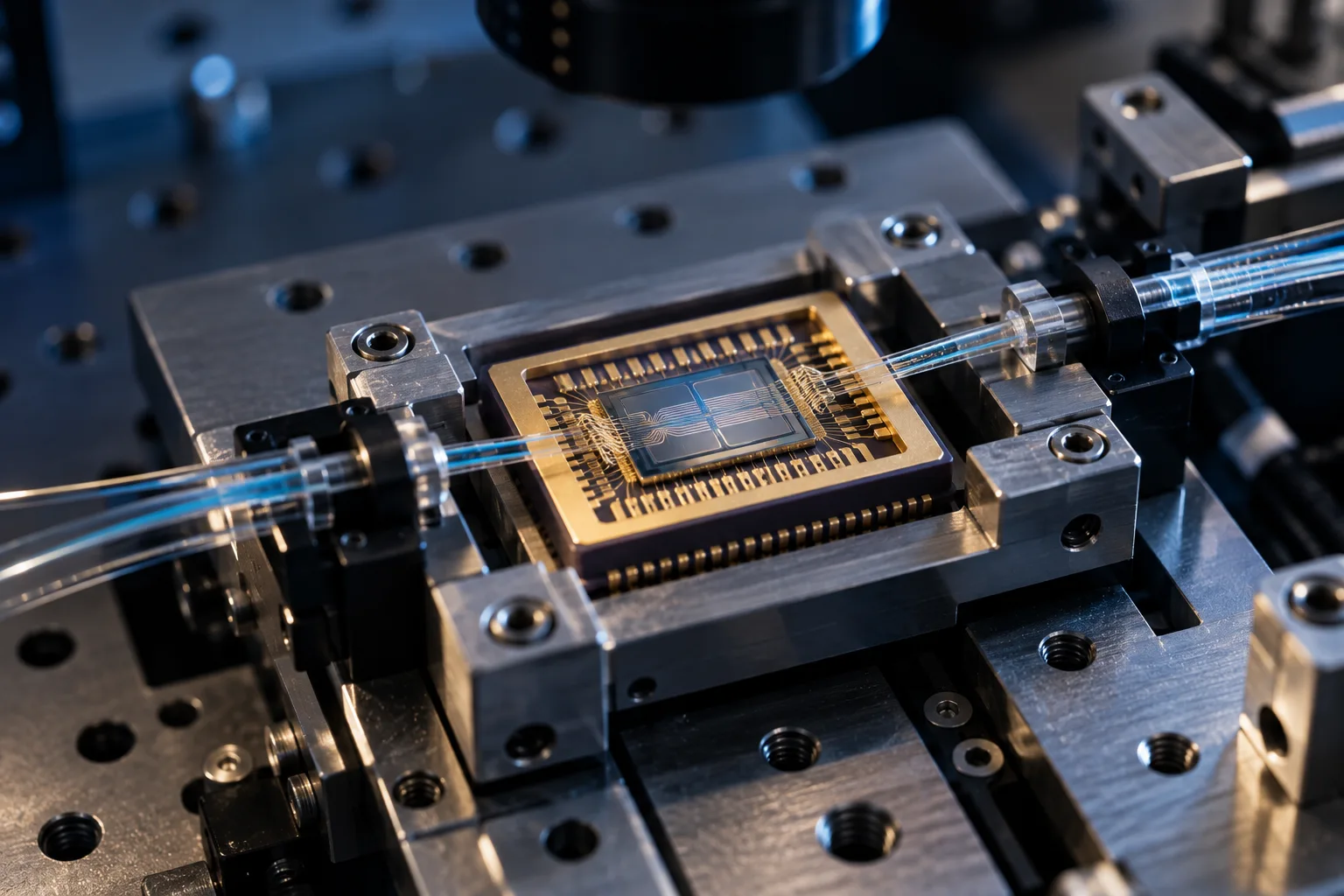
Quantum annealing uses special-purpose quantum hardware, such as D-Wave's annealers, to search for low-energy answers to optimisation and simulation problems. Whether these machines beat the best classical methods is still disputed: early tests found no clear speed-up, and a 2025 claim of beyond-classical simulation has been challenged by classical researchers.
In plain language
Many practical puzzles, such as scheduling jobs in a factory or arranging parts efficiently, have so many possible answers that checking them one by one is impossible. A classical method called simulated annealing searches for good answers by making large changes at first and then gradually settling, a little like metal cooling into a stable shape. Quantum annealing follows the same idea but uses quantum effects to help the search move between answers. Special-purpose quantum annealers, such as those built by D-Wave, are designed to run this process on problems that can be written in a particular form.
The open question is whether this gives a real advantage over the best classical computers. Early tests on random problems did not show a clear speed-up. In 2025, D-Wave reported a simulation of magnetic materials that it said no classical computer could match in a reasonable time. Classical researchers have since shown that other methods can match, and in some cases beat, the annealer on a similar simulation. In one pilot study on a factory scheduling problem, a hybrid solver that mixes quantum and classical steps did best at medium problem sizes, but the gains faded on large problems.
Technical explanation
Quantum annealing encodes a problem as the lowest-energy state of an Ising model, a network of binary spins with pairwise couplings. The processor starts the qubits in a simple quantum state, adds a transverse field that makes them fluctuate, and then slowly lowers that field while the problem term takes over. Kadowaki and Nishimori introduced this approach in 1998 by adding quantum fluctuations to the simulated annealing process for optimisation problems. In practice, devices are noisy and have limited precision when setting couplings, and the sources reviewed here treat these limits as a central part of any performance test.
Quantum annealers are also used to simulate physical systems. In the 2025 Science paper by King and colleagues, D-Wave's superconducting annealing processors were used to generate the dynamics of spin glasses, a model for certain disordered magnetic materials. The classical comparison relies on tensor networks, which represent quantum states as networks of smaller tensors. Entanglement grows during a time evolution, so the bond dimension needed for accuracy also grows, which makes long simulations expensive. Tindall and colleagues describe a lattice-specific tensor-network method with belief propagation that is scalable in two and three dimensions and was used to check Kibble-Zurek physics on systems of hundreds of qubits.
The disagreement is about scope and settings. Classical results depend on parameters such as bond dimension, and reported comparisons differ by lattice geometry: the Flatiron team's method reportedly had lower error than the annealer on cylindrical and diamond lattices and similar error on cubic lattices at a fixed annealing time. D-Wave argues that the classical work covers only a subset of its benchmark, including the largest three-dimensional geometries. For optimisation, the best-documented evidence so far shows annealers that are competitive on small or intermediate instances, with classical heuristics catching up as problems grow.
What the evidence says
Each statement is typed by the strength of its evidence and linked to the source that supports it.
Demonstrated Shown in a published experiment, test or shipping product.
Quantum annealing adds quantum fluctuations to simulated annealing, a classical optimisation method, as introduced by Kadowaki and Nishimori in 1998.
Sources: [6] · AbstractFor random spin glass instances with limited precision, a D-Wave Two device with up to 503 qubits showed no evidence of quantum speedup when the entire data set was considered.
Sources: [5] · AbstractRønnow and colleagues found that comparing subsets of the instances, one subset at a time, gave inconclusive results.
Sources: [5] · Abstract · medium confidenceOn a multi-car paint shop scheduling problem, D-Wave 2000Q and Advantage processors were well suited to smaller problems and the hybrid solver to intermediate sizes, but performance approached that of a simple greedy algorithm at large sizes.
Sources: [7] · Abstract · medium confidenceTindall and colleagues describe a lattice-specific tensor-network method, using belief propagation, that computes quantum annealing dynamics of Ising spin glasses and is scalable in both two and three dimensions.
Sources: [2] · AbstractReported, unverified Stated by a company or team but not independently confirmed.
Physics World reports that, once the bond dimension is large enough, the classical method's error was markedly lower than the annealer's on cylindrical lattices and lower on diamond lattices, and was similar on cubic lattices at a fixed annealing time.
Sources: [3] · Main text · medium confidenceAccording to Quantum Computing Report, D-Wave used over 5,000 qubits on its Advantage2 processor, across four graph topologies: square, cubic, diamond and biclique.
Sources: [4] · Background · medium confidenceDisputed Contested by other credible sources.
King and colleagues (2025) state that several leading approximate tensor-network and neural-network methods cannot reach a quantum annealer's accuracy on spin-glass quench dynamics within a reasonable time frame.
Sources: [1] · Abstract · medium confidenceD-Wave argues that the classical work is an isolated advance that does not reproduce the full benchmark, was restricted to localised sub-sectors, and did not reproduce the largest three-dimensional geometries tested on its hardware.
Sources: [4] · Main text · medium confidenceLimitations and open problems
- On random spin glass instances, a 503-qubit D-Wave Two showed no evidence of quantum speedup when the full dataset was considered, and results on subsets of instances were inconclusive (Rønnow and colleagues, 2014).
- In a paint-shop scheduling study, annealer performance approached that of a simple greedy algorithm as problem size grew, and the hybrid solver was strongest at intermediate sizes (Yarkoni and colleagues, 2021; preprint).
- The 2025 beyond-classical simulation claim is contested. Classical tensor-network results match or beat the annealer on some lattices, while D-Wave says these results do not reproduce the full benchmark.
- Classical results depend on settings. The cylindrical-lattice advantage depends on the bond dimension being large enough, and cubic lattices showed no clear winner at a fixed annealing time (as reported by Physics World).
- Vendor-reported figures for real deployments were not checked against independent sources in this profile, and the sources reviewed here do not give verified speed-up factors on practical problems.
Possible future uses
Ideas, not predictions. None of these has been demonstrated.
- Scheduling and sequencing in factories and logistics, where annealers could be used as one step in a hybrid classical-quantum solver.
- Simulation of disordered magnetic materials to guide the design of new magnets, if classical methods are shown to struggle on the materials of interest.
Timeline
- 1998Kadowaki and Nishimori introduce quantum annealing by adding quantum fluctuations to simulated annealing for optimisation problems. Sources: [6]
- 2014Rønnow and colleagues report no evidence of quantum speedup for a D-Wave Two device with up to 503 qubits when the full random spin glass dataset is considered. Sources: [5]
- Sept 2021Yarkoni and colleagues post a preprint comparing D-Wave 2000Q and Advantage processors with classical and hybrid solvers on a multi-car paint shop problem. Sources: [7]
- 11 Apr 2025King and colleagues, with D-Wave authors, report in Science that a quantum annealer generates spin-glass dynamics that classical approximations cannot match in a reasonable time. Sources: [1]
- May 2026D-Wave publicly disputes the classical result, arguing that it covers only part of the 2025 benchmark. Sources: [4]
- 21 May 2026Tindall and colleagues publish a classical tensor-network method in Science that matches or beats the annealer on some lattice geometries. Sources: [2], [3]
Futures this could help bring about
Glossary
- Quantum annealing
- A method that finds low-energy answers to a problem by starting from a simple quantum state and slowly moving the system toward a state that encodes the problem.
- Simulated annealing
- A classical search method that makes large random changes at first and then gradually makes smaller ones, to reach good answers without getting stuck.
- Spin glass
- A disordered magnetic material in which competing interactions make many arrangements of the spins almost equally stable.
- Tensor network
- A way of representing a quantum state as a network of smaller linked arrays, which can make some quantum systems cheaper to simulate on classical computers.
Sources
- peer reviewed paper
Beyond-classical computation in quantum simulation
Andrew D. King, Alberto Nocera, Marek M. Rams et al.. Science, 11 Apr 2025. DOI: 10.1126/science.ado6285. Accessed 21 Oct 2026. - peer reviewed paper
Dynamics of disordered quantum systems with two- and three-dimensional tensor networks
Joseph Tindall, Antonio Francesco Mello, Matthew Fishman et al.. Science, 21 May 2026. DOI: 10.1126/science.adx2728. Accessed 21 Oct 2026. - news
No quantum advantage (yet) in the world of tensor networks
Nohora Hernández. Physics World, 21 Aug 2026. Accessed 21 Oct 2026. - news
D-Wave Systematically Rebuts Flatiron Claims, Reaffirming Beyond-Classical Simulation Milestones
Quantum Computing Report, 26 May 2026. Accessed 21 Oct 2026. - peer reviewed paper
Defining and detecting quantum speedup
Troels F. Rønnow, Zhihui Wang, Joshua Job et al.. Science, 2014. DOI: 10.1126/science.1252319. Accessed 21 Oct 2026. - peer reviewed paper
Quantum Annealing in the Transverse Ising Model
Tadashi Kadowaki, Hidetoshi Nishimori. Physical Review E, 1998. Accessed 21 Oct 2026. - preprint
Multi-car paint shop optimization with quantum annealing
Sheir Yarkoni, Alex Alekseyenko, Michael Streif et al.. arXiv (accepted to IEEE QCE21), Sept 2021. Accessed 21 Oct 2026.
Revision history
4 changes since this profile was created.