Analogue quantum simulation
Also known as Analog quantum simulation, Analogue quantum simulator, Programmable quantum simulator
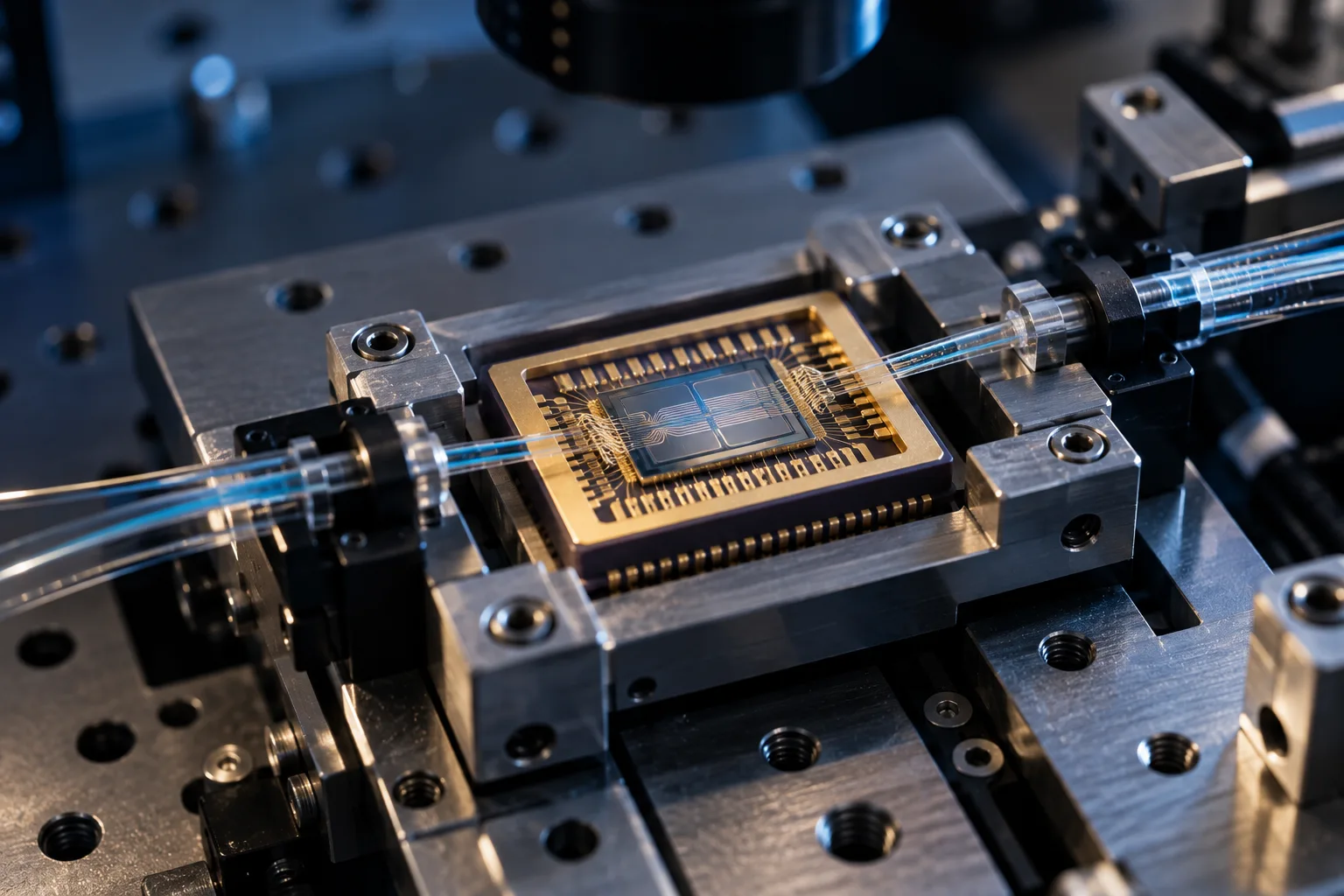
Analogue quantum simulators are programmable devices, built from cold atoms, Rydberg atom arrays or trapped ions, that are tuned to behave like a chosen quantum model so that researchers can study its physics. Published experiments reach up to 256 atoms or ions and reproduce known phases of matter, while claims of practical advantage over classical computers are early and hard to verify.
In plain language
An analogue quantum simulator is a device built to behave like a quantum system that is hard to study directly. Researchers trap many atoms or ions, then use lasers and electric or magnetic fields to control how strongly they interact. The arrangement is chosen so that the device follows a model of interest, such as a magnet or a set of interacting electrons, and the researchers then measure what happens.
This is different from a quantum computer that runs a sequence of logic gates. In an analogue simulator the whole device evolves together under one set of controlled interactions, and the researchers adjust a few settings such as laser strength, timing or the spacing of particles. Early experiments used a chain of up to 16 trapped ytterbium ions to test how competing interactions shape magnetic order. Later experiments used arrays of up to 256 neutral atoms to map out phases of matter. These results show that the platforms can reproduce known physics, and they are now being used to explore states that are hard to predict.
Technical explanation
Analogue platforms encode a model in the native interactions of a physical system. In Rydberg arrays, individual neutral atoms are held in optical tweezers and excited by laser light into Rydberg states, where they interact strongly with close neighbours. Ebadi and colleagues describe this as a tunable quantum spin model with 64 to 256 qubits, validated by preparing antiferromagnetic order and observing Ising-type critical behaviour in (2+1) dimensions. Bernien and colleagues used a 51-atom array to show that a sudden quench across a phase boundary produces lasting oscillations in the ordered state. Trapped-ion simulators use chains of charged atoms whose couplings can be set by laser fields, and Islam and colleagues showed that tuning the interaction range controls the level of frustration in a long-range Ising model with a transverse field.
Several experiments have moved from reproducing known models toward new physics. Semeghini and colleagues placed 219 atoms on the links of a kagome lattice and detected the onset of a toric-code-type spin liquid through topological string operators. The authors describe this as a first step, because the topological qubit still needs to be encoded and manipulated. On the advantage question, Daley and colleagues argue that analogue simulators may already offer a first practical advantage on specialised tasks, while fully digital devices need further fault-tolerant hardware to address a wider range of problems. Jackson and Datta (2025, preprint) propose an accreditation protocol for analogue simulators that does not require universal gate sets, does not require two-qubit gates, and does not assume the same noise map in every run. Checking that a device is correct is the central difficulty: a result that classical methods can reproduce does not show advantage, and a result that classical methods cannot check is hard to confirm.
What the evidence says
Each statement is typed by the strength of its evidence and linked to the source that supports it.
Demonstrated Shown in a published experiment, test or shipping product.
Ebadi and colleagues realised a tunable quantum spin model with 64 to 256 qubits in two-dimensional arrays of neutral atoms, prepared antiferromagnetic order with high fidelity and observed universal properties of an Ising-type quantum phase transition in (2+1) dimensions.
Sources: [3] · AbstractEbadi and colleagues identified several new quantum phases arising from the competition between interactions and laser excitation, and mapped the resulting phase diagram experimentally.
Sources: [3] · AbstractBernien and colleagues used a programmable Ising-type spin model with tunable interactions and system sizes up to 51 atoms, and observed spatially ordered phases prepared with high fidelity.
Sources: [2] · AbstractAfter a sudden quench across a phase boundary in a 51-atom array, the ordered state showed lasting oscillations.
Sources: [2] · Abstract · medium confidenceSemeghini and colleagues placed 219 atoms on the links of a kagome lattice and detected the onset of a toric-code-type spin liquid through topological string operators; the authors describe this as a first step.
Sources: [4] · Abstract · medium confidenceIslam and colleagues used a chain of up to 16 trapped ytterbium ions to simulate a long-range antiferromagnetic Ising model with a transverse field, and found that the magnetic order depends strongly on how much frustration is set by tuning the interaction range.
Sources: [1] · Abstract (arXiv preprint 1210.0142)Reported, unverified Stated by a company or team but not independently confirmed.
Daley and colleagues argue that analogue quantum simulators already offer a first practical advantage for specialised applications, while fully digital devices will need further development of fault-tolerant hardware before they can address a broad range of problems.
Sources: [5] · Abstract (indexed summary) · medium confidenceProposed A design or plan that has not yet been built or tested.
Semeghini and colleagues suggest that quantum spin liquids, which carry long-range entanglement, may enable robust quantum computation.
Sources: [4] · Abstract · medium confidenceJackson and Datta propose an accreditation protocol for analogue quantum simulators that does not depend on universal Hamiltonians or two-qubit gates and does not assume identical noise in every run, and present it as a near-term, simulation-based route to demonstrating quantum advantage.
Sources: [6] · Abstract · low confidenceLimitations and open problems
- Each analogue device is built to realise a particular family of models, such as Ising or Hubbard-type spin systems, so it cannot run arbitrary algorithms without being redesigned.
- Noise and decoherence limit how long and how accurately a device can evolve, and there is no general error correction for analogue hardware.
- Checking that a device is working correctly is difficult. Proposed accreditation methods, such as Jackson and Datta (2025), are preprints and had not been independently tested in the sources reviewed here.
- Advantage claims depend on the classical methods available for comparison, and those methods keep improving. The sources reviewed here do not show any analogue result that is beyond every known classical method.
- The largest published arrays reviewed here hold 219 to 256 atoms, and atom count alone does not show that a device is useful for a real materials or chemistry problem.
- Different platforms, such as atoms and ions, differ in interaction range, noise and control, so results cannot be compared directly without care.
Possible future uses
Ideas, not predictions. None of these has been demonstrated.
- Screening candidate magnetic or topological materials on an analogue simulator before committing to slow and costly synthesis.
- Testing models of electrons in strongly correlated materials, including Hubbard-type models, in regimes that classical methods handle poorly.
- Hybrid devices that use an analogue block to handle hard dynamics inside a larger computation that also uses gates.
Timeline
- 3 May 2013Islam and colleagues report a trapped-ion simulator with up to 16 Yb+ ions, in which tuning the interaction range controls frustration of magnetic order. Sources: [1]
- 30 Nov 2017Bernien and colleagues publish a 51-atom Rydberg array that shows ordered phases and lasting oscillations after a quench. Sources: [2]
- 7 Jul 2021Ebadi and colleagues publish a 256-atom programmable quantum simulator that realises several new phases of matter. Sources: [3]
- 3 Dec 2021Semeghini and colleagues report the onset of a toric-code-type spin liquid in a 219-atom kagome array. Sources: [4]
- 27 Jul 2022Daley and colleagues publish a Nature perspective arguing that analogue simulators can already offer a first practical advantage on specialised tasks. Sources: [5]
- 10 Feb 2025Jackson and Datta post a preprint proposing an accreditation protocol for analogue quantum simulators and a simulation-based route to demonstrating advantage. Sources: [6]
Futures this could help bring about
Glossary
- Analogue quantum simulator
- A device whose physical interactions are tuned to match a model of interest, so that the device itself evolves like the model, rather than running a sequence of logic gates.
- Rydberg state
- A highly excited state of an atom in which the outer electron sits far from the nucleus, so the atom interacts strongly with nearby atoms.
- Frustration
- A situation in which competing interactions cannot all be satisfied at once, so the system cannot settle into a simple ordered pattern.
- Quantum spin liquid
- A state of matter in which quantum magnetic moments stay disordered and entangled instead of forming a conventional magnet, even at very low temperatures.
Sources
- peer reviewed paper
Emergence and frustration of magnetism with variable-range interactions in a quantum simulator
R. Islam, C. Senko, W. C. Campbell et al.. Science, 3 May 2013. DOI: 10.1126/science.1232296. Accessed 21 Oct 2026. - peer reviewed paper
Probing many-body dynamics on a 51-atom quantum simulator
Hannes Bernien, Sylvain Schwartz, Alexander Keesling et al.. Nature, 30 Nov 2017. DOI: 10.1038/nature24622. Accessed 21 Oct 2026. - peer reviewed paper
Quantum phases of matter on a 256-atom programmable quantum simulator
Sepehr Ebadi, Tout T. Wang, Harry Levine et al.. Nature, 7 Jul 2021. DOI: 10.1038/s41586-021-03582-4. Accessed 21 Oct 2026. - peer reviewed paper
Probing topological spin liquids on a programmable quantum simulator
Giulia Semeghini, Harry Levine, Alexander Keesling et al.. Science, 3 Dec 2021. DOI: 10.1126/science.abi8794. Accessed 21 Oct 2026. - review article
Practical quantum advantage in quantum simulation
A. Daley, I. Bloch, C. Kokail et al.. Nature, 27 Jul 2022. DOI: 10.1038/s41586-022-04940-6. Accessed 21 Oct 2026. - preprint
Improved Accreditation of Analogue Quantum Simulation and Establishing Quantum Advantage
Andrew Jackson, Animesh Datta. arXiv, 10 Feb 2025. Accessed 21 Oct 2026.
Revision history
3 changes since this profile was created.