Trapped-ion quantum computers
Also known as Trapped-ion quantum computing, Ion-trap quantum computers, QCCD quantum computers
Trapped-ion quantum computers store each qubit in a single charged atom held in place by electromagnetic fields. Vendor-reported figures for the 98-qubit Quantinuum Helios system show two-qubit gate errors of about 8 in 10,000, but gate speed, scaling and independent verification remain open questions.
In plain language
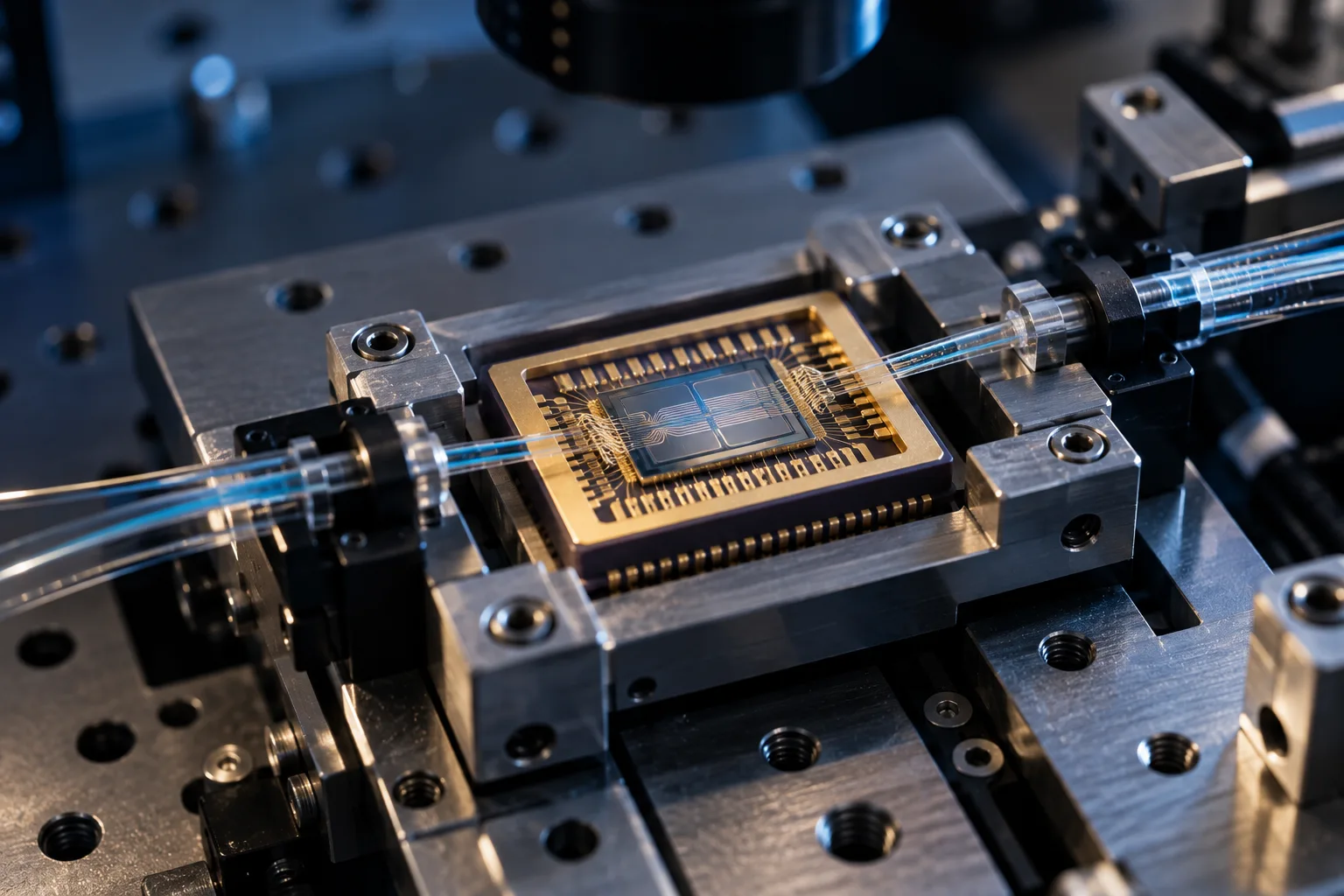
A trapped-ion quantum computer stores each qubit in a single charged atom, called an ion. Electric and magnetic fields hold the ions in place inside a vacuum chamber, and laser pulses or, in newer designs, electronic signals change the internal state of each ion. Two ions can then be made to interact in a controlled way, which creates the links between qubits that a quantum program needs.
The main attraction is accuracy. Quantinuum's Helios preprint reports that, averaged over the machine, a single-qubit operation fails about once in 40,000 tries and a two-qubit operation fails about once in 1,270. These are company-reported averages, and the machines are slow compared with the time an operation takes on some other kinds of quantum hardware: the preprint gives about 70 microseconds for one two-qubit operation. The open questions are whether this accuracy holds as the number of ions grows and whether outside groups can reproduce the results.
Technical explanation
Helios uses barium-137 ions as hyperfine qubits and follows the quantum charge-coupled device (QCCD) architecture, in which ions are shuttled between separate operation zones. A rotatable ion storage ring links two operation regions through a junction, which gives all-to-all connectivity across 98 physical qubits. According to the preprint, speed gains come from running operations in parallel and from a software stack that supports real-time compilation of dynamic programs.
Averaged over all operational zones, the Helios preprint reports average infidelities of 2.5(1) × 10⁻⁵ for single-qubit gates and 7.9(2) × 10⁻⁴ for two-qubit gates. It suggests, as one possible explanation, that leakage in the operational zones accounts for part of the gap between measured and predicted two-qubit error. It also reports much larger crosstalk errors for ions next to the 493 nm lasers during mid-circuit measurement and reset. Quantinuum's launch announcement quotes 99.921% two-qubit and 99.9975% single-qubit gate fidelity for the 98-qubit system. IonQ reports 99.99% two-qubit gate fidelity using its Electronic Qubit Control, which uses electronics rather than lasers to control the qubits. That result was demonstrated on prototype systems in IonQ's research laboratories and is not a commercial service specification.
Logical qubits group several physical qubits so that errors can be detected or corrected. Quantinuum reports 94 error-detected logical qubits in a globally entangled state, 50 error-detected logical qubits in a magnetism simulation, and 48 error-corrected logical qubits at a 2:1 encoding rate, using code concatenation. Quantinuum describes all three logical-qubit results as performing better than their physical qubits.
What the evidence says
Each statement is typed by the strength of its evidence and linked to the source that supports it.
Demonstrated Shown in a published experiment, test or shipping product.
Helios has 98 physical qubits made from barium-137 ions, with all-to-all connectivity through a rotatable ion storage ring that links two operation regions.
Sources: [1], [3] · AbstractThe 2019 review states that the basic requirements for universal quantum computing have all been demonstrated with ions, and discusses increasing the scale of trapped-ion computers while mitigating decoherence and control errors.
Sources: [5] · Abstract · medium confidenceReported, unverified Stated by a company or team but not independently confirmed.
Averaged over all operational zones, the Helios preprint reports average infidelities of 2.5(1) × 10⁻⁵ for single-qubit gates and 7.9(2) × 10⁻⁴ for two-qubit gates.
Sources: [1] · AbstractQuantinuum's launch announcement gives 99.921% two-qubit and 99.9975% single-qubit gate fidelity for the 98-qubit Helios system.
Sources: [2], [3] · medium confidenceThe Helios preprint gives about 70 microseconds for one two-qubit gate operation.
Sources: [1] · Section II.3Quantinuum says its 94-qubit and 50-qubit logical results use error detection, not error correction, and that its 48-qubit logical result uses error correction.
Sources: [2]Quantinuum reports 48 fully error-corrected logical qubits at a 2:1 encoding rate, using code concatenation, with 99.99% state preparation and measurement fidelity cited as a condition.
Sources: [3], [2] · medium confidenceIonQ reports 99.99% two-qubit gate fidelity using Electronic Qubit Control on prototype systems in its research laboratories, and this is a lab result rather than a commercial service figure.
Sources: [4] · medium confidenceThe Helios preprint names increasing clock speed as one scaling challenge for the QCCD platform.
Sources: [1] · Section IVLimitations and open problems
- Speed: the Helios preprint gives about 70 microseconds for one two-qubit operation, and its authors list increasing clock speed as one scaling challenge for the QCCD platform.
- Most headline figures are company-reported. The Helios figures come from a preprint, and they are averages over all operational zones; the preprint says per-qubit values are given in its appendix tables, which were not reviewed here.
- Logical-qubit results depend on the scenario. The 94-qubit and 50-qubit results use error detection rather than correction, and the 48-qubit error-corrected result is reported with 99.99% state preparation and measurement fidelity as a condition.
- Conditions differ between figures. The 48-qubit logical result cites 99.99% state preparation and measurement fidelity, while the Helios preprint reports an averaged state preparation and measurement infidelity of 4.8(6) × 10⁻⁴.
- Scaling is unproven. The Helios preprint says its component infidelities are not fundamentally limited, but no source reviewed shows that the averaged figures hold at larger qubit counts. The 2019 review identifies increasing scale while mitigating decoherence and control errors as a key challenge.
Possible future uses
Ideas, not predictions. None of these has been demonstrated.
- Error-corrected trapped-ion logical qubits running chemistry or materials simulations at accuracy that classical methods cannot match for the same problems.
- Trapped-ion modules linked by photonic interconnects into larger machines. This has not been demonstrated in the sources reviewed here.
- Parallel operations and faster control electronics that reduce the time per logical operation enough to make long error-corrected circuits practical.
Timeline
- Jun 2019Bruzewicz and colleagues publish a review of trapped-ion quantum computing that sets out the platform's progress and the challenges of scaling it while managing decoherence and control errors. Sources: [5]
- 21 Oct 2025IonQ reports 99.99% two-qubit gate fidelity with Electronic Qubit Control on prototype systems in its research laboratories. Sources: [4]
- 5 Nov 2025Quantinuum launches Helios, a 98-qubit trapped-ion system, and reports 99.921% two-qubit gate fidelity across all qubit pairs. Sources: [2], [3]
- 5 Nov 2025Quantinuum reports 94 error-detected logical qubits, 50 error-detected logical qubits in a magnetism simulation, and 48 error-corrected logical qubits on Helios. Sources: [2], [3]
- 7 Nov 2025The Helios preprint (arXiv:2511.05465) describes the 98-qubit architecture and reports averaged infidelities across operational zones. Sources: [1]
Futures this could help bring about
Related breakthroughs
Glossary
- Trapped ion
- An atom with one or more electrons removed, held in place by electric and magnetic fields so that its internal states can be used as qubits.
- Infidelity
- The chance that an operation does not do what it should. An infidelity of 0.001 means about one failure in every thousand operations.
- Logical qubit
- A qubit encoded across several physical qubits so that errors can be detected or corrected.
- Error detection and error correction
- Error detection flags that an error has happened. Error correction also works out the fix and applies it, so the encoded information is kept.
Sources
- preprint
Helios: A 98-qubit trapped-ion quantum computer
Anthony Ransford, M. S. Allman, Jake Arkinstall et al.. arXiv (quant-ph), 7 Nov 2025. Accessed 21 Oct 2026. - company announcement
Quantinuum Announces Commercial Launch of New Helios Quantum Computer that Offers Unprecedented Accuracy to Enable Generative Quantum AI (GenQAI)
Quantinuum, 5 Nov 2025. Accessed 21 Oct 2026. - company announcement
Introducing Helios: The Most Accurate Quantum Computer in the World
Quantinuum, 5 Nov 2025. Accessed 21 Oct 2026. - news
IonQ Achieves 99.99% Two-Qubit Gate Performance
The Quantum Insider, 21 Oct 2025. Accessed 21 Oct 2026. - review article
Trapped-Ion Quantum Computing: Progress and Challenges
Colin D. Bruzewicz, John Chiaverini, Robert McConnell et al.. Applied Physics Reviews, Jun 2019. DOI: 10.1063/1.5088164. Accessed 21 Oct 2026.
Revision history
3 changes since this profile was created.