Quantum random number generators
Also known as QRNG, Quantum random number generation, Quantum randomness
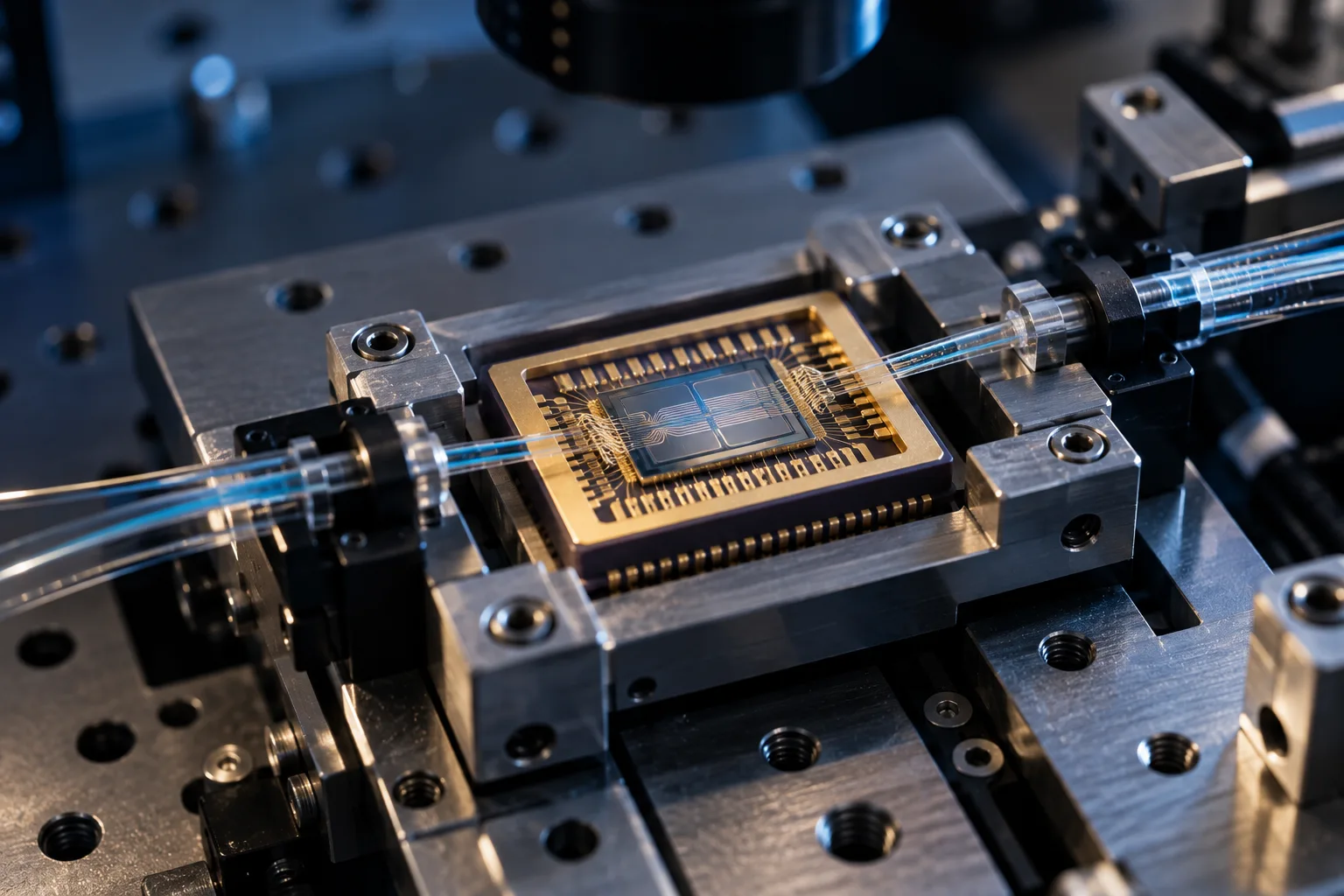
Quantum random number generators (QRNGs) turn measurements of quantum processes into random bits, and at least one smartphone has carried a chip-scale version. Whether this adds security over well-engineered classical sources is an open question, and the sources reviewed here give no public throughput figures for consumer chips.
In plain language
Computers need random numbers to create secret keys, one-time passcodes and fair draws. Most devices gather unpredictable noise from their hardware and turn it into random numbers in software. A quantum random number generator, or QRNG, takes a different route: it reads a physical process from quantum physics, such as the detection of single particles of light, whose results are random according to quantum theory. A small QRNG chip was built into a smartphone announced in 2020.
Whether this extra step adds real security is an open question. A good classical source may already be hard to predict, and a quantum source is only as trustworthy as the hardware around it. An attacker who can influence the device, or who learns something about its inner workings, may still be able to predict its output. Researchers are also working on a stronger design, called device-independent randomness, in which a test based on entangled particles shows that the output could not have been predicted without trusting the device's internals. Those experiments are slow and rely on strict assumptions.
Technical explanation
A QRNG turns a quantum measurement into bits. Chip-scale designs combine a quantum light source, a detector and electronics, then pass the raw signal through health tests and a randomness extractor, which removes bias and compresses the output. NIST Special Publication 800-90B, published in January 2018, sets out design principles and requirements for the entropy source, meaning the noise-producing part, together with tests for validating it. The publication is meant to be combined with deterministic random bit generator mechanisms from related NIST standards.
Certified randomness goes further. In a device-independent protocol, a Bell test on entangled particles is used to certify that output bits could not be predicted by an adversary who respects the test's assumptions. Liu and colleagues reported 6.2469 × 10^7 certified bits over 96 hours, about 181 bits per second, in a 2018 Nature paper. A 2025 Nature paper reports that a 56-qubit Quantinuum H2-1 trapped-ion processor certified 71,313 bits under a restricted class of adversaries and additional assumptions, and that its verification was classical, run on multiple supercomputers.
Security is a property of the whole implementation. ETSI's implementation guidelines (TR 104 171), announced in a September 2026 press release, warn that output may appear statistically random yet become predictable to an attacker with relevant side information. A 2020 proof of concept biased one prototype unit by shining light through a ventilation hole in its casing. The NIST Randomness Beacon, which uses a NIST-developed photon-detection QRNG, warns against using its values as cryptographic secret keys.
What the evidence says
Each statement is typed by the strength of its evidence and linked to the source that supports it.
Demonstrated Shown in a published experiment, test or shipping product.
NIST SP 800-90B, published in January 2018, sets out design principles and requirements for entropy sources used in random bit generation, along with tests for validating them.
Sources: [1] · Publication page summaryThe NIST Randomness Beacon publishes indexed, time-stamped and signed pulses, each containing a fresh 512-bit random value; its project page gives one pulse per minute as an example rate.
Sources: [2] · Project descriptionThe NIST Randomness Beacon uses a NIST-developed quantum random number generator based on photon detection, but its project page does not describe its output as certified, and it warns against using beacon values as cryptographic secret keys.
Sources: [2] · Project descriptionIn a 2018 Nature paper, Liu and colleagues reported 6.2469 × 10^7 quantum-certified random bits in 96 hours, about 181 bits per second, from a device-independent Bell-test experiment, with output uniform to within 10^-5.
Sources: [3] · AbstractA 2025 Nature paper reports that a 56-qubit Quantinuum H2-1 trapped-ion processor certified 71,313 bits of entropy under a restricted class of near-term adversaries and additional assumptions, and that its verification was classical, run at 1.1 × 10^18 floating-point operations per second across multiple supercomputers.
Sources: [7] · Abstract · medium confidenceThe ID Quantique announcement gives no speed, throughput or entropy-rate figures for the phone chip.
Sources: [4] · AnnouncementIn a 2020 proof of concept on a prototype QRNG module, light injected through its top ventilation holes biased the output towards ones, with the final sequence above 80% ones in the unit used for most of the work, and the attack-generated bits failed FIPS 140-2 tests that normal output passed.
Sources: [5] · ResultsReported, unverified Stated by a company or team but not independently confirmed.
ID Quantique announced the Galaxy A Quantum on 13 May 2020, a custom edition of the Samsung Galaxy A71 5G commercialised by SK Telecom, and describes its Quantis chip (IDQ250C2) as the first QRNG designed and manufactured specifically for mobile handsets.
Sources: [4] · AnnouncementETSI's 2026 press release on its QRNG implementation guidelines (TR 104 171) says QRNG output may appear statistically random yet become predictable to an adversary with relevant side information, so the whole implementation matters.
Sources: [6] · Press release · medium confidenceLimitations and open problems
- The sources reviewed give no public throughput or entropy-rate figures for consumer QRNG chips, so their speed and quality cannot be checked against each other or against software-based sources.
- A quantum source does not guarantee good randomness on its own. ETSI's press release warns that side information can make output predictable even when it looks statistically random.
- Physical attacks are a real concern. A 2020 proof of concept biased one prototype unit under a light-injection attack, which does not show that every QRNG is vulnerable in the same way.
- Certified randomness is slow or strictly assumed. The 2018 device-independent run produced about 181 bits per second, and the 2025 trapped-ion run relied on a restricted adversary model and classical verification.
- The NIST Randomness Beacon's output is not described as certified randomness on its project page, and the page warns against using beacon values as keys.
- Whether quantum randomness adds security over a well-engineered classical source is not settled, and the sources reviewed here do not quantify it.
Possible future uses
Ideas, not predictions. None of these has been demonstrated.
- Public randomness beacons whose outputs anyone can verify as certified, rather than trusting the operator to be honest.
- Fair draws in lotteries, audits and public selections where people need proof that the outcome was not chosen in advance.
- Strong key generation in small Internet of Things devices that cannot afford a separate high-quality entropy source.
Timeline
- Jan 2018NIST publishes SP 800-90B, which sets out requirements and validation tests for entropy sources used in random bit generation. Sources: [1]
- 19 Sept 2018Liu and colleagues publish a device-independent QRNG experiment in Nature, reporting 6.2469 × 10^7 certified random bits over 96 hours. Sources: [3]
- 13 May 2020ID Quantique and SK Telecom announce a phone with the Quantis QRNG chip (IDQ250C2), the Galaxy A Quantum. Sources: [4]
- 3 Aug 2020PLOS ONE publishes a paper that includes a light-injection attack biasing the output of a prototype QRNG. Sources: [5]
- 26 Mar 2025A Nature paper reports certified randomness from a 56-qubit trapped-ion processor, with 71,313 certified bits under stated assumptions. Sources: [7]
- 24 Sept 2026ETSI publishes a press release on TR 104 171, its implementation guidelines for QRNGs, which set out their limitations. Sources: [6]
Futures this could help bring about
Glossary
- Entropy source
- The part of a random number generator that produces unpredictable raw bits, such as noise from a physical process.
- Randomness extractor
- A step that removes bias from raw random bits and compresses them into a shorter, more uniform output.
- Bell test
- An experiment on entangled particles that checks whether their results can be explained by ordinary, pre-set properties.
- Device-independent randomness
- Randomness certified by observed test results, without needing to trust the inner workings of the device that produced it.
Sources
- standard
Recommendation for the Entropy Sources Used for Random Bit Generation (NIST SP 800-90B)
Meltem Sönmez Turan, Elaine Barker, John Kelsey et al.. NIST, Jan 2018. Accessed 21 Oct 2026. - government report
Interoperable Randomness Beacons (NIST Randomness Beacon project page)
NIST, Jun 2019. Accessed 21 Oct 2026. - peer reviewed paper
Device independent quantum random number generation
Yang Liu, Qi Zhao, Ming-Han Li et al.. Nature, 19 Sept 2018. DOI: 10.1038/s41586-018-0559-3. Accessed 21 Oct 2026. - company announcement
ID Quantique and SK Telecom announce the world's first 5G smartphone equipped with a Quantum Random Number Generator (QRNG) chipset
ID Quantique, 13 May 2020. Accessed 21 Oct 2026. - peer reviewed papercorrected
Attacking quantum key distribution by light injection via ventilation openings
Juan Carlos Garcia-Escartin, Shihan Sajeed, Vadim Makarov. PLOS ONE, 3 Aug 2020. DOI: 10.1371/journal.pone.0236630. Accessed 21 Oct 2026. - other
ETSI identifies limitations of quantum random number generators
ETSI, 24 Sept 2026. Accessed 21 Oct 2026. - peer reviewed paper
Certified randomness using a trapped-ion quantum processor
Minzhao Liu, Ruslan Shaydulin, Pradeep Niroula et al.. Nature, 26 Mar 2025. DOI: 10.1038/s41586-025-08737-1. Accessed 21 Oct 2026.
Revision history
4 changes since this profile was created.