Diffractive photonic processor reports 1,024-size matrix multiplication with 10^-6 mean error
What was demonstrated
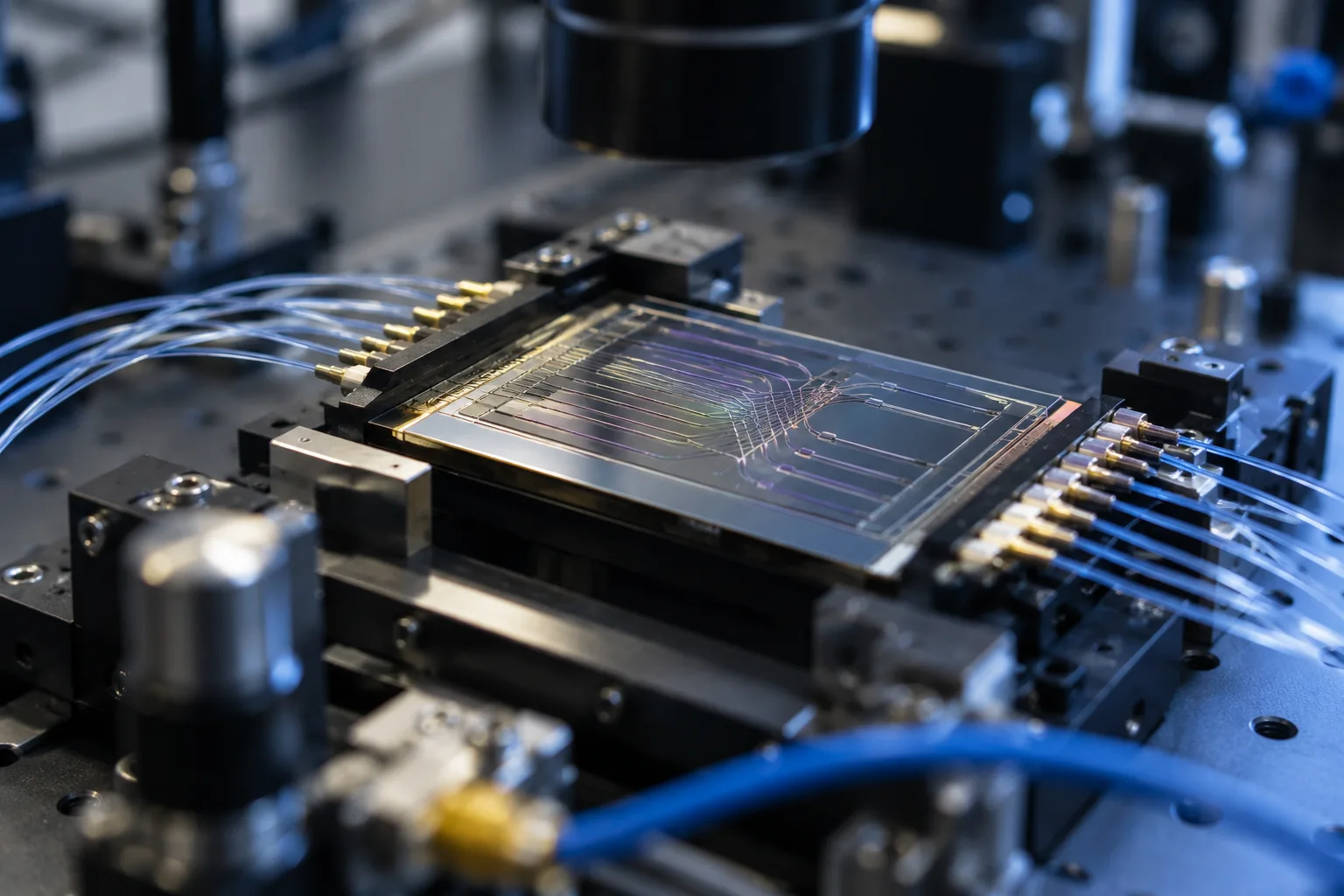
The authors report a reconfigurable diffractive tensor processor, the diffractive tensorized unit, that performs arbitrary matrix multiplication at size 1,024 with a mean absolute error of 10^-6. They also report competitive accuracy on natural-language-generation and cross-modal-recognition tasks, and a 1,000-fold improvement in computing throughput over conventional electronic processors in their own comparison.
Why it matters
The authors say the lack of on-chip reconfigurability has been a major obstacle to general-purpose computing with diffraction-based architectures. If the reported accuracy and throughput hold under full evaluation, the work would add a photonic option for matrix-heavy AI workloads.
Caveats
- The record relies on the abstract as quoted in a Dryad data-repository page and a press summary. The Nature Photonics page could not be opened, so the full paper has not been checked.
- The 1,000-fold figure is a throughput comparison in the authors' own setup. It is not an end-to-end application speedup, and the sources reviewed do not show whether the throughput was measured or projected.
- No energy figure was found in the sources reviewed. Energy accounting, the electronic baseline and the task conditions need checking against the full paper.
- Million-TOPS is a processor capability claim. It does not show a commercially deployed general-purpose computer.
Technology profiles
Sources
- peer reviewed paper
Diffractive tensorized unit for million-TOPS general-purpose computing
Chao Wang, Yuan Cheng, Zhihao Xu et al.. Nature Photonics, Aug 2025. DOI: 10.1038/s41566-025-01749-3. - dataset
Data from: Diffractive tensorized unit for million-TOPS general-purpose computing
Chao Wang, Yuan Cheng, Zhihao Xu et al.. Dryad, 18 Aug 2025. DOI: 10.5061/dryad.7d7wm387c.
Last reviewed 22 Oct 2026.