Photonic computing for AI
Also known as Optical computing for AI, Optical neural networks, Photonic AI accelerators
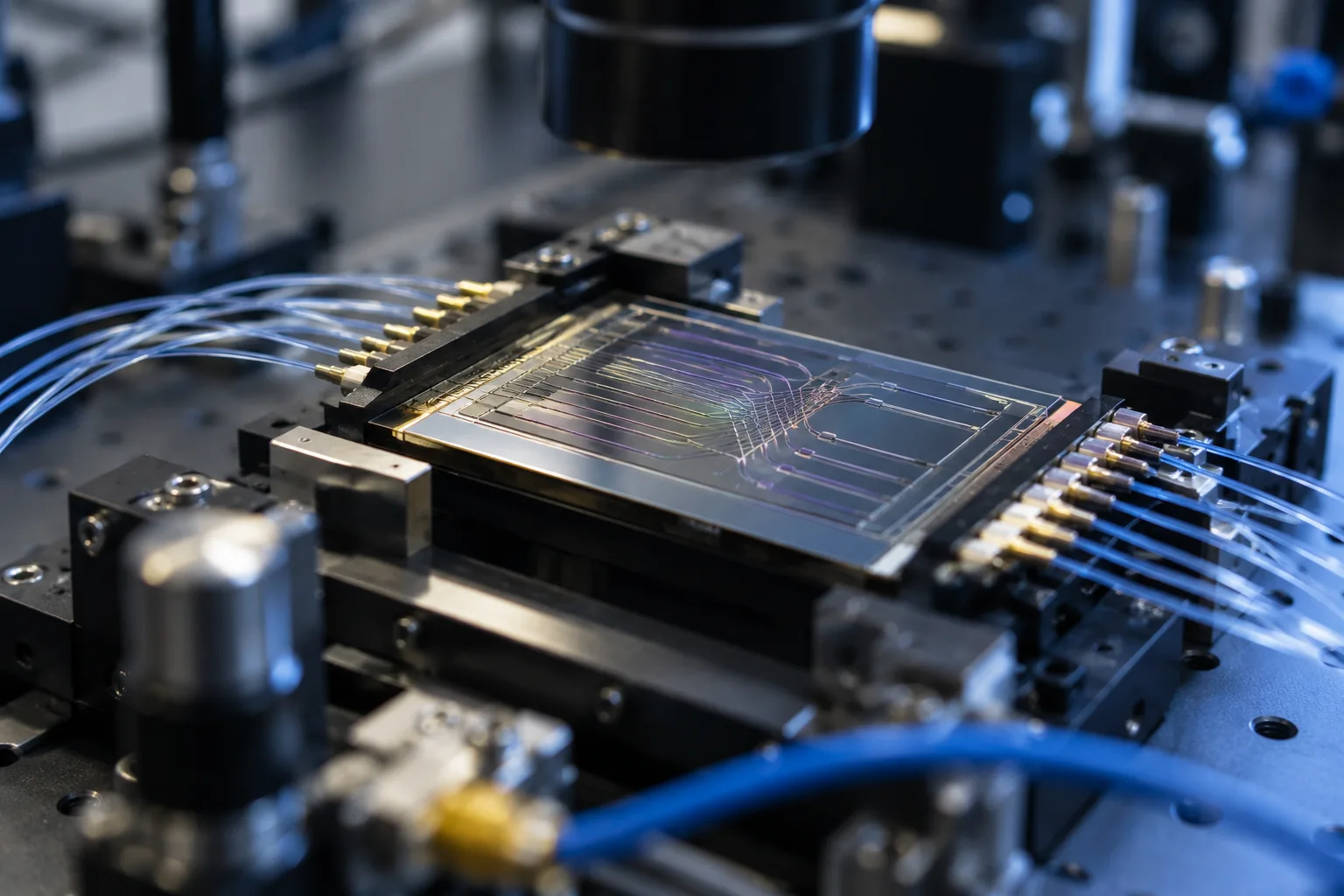
Photonic computing uses light, rather than electrical signals, to carry out some of the matrix calculations used in AI. Laboratory chips have run small neural networks and a packaged optical accelerator, but the sources reviewed here do not show that photonic chips outperform electronic hardware on real AI workloads.
In plain language
Much of AI work consists of multiplying large grids of numbers, called matrices. Ordinary chips do this with electrical signals moving through transistors. Photonic computing tries to do some of the same sums with light, which can travel through tiny channels on a chip and carry several signals at different colours at once.
Early demonstrations show that light can perform parts of a neural network. In 2025, researchers reported a silicon photonic chip that ran a small image-classification network from input to output, and a packaged accelerator that performs repeated matrix operations for one optimisation algorithm. Both still depend on electronics for control, memory and conversion, and the sources reviewed here do not show either running large contemporary AI models.
The main attraction is speed and energy use for certain operations. However, light is harder to control precisely, and it has to be converted back into electrical signals to be useful. For now, photonic systems are best seen as specialist research accelerators rather than general replacements for the processors used in AI data centres.
Technical explanation
Neural network inference is dominated by matrix-vector and matrix-matrix products. In coherent nanophotonic circuits, programmable interferometer meshes, such as Mach-Zehnder interferometers, set the amplitude and phase of light in each channel so that the circuit applies a matrix to an input encoded in the light. Shen and colleagues (2017) report deep learning implemented on a coherent nanophotonic circuit, which is an early demonstration that such a chip can run a neural network.
Integrated photonic tensor cores extend this idea by using wavelength multiplexing, which sends several colours of light through the same waveguide, to run many multiply-accumulate operations in parallel on one chip. Feldmann and colleagues (2021) report parallel convolutional processing on an integrated photonic tensor core. Xu and colleagues (2021) report a photonic convolutional accelerator with a throughput of 11 TOPS in their test system. Analog optical signals carry noise and crosstalk, which limit numerical precision. Zhou and colleagues (2022) survey several photonic matrix-multiplication methods and discuss open challenges.
Wu and colleagues (2025) report a monolithically integrated silicon photonic network with opto-electro-opto nonlinear activations, convolutional layers and a partially coherent light source. The network was trained in situ and tested on small handwritten-digit and fashion-image tasks. The authors calculate 121.7 picojoules per operation for their experimental system from its total power of 10.57 W, which includes the laser source, external electrical circuits and the optical chip, so it is not a chip-only measure.
Hua and colleagues (2025) report a packaged hybrid system in which a photonic integrated circuit performs matrix multiply-accumulate operations and a separate electronic chip handles logic, memory and control. The system was applied to heuristic solvers for Ising optimisation problems, where the authors report a clock frequency of up to 1 GHz.
Inference is the most likely early use. Wetzstein and colleagues (2020) publish a Perspective in Nature on optical computing for AI inference. Its abstract says that inference may offer opportunities for optical and photonic systems, and it discusses the challenges. The Perspective does not show such a system in deployed use, so its view should be read as a proposal rather than a demonstrated result.
Optical interconnects are a separate line of work. Daudlin and colleagues (2025) report three-dimensional photonic integration for high-bandwidth data links between chips. That work moves data; it does not show optical matrix multiplication.
What the evidence says
Each statement is typed by the strength of its evidence and linked to the source that supports it.
Demonstrated Shown in a published experiment, test or shipping product.
Shen and colleagues reported deep learning implemented on a coherent nanophotonic circuit.
Sources: [1] · Title · medium confidenceFeldmann and colleagues reported parallel convolutional processing on an integrated photonic tensor core.
Sources: [2] · Title · medium confidenceXu and colleagues reported a photonic convolutional accelerator with a throughput of 11 TOPS in their test system.
Sources: [3] · Title · medium confidenceWu and colleagues built a monolithically integrated silicon photonic network with a 64-element input layer, two convolutional layers and two fully connected layers. It was trained in situ and reached 96% accuracy on a two-class fashion-image task, as stated in the abstract, with no train or test split reported for that task.
Sources: [6] · Abstract (Europe PMC); results section (full text, PMC12443992) · medium confidenceOn a four-class handwritten-digit task with 100 test images, Wu and colleagues report 90% test accuracy for a partially coherent source and 87% for a real-valued reference network using a narrow-linewidth laser. The 94% figure in the abstract is the training accuracy for the partially coherent network.
Sources: [6] · Results section (full text) · medium confidenceWu and colleagues report a total power consumption of 10.57 W for the experimental system, which includes the laser source, external electrical circuits and optical chip. They estimate 4.1 ns pulse latency per inference and calculate 121.7 picojoules per operation from the total power, based on 356 operations per inference.
Sources: [6] · Results section (full text, PMC12443992) · medium confidenceHua and colleagues report a packaged photonic accelerator with more than 16,000 photonic components. It combines a photonic integrated circuit with a separate electronic chip in one package, and performs repeated matrix multiply-accumulate operations for heuristic solvers of Ising optimisation problems.
Sources: [7] · Abstract (checked via Europe PMC) · medium confidenceDaudlin and colleagues report three-dimensional photonic integration for high-bandwidth data links between chips. The work concerns data communication, not optical matrix multiplication.
Sources: [8] · Title · medium confidenceReported, unverified Stated by a company or team but not independently confirmed.
The 2022 review by Zhou and colleagues surveys photonic matrix-multiplication methods, including Mach-Zehnder interferometer meshes and wavelength division multiplexing.
Sources: [5] · Abstract (full text not reviewed) · medium confidenceThe 2022 review by Zhou and colleagues comments on the challenges and perspectives for photonic matrix multiplication and photonic accelerators.
Sources: [5] · Abstract (full text not reviewed) · medium confidenceHua and colleagues report a clock frequency of up to 1 GHz and a cycle latency as small as 3 ns per cycle for the photonic computation. The electronic chip handles logic, memory and control.
Sources: [7] · Abstract (checked via Europe PMC; full text not reviewed) · medium confidenceProposed A design or plan that has not yet been built or tested.
Wetzstein and colleagues argue that AI inference, especially for visual computing, may offer opportunities for optical and photonic systems.
Sources: [4] · Abstract (full text not reviewed) · medium confidenceLimitations and open problems
- Most published results come from laboratory chips and test systems. The sources reviewed here do not show performance on full-scale AI models in production.
- Analog optical computing has limited numerical precision because of noise and crosstalk, which affects which AI tasks are practical.
- Converting between light and electrical signals at the edges of a chip costs energy and can cancel out some of the speed gain.
- Photonic circuits need precise phase and temperature control, and manufacturing variation affects each interferometer on the chip.
- Software tools, training methods and standard benchmarks for photonic AI hardware are not yet mature.
- The 2025 silicon network was tested on small benchmark image sets. Its handwritten-digit test used 100 images, and its accuracy has not been shown on large contemporary vision models.
- The 2025 energy figure of 121.7 picojoules per operation comes from a whole experimental setup, including the laser source and electronic circuits, so it is not a chip-only figure.
- The 2025 packaged accelerator is built for a defined iterative algorithm. Its result does not show that arbitrary programs or complete AI models run optically.
- Faster optical data links between chips do not by themselves make the arithmetic optical. Product claims should say which part of the system is photonic.
Possible future uses
Ideas, not predictions. None of these has been demonstrated.
- Optical accelerators in data centres that handle the inference part of large AI models using less energy per operation.
- Optical front ends that process sensor data as light before conversion to digital, reducing how much data moves between chips.
- Low-latency optical processing for real-time sensing in vehicles or robots.
Timeline
- 12 Jun 2017Shen and colleagues report deep learning implemented on a coherent nanophotonic circuit in Nature Photonics. Sources: [1]
- 2 Dec 2020Wetzstein and colleagues publish a Perspective on optics and photonics for AI inference in Nature. Sources: [4]
- 6 Jan 2021Feldmann and colleagues report parallel convolutional processing on an integrated photonic tensor core in Nature. Sources: [2]
- 6 Jan 2021Xu and colleagues report a photonic convolutional accelerator with 11 TOPS throughput in their test system in Nature. Sources: [3]
- 3 Feb 2022Zhou and colleagues publish a review of photonic matrix multiplication for photonic accelerators in Light: Science & Applications. Sources: [5]
- 21 Mar 2025Daudlin and colleagues publish three-dimensional photonic integration for high-bandwidth interchip data links in Nature Photonics. This is a data-communication result, not optical computation. Sources: [8]
- 9 Apr 2025Hua and colleagues publish an integrated large-scale photonic accelerator with ultralow latency in Nature, pairing a photonic chip with an electronic chip in one package. Sources: [7]
- 17 Sept 2025Wu and colleagues publish scaling up for end-to-end on-chip photonic neural network inference in Light: Science & Applications. Sources: [6]
Futures this could help bring about
Related breakthroughs
- Diffractive photonic processor reports 1,024-size matrix multiplication with 10^-6 mean error (27 Aug 2025)
- An integrated photonic accelerator with more than 16,000 components reduces computation time for Ising-problem solvers (9 Apr 2025)
- Photonic processor runs ResNet, BERT and an Atari reinforcement learning agent (9 Apr 2025)
Glossary
- Matrix multiplication
- The core arithmetic of neural networks, in which a grid of numbers is combined with another grid to produce a new set of numbers.
- Photonic integrated circuit
- A small chip that guides light along tiny channels, performing optical functions such as splitting, mixing and phase shifting.
- Wavelength multiplexing
- Sending several colours (wavelengths) of light through the same channel at once, so that each colour carries a separate signal.
- Mach-Zehnder interferometer
- A device that splits light into two paths and recombines it, so that the amount and phase of the output light can be tuned.
- Opto-electro-opto (O-E-O) conversion
- Converting an optical signal into an electrical one for processing, then converting the result back to light.
- Partially coherent light
- Light whose waves have a limited phase relationship with each other. The Wu and colleagues network uses this kind of source in place of a narrow-linewidth laser.
- Ising problem
- A mathematical model of interacting binary variables, used to represent some hard combinatorial optimisation tasks.
Sources
- peer reviewed paper
Deep learning with coherent nanophotonic circuits
Shen, Harris, Skirlo et al.. Nature Photonics, 12 Jun 2017. DOI: 10.1038/nphoton.2017.93. Accessed 21 Oct 2026. - peer reviewed paper
Parallel convolutional processing using an integrated photonic tensor core
Feldmann, Youngblood, Karpov et al.. Nature, 6 Jan 2021. DOI: 10.1038/s41586-020-03070-1. Accessed 21 Oct 2026. - peer reviewed paper
11 TOPS photonic convolutional accelerator for optical neural networks
Xu, Tan, Corcoran et al.. Nature, 6 Jan 2021. DOI: 10.1038/s41586-020-03063-0. Accessed 21 Oct 2026. - review article
Inference in artificial intelligence with deep optics and photonics
Wetzstein, Ozcan, Gigan et al.. Nature, 2 Dec 2020. DOI: 10.1038/s41586-020-2973-6. Accessed 21 Oct 2026. - review article
Photonic matrix multiplication lights up photonic accelerator and beyond
Zhou, Dong, Cheng et al.. Light: Science & Applications, 3 Feb 2022. DOI: 10.1038/s41377-022-00717-8. Accessed 21 Oct 2026. - peer reviewed paper
Scaling up for end-to-end on-chip photonic neural network inference
Wu, Huang, Zhang et al.. Light: Science & Applications, 17 Sept 2025. DOI: 10.1038/s41377-025-02029-z. Accessed 21 Oct 2026. - peer reviewed paper
An integrated large-scale photonic accelerator with ultralow latency
Hua, Divita, Yu et al.. Nature, 9 Apr 2025. DOI: 10.1038/s41586-025-08786-6. Accessed 21 Oct 2026. - peer reviewed paper
Three-dimensional photonic integration for ultra-low-energy, high-bandwidth interchip data links
Daudlin, Rizzo, Lee et al.. Nature Photonics, 21 Mar 2025. DOI: 10.1038/s41566-025-01633-0. Accessed 21 Oct 2026.
Revision history
5 changes since this profile was created.