How far are we from data centres that calculate with light?
In 2025, researchers reported photonic chips that do matrix arithmetic with light in small neural networks, in a hard optimisation workload and in a packaged engine of more than 16,000 photonic components. Chip makers have also announced co-packaged optics switches, which use light to move data between chips. The sources reviewed do not show a data centre running AI models with optical arithmetic at measured energy savings. The energy figures found so far use different boundaries, and most of the company figures are not independently measured.
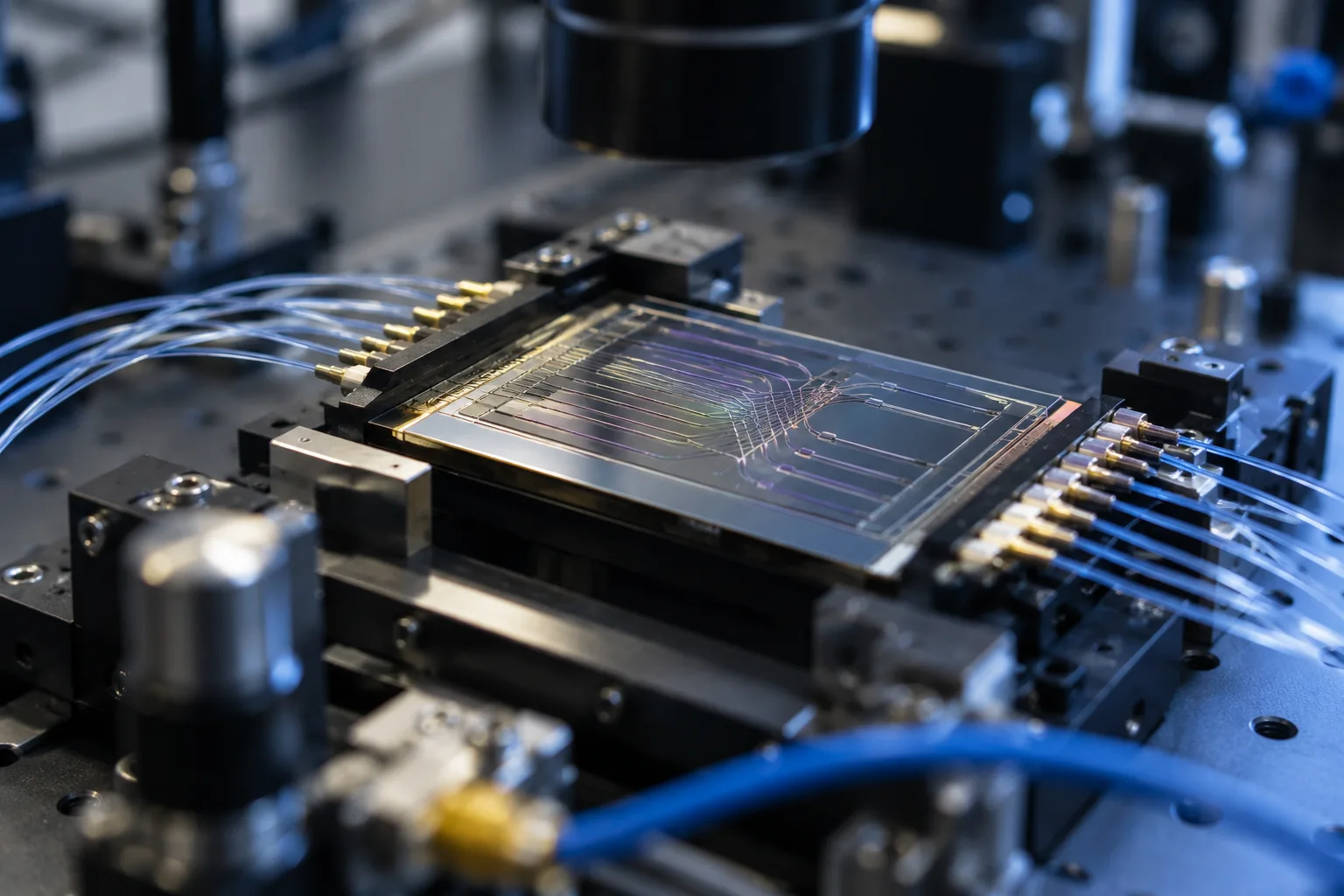
Getting closer. Prototypes exist, but not in real-world use.
Photonic computing has reached packaged engineering prototypes. Wu and colleagues (2025) ran a complete small inference on an integrated silicon photonic chip, and Hua and colleagues (2025) reported a packaged photonic engine. Co-packaged optics for links is further along: switches have been announced and Broadcom's switch is reported to be sampling to early-access customers. No source reviewed shows volume deployment of photonic computing in AI data centres, so the overall stage is engineering prototype, with optical links at an early pilot stage.
The tech tree
Everything recorded on Vrulum that this future needs, oldest foundations at the top and the goal at the bottom. Lines show what each step requires.
- 2011Photonic integrated circuitsPilot and early commercial Unlocked.
- 2017Photonic computing for AIResearch and prototypes Being researched.
- 2019Optical interconnects and co-packaged opticsResearch and prototypesRequires: Orbital data centres. Being researched.
- 2025Co-packaged optics switches announcedDone Unlocked.
- 2025Dense optical link between chips in the labDone Unlocked.
- 2025Large packaged photonic accelerator on an optimisation workloadDone Unlocked.
- 2025Photonic processor running standard AI modelsDone Unlocked.
- 2025Small neural network inference on an integrated photonic chipDone Unlocked.
- Date not recordedCo-packaged optics switches in customer hardwareIn progress Being researched.
- Date not recordedPhotonic processors in production AI workloadsNot started Locked.
- Date not recordedWhole-system energy compared with electronic acceleratorsNot started Locked.
- GoalComputers that calculate with light in data centresGoalRequires: Photonic computing for AI, Optical interconnects and co-packaged optics, Photonic integrated circuits, Small neural network inference on an integrated photonic chip, Dense optical link between chips in the lab, Large packaged photonic accelerator on an optimisation workload, Photonic processor running standard AI models, Co-packaged optics switches announced, Co-packaged optics switches in customer hardware, Photonic processors in production AI workloads, Whole-system energy compared with electronic accelerators. Locked.
The road so far
5 of 8 steps done, 1 in progress.
- Done · 17 Sept 2025Small neural network inference on an integrated photonic chip
Wu and colleagues ran a partially coherent deep optical neural network on a silicon photonic chip of about 17 mm2, with two convolutional layers and two fully connected layers. The non-linear layers used on-chip opto-electro-opto conversion. On a four-class handwritten-digit task (digits 0, 1, 2 and 5 from the MNIST dataset), the chip reached 90% test accuracy with a partially coherent source and 87% with a narrow-linewidth laser. Each test used 100 test images and 100 training images. [1]
- Done · 21 Mar 2025Dense optical link between chips in the lab
Daudlin and colleagues report a three-dimensional photonic-electronic interconnect with 80 transmitters and 80 receivers at 10 Gb/s per channel, giving 800 Gb/s aggregate bandwidth. The reported energy is about 120 fJ per communicated bit. The authors state that the design is compatible with commercial CMOS foundry processing on 300 mm wafers. [4]
- Done · 9 Apr 2025Large packaged photonic accelerator on an optimisation workload
Hua and colleagues report an integrated photonic accelerator built from more than 16,000 photonic components. It performs standard linear matrix multiply-accumulate operations at clock speeds up to 1 GHz, with latency as small as 3 ns per cycle. It is packaged with a co-integrated electronics chip for logic, memory and control, joined by 2.5D hybrid packaging. The authors used it for heuristic solvers of hard Ising problems, where latency matters most. The abstract summary reviewed does not mention an energy figure or a direct comparison with GPUs. [2]
- Done · 9 Apr 2025Photonic processor running standard AI models
Ahmed and colleagues describe a photonic AI processor that runs ResNet, BERT and an Atari deep reinforcement learning algorithm, and report near-electronic precision for many workloads. A Physics magazine article reports that the chip reached around 80 trillion operations per second against a design target of 400 trillion, with 7 to 10 bit precision, and that it is at least 10 times more energy-efficient than traditional GPUs. The baseline and conditions for that energy claim are not given in the sources reviewed. [3][7]
- Done · 18 Mar 2025Co-packaged optics switches announced
NVIDIA announced Spectrum-X Photonics and Quantum-X Photonics switches on 18 March 2025, claiming 3.5 times more power efficiency, 4 times fewer lasers and 10 times better network resiliency at scale, each compared with traditional methods. The baseline is not specified. A StorageReview news report dated 8 October 2025 describes Broadcom's Tomahawk 6 Davisson switch, with 102.4 Tb/s of optically enabled switching capacity from sixteen 6.4 Tb/s optical engines, and a claimed reduction of about 70% in optical interconnect power against traditional pluggable optics. [5][6]
- In progressCo-packaged optics switches in customer hardware
Broadcom's Tomahawk 6 Davisson switch is described as sampling to early-access customers, with general availability to follow. A news report of the launch uses the word shipping in its headline, but the availability section describes sampling. NVIDIA said that its Quantum-X Photonics switches were expected later in 2025 and its Spectrum-X Photonics Ethernet switches in 2026. The sources reviewed give no shipment volumes or measured customer deployments. [6][5]
- Not startedPhotonic processors in production AI workloads
The sources reviewed do not report photonic processors running production AI services. The demonstrations so far use small or specialised workloads on laboratory or packaged prototype systems. [1][2][3]
- Not startedWhole-system energy compared with electronic accelerators
The energy figures reviewed use different boundaries. Wu and colleagues report 121.7 pJ per operation for their experimental system, calculated from a total system power of 10.57 W. Daudlin and colleagues report energy for an interconnect link, not a compute system. No source reviewed compares a complete photonic compute system with a GPU or other electronic accelerator at matched accuracy, latency and energy boundary. [1][4]
Why it matters
AI data centres spend large amounts of energy and time moving data between chips. If light can carry that traffic at low energy per bit, or can carry out some repeated matrix operations with less energy than electronics, some of the power and cost limits on AI hardware could ease. The gain depends on whole-system accounting. A faster optical step does not by itself make a data centre faster or cheaper to run.
What stands in the way
- Analog optical arithmetic has limited precision. A Physics magazine article reports 7 to 10 bits for the Lightmatter processor, and Ahmed and colleagues say that earlier photonic chips had not reached the precision practical AI needs.
- Data conversion and memory surround every optical operation. Wu and colleagues report an intensity modulator 3 dB bandwidth of 22 MHz and a micro-ring extinction ratio of 6 dB, so fast optical arithmetic does not by itself show fast end-to-end applications.
- Energy figures are measured on different boundaries. Wu and colleagues report energy per operation from total system power, while Daudlin and colleagues report energy per bit for an interconnect.
- Benchmarks are small or specialised. The digit test used 100 training and 100 test images from MNIST, and the Ising result is for a heuristic solver rather than neural-network training or inference at scale.
- Company power claims are not independently measured in the sources reviewed, and their baselines are not always stated. NVIDIA compares with traditional methods, and the StorageReview report gives both about 70% and more than 3.5 times lower optical power for Broadcom, which do not match each other.
- Volume manufacturing, yield, packaging reliability and thermal behaviour of combined photonic and electronic packages are not shown in the sources reviewed.
Signals to watch
- An independent comparison of a photonic accelerator against an optimised GPU at matched accuracy, with energy measured for the whole system.
- Broadcom moving its Tomahawk 6 Davisson switch from sampling to general availability, and NVIDIA's photonic switches reaching customers on the stated dates.
- Photonic compute demonstrated on larger models, with input and output conversion, memory access and laser power included in the energy figure.
- A second research group reproducing the accuracy and speed results of Hua and colleagues or Ahmed and colleagues.
Sources
- peer reviewed paper
Scaling up for end-to-end on-chip photonic neural network inference
Bo Wu, Chaoran Huang, Jialong Zhang et al.. Light: Science & Applications (Springer Nature), 17 Sept 2025. - peer reviewed paper
An integrated large-scale photonic accelerator with ultralow latency
Shiyue Hua, Erwan Divita, Shanshan Yu et al.. Nature, 9 Apr 2025. - peer reviewed paper
Universal photonic artificial intelligence acceleration
Sufi R. Ahmed, Reza Baghdadi, Mikhail Bernadskiy et al.. Nature, 9 Apr 2025. - peer reviewed paper
Three-dimensional photonic integration for ultra-low-energy, high-bandwidth interchip data links
Stuart Daudlin, Anthony Rizzo, Sunwoo Lee et al.. Nature Photonics, 21 Mar 2025. - company announcement
NVIDIA Announces Spectrum-X Photonics, Co-Packaged Optics Networking Switches to Scale AI Factories to Millions of GPUs
NVIDIA, 18 Mar 2025. - news
Broadcom Ships Tomahawk 6-Davisson CPO Ethernet Switch, Doubling Bandwidth to 102.4 Tb/s for AI Fabrics
Harold Fritts. StorageReview.com, 8 Oct 2025. - news
Photonic Computing Takes a Step Toward Fruition
Ananya Palivela. American Physical Society (Physics magazine), 21 Apr 2025.
Last reviewed 21 Oct 2026.