Optical interconnects and co-packaged optics
Also known as Co-packaged optics, CPO, Optical I/O, Silicon photonic interconnects
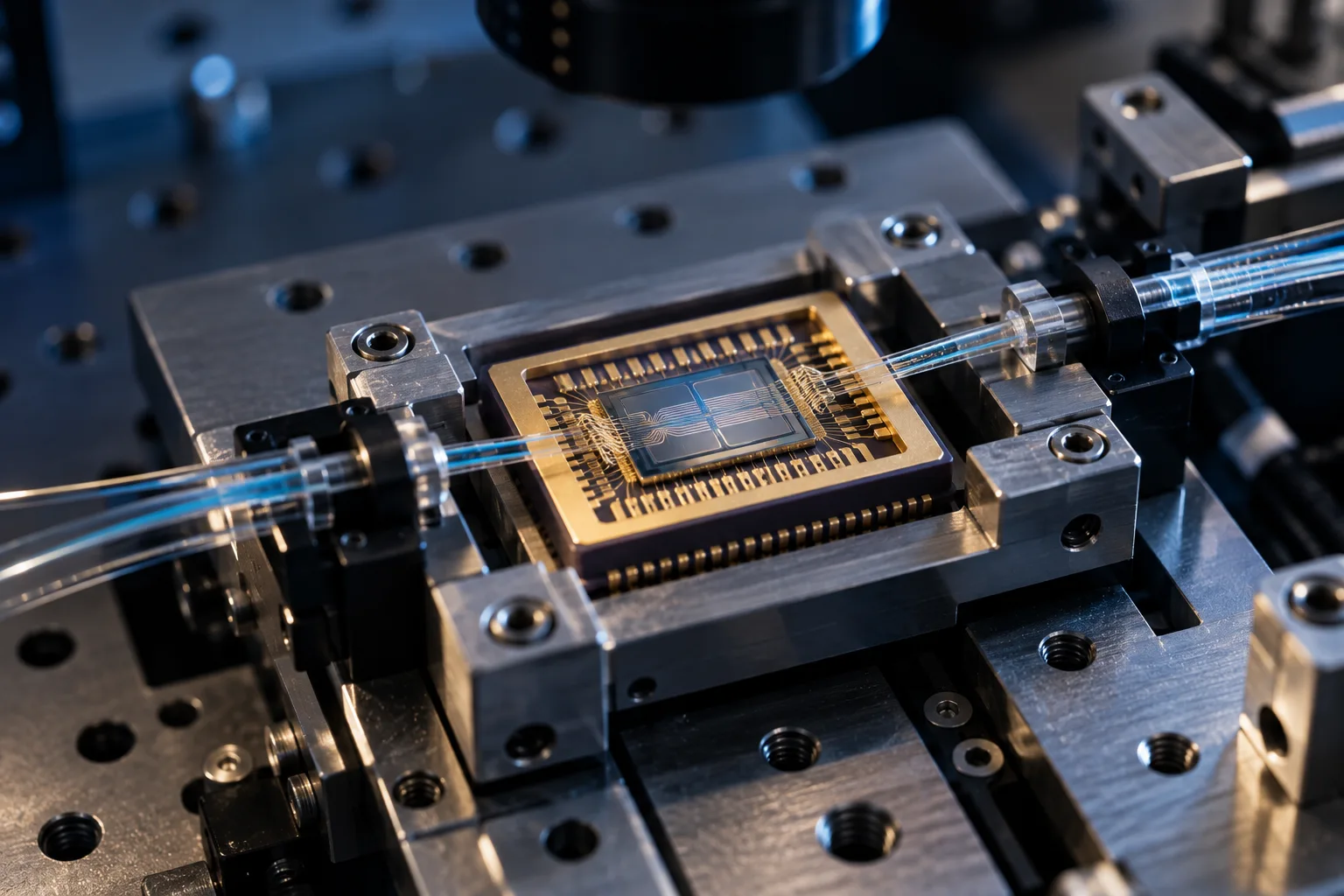
Optical interconnects carry data between chips, switches and racks as light rather than electrical current. Co-packaged optics (CPO) places the optical engines inside the same package as the switch or processor, which shortens the electrical links and may reduce power per bit, but the approach is still in early industrial use.
In plain language
Large AI data centres move huge volumes of data between processors, switches and memory. Most of that traffic still travels as electrical signals along copper wires, and the signal weakens over distance, so power-hungry circuits have to boost and clean it up on the way.
Co-packaged optics moves the conversion from electricity to light much closer to the chip. The optical engines sit in the same package as the switch or processor, so the electrical wires become very short, and the data leaves the package as light along fibre. Demonstrations in the lab and at trade shows have shown this working, but the approach is still early in becoming a mass-produced product.
Technical explanation
In a conventional switch, the switch chip sends data over electrical links, called SerDes, to pluggable optical modules at the front panel. Tian and colleagues (2024) note that pluggable optics are driven by wires that are usually a few inches long. Tan and colleagues (2023) state that co-packaged optics shortens the SerDes distance significantly, which greatly reduces the power needed for the electrical part of the link. VCSEL-based designs remain at the research and development stage (Tian and colleagues, 2024).
Power per bit is the main metric. Tian and colleagues quote Broadcom data suggesting that pluggable modules use about 15 to 20 pJ/bit, against about 5 to 10 pJ/bit for co-packaged optics. Individual demonstrations report lower figures. Tian and colleagues cite an Intel ISSCC 2024 link with a system power consumption of 1.3 pJ/bit, and an IBM MOTION transceiver at 4 pJ/bit at its maximum speed. Tan and colleagues give a target of below 5 pJ/bit for an Intel and Ayar Labs optical I/O design. This is an aim rather than a measured result. Tu and colleagues (2019) report a 32 by 32 silicon photonic switch fabric at about 0.8 pJ/bit for a 100 Gb/s light path, when the switch cell power is below 5 mW, as stated by the authors of their own device.
The external laser is a significant power cost. Tan and colleagues estimate about 18 W for the external laser source of a 6.4 Tbit/s tile, under an assumed configuration with a wall-plug efficiency of about 0.3. Thermal management is also difficult. A standards working group simulation, cited by Tian and colleagues, estimates a switch chip temperature of 151.76 °C at 5 m/s airflow with 16 CPO modules, which the authors say makes normal operation nearly impossible.
What the evidence says
Each statement is typed by the strength of its evidence and linked to the source that supports it.
Reported, unverified Stated by a company or team but not independently confirmed.
Shortening the electrical link between the switch chip and the optics reduces the power needed for SerDes, because the signal travels a much shorter distance.
Sources: [2], [1] · Introduction · medium confidenceTian and colleagues quote Broadcom data suggesting that pluggable optical modules use about 15 to 20 pJ/bit, while co-packaged optics could reach about 5 to 10 pJ/bit.
Sources: [1] · Power section · medium confidenceIndividual lab demonstrations report link energy of about 1.3 pJ/bit (Intel, ISSCC 2024) and about 4 pJ/bit (IBM MOTION transceiver), as reported in a review.
Sources: [1] · Power section · medium confidenceThe Cisco OFC 2023 demonstration used a co-packaged optics router driving 64 x 400G. Cisco states that power for the switch-to-optics link can be reduced by up to 50%, and total fixed system power by up to 25 to 30%, but the post reports no measured figures.
Sources: [4] · Demonstration setup and power claims · low confidenceCo-packaged optics is described as being in the early stage of industrialisation, and VCSEL-based optical engines are still at the research and development stage.
Sources: [1] · Status and challenges · medium confidenceFibre coupling, on-chip light source integration, packaging, thermal management and standardisation are identified as main challenges for co-packaged optics.
Sources: [1], [2] · Status and challenges · medium confidenceThe external laser source for a 6.4 Tbit/s co-packaged optics tile is estimated at about 18 W, under an assumed configuration with a wall-plug efficiency of about 0.3.
Sources: [2] · External laser source section · medium confidenceA standards working group simulation estimates a switch chip temperature of 151.76 °C at 5 m/s airflow with 16 co-packaged optics modules, which the authors describe as rendering normal operation nearly impossible.
Sources: [1] · Status and challenges · medium confidenceLimitations and open problems
- Most power-per-bit figures come from single lab demonstrations or vendor data. The reviews cited here do not provide independently measured system-level savings.
- Thermal management is a serious constraint. The simulated 151.76 °C switch chip temperature cited by Tian and colleagues is a simulation result, not a measured one.
- Large-scale light sources are not yet mature. Tian and colleagues report that no stable, reliable large-scale VCSEL array exists at 56 GBaud. Tan and colleagues report that fibre coupling and light source integration are the main fabrication challenges for CPO chips.
- Waveguide and coupling losses cut into the power budget. Tan and colleagues report an extra 3 dB/cm loss in a standard strip waveguide with 50 mW injected.
- Standardisation is still in development. Tan and colleagues (2023) describe external laser source standardisation work under OIF.
- The Cisco demonstration reports system power savings only as 'up to' values, with no measured figures in the post (Cisco, 2023).
Possible future uses
Ideas, not predictions. None of these has been demonstrated.
- Optical links between accelerators in large AI clusters that reach across racks as well as within a single rack.
- Disaggregated data centres in which memory and processors are linked optically over distances that copper cannot cover at the same energy cost.
- Optical I/O built into AI accelerator packages to reduce the number of electrical connections per chip.
Timeline
- 13 Jan 2019A review of silicon photonic switches reports a 32 by 32 switch fabric at about 0.8 pJ/bit for a 100 Gb/s light path, under the conditions stated by its authors. Sources: [3]
- 2021Intel and Ayar Labs demonstrate a multi-chip package reaching 8 Tbps, as reported in a 2024 review. Sources: [1]
- 7 Mar 2023Cisco demonstrates a co-packaged optics router prototype at OFC 2023 driving 64 x 400G, compared against a pluggable-optics baseline. Sources: [4]
- 2024Intel's ISSCC 2024 work reports a 4 x 64 Gb/s link at 1.3 pJ/bit, as reported in a 2024 review. Sources: [1]
Futures this could help bring about
Computers built from mix-and-match chiplets
Engineering prototypes · 4 of 7 steps done
Computers that calculate with light in data centres
Engineering prototypes · 5 of 8 steps done
Internet cables that carry light through air
Pilots · 2 of 6 steps done
Related breakthroughs
Glossary
- Co-packaged optics (CPO)
- Optical engines placed in the same package as a switch or processor chip, so that the electrical links between them are very short.
- SerDes
- Serialiser-deserialiser circuits that convert parallel data into a fast serial stream for transmission over an electrical link.
- Pluggable optical module
- A removable optical transceiver that plugs into the front panel of a switch or server.
- pJ/bit
- Picojoules of energy used to move one bit of data; lower values mean more efficient links.
Sources
- review article
Progress in Research on Co-Packaged Optics
Wenchao Tian, Huahua Hou, Haojie Dang et al.. Micromachines (MDPI), 29 Sept 2024. DOI: 10.3390/mi15101211. Accessed 21 Oct 2026. - review article
Co-packaged optics (CPO): status, challenges, and solutions
Min Tan, Jiang Xu, Siyang Liu et al.. Springer (Frontiers of Optoelectronics), 20 Mar 2023. DOI: 10.1007/s12200-022-00055-y. Accessed 21 Oct 2026. - review article
State of the Art and Perspectives on Silicon Photonic Switches
Xin Tu, Chaolong Song, Tianye Huang et al.. Micromachines (MDPI), 13 Jan 2019. DOI: 10.3390/mi10010051. Accessed 21 Oct 2026. - company announcement
Cisco Demonstrates Co-packaged Optics (CPO) System at OFC 2023
Anthony Torza. Cisco Systems (blog), 7 Mar 2023. Accessed 21 Oct 2026.
Revision history
3 changes since this profile was created.
What it took to get here
The inventions this technology was built on, oldest foundations at the top. Lines show what each one required.
- 2019Optical interconnects and co-packaged opticsResearch and prototypesRequires: Orbital data centres. Being researched.