Reusable launch vehicles
Also known as Reusable rockets, Reusable launchers, Reusable booster stages
Reusable launch vehicles are rockets, or rocket stages, designed to fly more than once so that hardware is not thrown away after each launch. Whether reuse saves money depends on refurbishment costs and how often each vehicle flies, and most published cost figures come from design studies or agency estimates rather than audited accounts.
In plain language
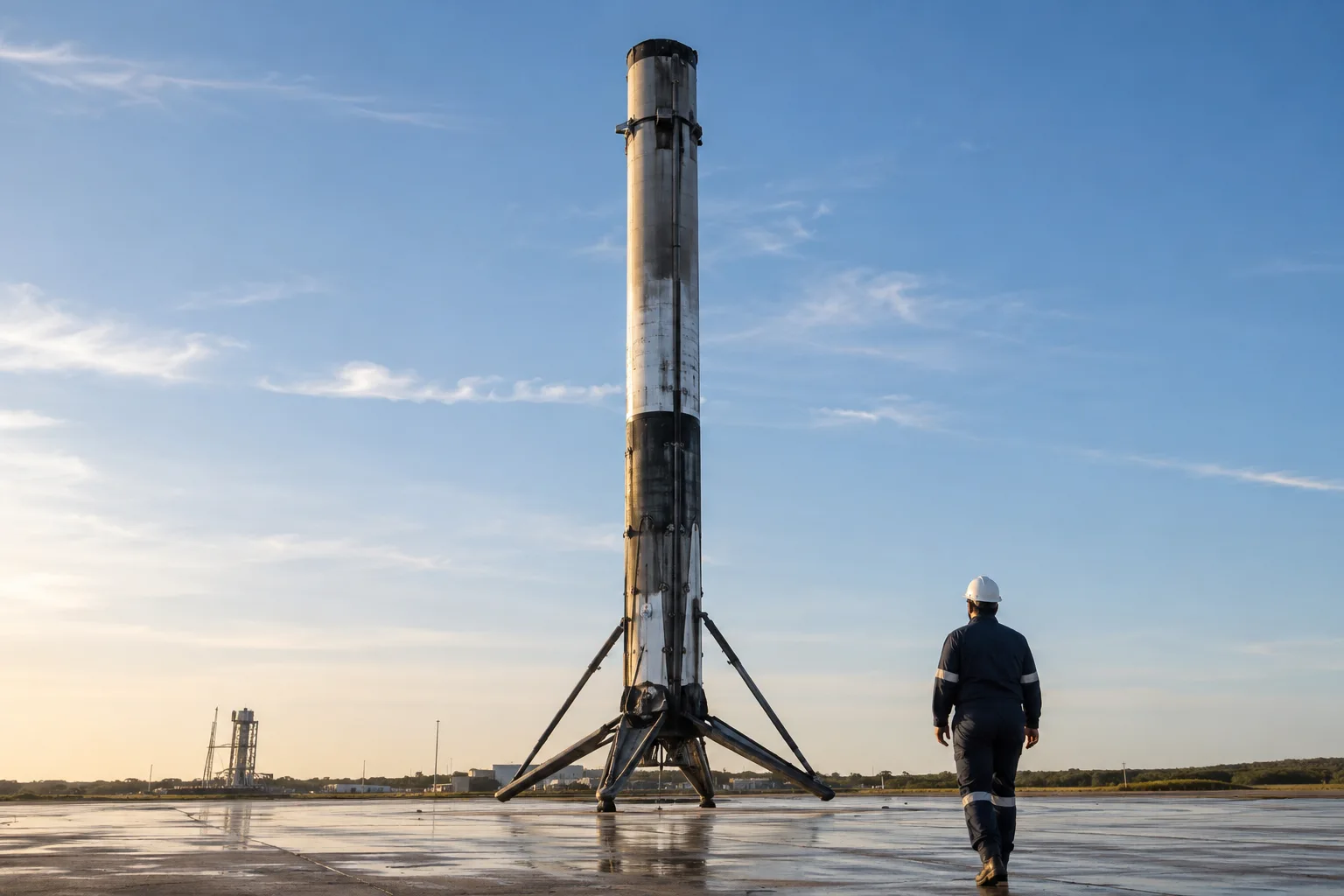
A reusable launch vehicle is a rocket, or part of one, designed to fly again instead of being used once and discarded. The usual target is the first stage, the large lower section that does most of the work of climbing away from the ground and is one of the most expensive parts to build.
Reuse only saves money if the work of recovering, inspecting and refurbishing the hardware costs less than building a new one. Earlier studies and NASA's Space Shuttle programme both suggested that the saving depends on how many flights each vehicle makes, because a large share of running costs is fixed.
Technical explanation
Launch costs depend on how much hardware is lost on each flight and how much fixed operations capacity must be kept ready. In its 1993 review, the General Accounting Office (GAO) reported that NASA's average cost per Space Shuttle flight was $413.5 million in fiscal 1993. That figure omits about $30.2 billion spent through fiscal 1992 to develop the Shuttle. NASA estimated that dropping a single flight would save $44.4 million, because fixed costs made up about 90 per cent of the operations cost of a flight.
Earlier design work framed the economics in similar terms. R. W. Scarborough's 1964 SAE paper on recovering and reusing a two-stage launch vehicle found that first-stage recovery and reuse was profitable for programmes requiring 15 or more launches, and that average recovery and refurbishment cost approximately 20 per cent of the cost of a new vehicle. The abstract gives no further conditions for the 20 per cent figure, so it should be read as a design-era estimate.
A 2025 paper by Etzenbach, Hussein and de Weck, presented at the IAF Space Propulsion Symposium in Sydney, addresses the technical challenges and performance trade-offs of reusable liquid propellant rocket engines. The proceedings listing does not include the abstract, so no cost figures from that paper are used here.
What the evidence says
Each statement is typed by the strength of its evidence and linked to the source that supports it.
Demonstrated Shown in a published experiment, test or shipping product.
GAO reported that NASA's average cost per Space Shuttle flight was $413.5 million in fiscal 1993, excluding about $30.2 billion of development spending through fiscal 1992.
Sources: [2]GAO reported that NASA estimated the marginal saving from dropping one Shuttle flight at $44.4 million, because fixed costs made up about 90 per cent of the operations cost of a flight.
Sources: [2]Reported, unverified Stated by a company or team but not independently confirmed.
Scarborough's 1964 study put the average cost of recovery and refurbishment at approximately 20 per cent of the cost of a new vehicle.
Sources: [1] · Abstract · low confidenceProposed A design or plan that has not yet been built or tested.
Scarborough's 1964 design study found that first-stage recovery and reuse was profitable for programmes requiring 15 or more launches.
Sources: [1] · Abstract · medium confidenceLimitations and open problems
- Most cost figures come from design studies, agency estimates or abstracts, so they do not share one accounting basis and cannot be compared directly.
- The Shuttle figure of $413.5 million excludes development costs, so per-flight and whole-programme costs answer different questions (GAO, 1993).
- Scarborough's 1964 break-even point of 15 or more launches is a design-study result and depends on assumptions the abstract does not state.
- Reuse adds engineering trade-offs for engines, which the 2025 paper identifies as technical challenges and performance trade-offs (Etzenbach and colleagues, 2025).
Possible future uses
Ideas, not predictions. None of these has been demonstrated.
- Reusable upper stages that move cargo between orbits, reducing the cost of in-space logistics.
- Reusable landers that make repeated cargo trips to the Moon or Mars.
- Rapid-turnaround vehicles that could make frequent crewed flights economical if refurbishment times fall.
Timeline
- 1964R. W. Scarborough's SAE paper 'Recovery and Reuse of a Two Stage Launch Vehicle' sets out the reuse break-even analysis. Sources: [1]
- 28 Jan 1993GAO report NSIAD-93-115 reviews how NASA builds its Space Shuttle cost estimates, including the per-flight cost of $413.5 million for fiscal 1993. Sources: [2]
- Sept 2025Etzenbach, Hussein and de Weck present a paper on reusable liquid propellant rocket engines at the IAF Space Propulsion Symposium in Sydney. Sources: [3]
Futures this could help bring about
A permanent base on the Moon
Engineering prototypes · 2 of 6 steps done
A self-sustaining settlement on Mars
Science unproven · 3 of 9 steps done
A space elevator
Science unproven · 2 of 9 steps done
Humans back on the Moon
Engineering prototypes · 1 of 7 steps done
Humans landing on Mars
Engineering prototypes · 2 of 7 steps done
Hypersonic passenger flights
Science demonstrated · 4 of 7 steps done
Space holidays for ordinary people
Pilots · 2 of 6 steps done
Terraforming Mars
Science unproven · 4 of 13 steps done
Related breakthroughs
Glossary
- First stage
- The lowest and largest section of a multi-stage rocket, which provides the thrust needed to leave the ground.
- Refurbishment
- The inspection, repair and preparation needed to fly a recovered vehicle or stage again.
- Marginal cost
- The cost saved, or added, by making one more flight, excluding costs that stay the same whatever the flight rate.
Sources
- conference paper
Recovery and Reuse of a Two Stage Launch Vehicle
R. W. Scarborough. SAE International, 1964. Accessed 21 Oct 2026. - government report
Space Transportation: The Content and Uses of Shuttle Cost Estimates (GAO/NSIAD-93-115)
U.S. General Accounting Office (copy hosted by Justia), 28 Jan 1993. Accessed 21 Oct 2026. - conference paper
Designing for Reuse: Technical Challenges and Performance Trade-Offs for Reusable Liquid Propellant Rocket Engines
Lilly Etzenbach, Mennatallah Hussein, Olivier de Weck. International Astronautical Federation (IAF) proceedings, Sept 2025. DOI: 10.52202/083090-0003. Accessed 21 Oct 2026.
What it took to get here
The inventions this technology was built on, oldest foundations at the top. Lines show what each one required.
- 1964Reusable launch vehiclesPilot and early commercialRequires: In-space manufacturing. Unlocked.