Asteroid sample return missions
Also known as Asteroid sample return, Small-body sample return, Hayabusa2 and OSIRIS-REx sample return
An asteroid sample return mission collects material from an asteroid in space and brings it back to Earth for laboratory study. Hayabusa2 and NASA's OSIRIS-REx have both done this, and peer-reviewed analyses of the returned material are now being published.
In plain language
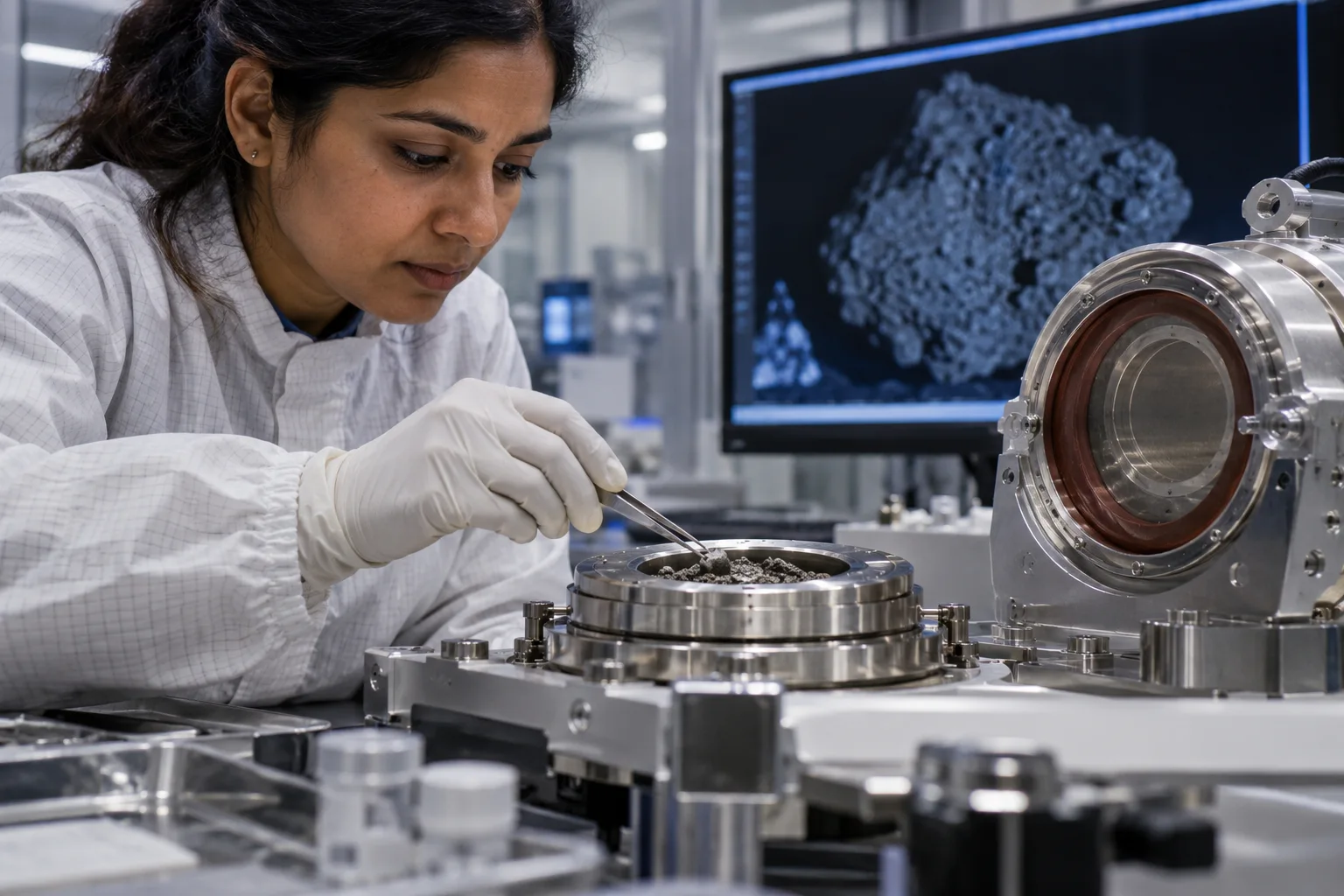
An asteroid sample return mission is a spacecraft that visits a small rock in space, collects some of its surface material, and carries it back to Earth in a sealed capsule. Scientists can then study the material in laboratories, using instruments that are too large or too delicate to fly on a spacecraft.
Meteorites that land on Earth are altered during their fall and through weathering, and their exact origin is often uncertain. Returned samples have a known source and a recorded collection site. Peer-reviewed papers in Science in February 2023 describe samples from the asteroid Ryugu, gathered during Japan's Hayabusa2 mission, and NASA's OSIRIS-REx capsule landed in Utah on 24 September 2023 with material from the asteroid Bennu.
Technical explanation
Each mission has to reach the surface of a small body, collect loose material, seal it in a container, and return it through the atmosphere in a capsule. Contamination control, from the spacecraft to the capsule and into the curation laboratory, is a key design concern. Sample quantities are small and finite, so each analysis has to be planned with care.
Nakamura and colleagues (2023) analysed 17 samples from Ryugu. They report water inclusions containing carbon dioxide inside a pyrrhotite crystal, few high-temperature materials such as chondrules, and a high content of phyllosilicates and carbonates. These features point to low-temperature alteration in water. Their simulations suggest the parent body formed about 2 million years after the Solar System began, a model-based estimate rather than a direct measurement. Yokoyama and colleagues (2023) report that the Ryugu samples resemble CI (Ivuna-type) carbonaceous chondrite meteorites, and that the primary minerals were altered in fluids at 37 ± 10 °C, about 5.2 million years after the first Solar System solids formed.
NASA estimated the OSIRIS-REx sample at about 250 grams. Lauretta and colleagues (2024) describe about 120 grams of pristine carbonaceous regolith returned from Bennu and report its early bulk physical, chemical and mineralogical properties. The two mass figures are not reconciled in the sources reviewed here, so inventories should be checked against curation records.
What the evidence says
Each statement is typed by the strength of its evidence and linked to the source that supports it.
Demonstrated Shown in a published experiment, test or shipping product.
Analysis of 17 Ryugu samples returned during the Hayabusa2 mission found water inclusions containing carbon dioxide within a pyrrhotite crystal.
Sources: [1] · AbstractSamples returned from the asteroid Ryugu are similar to CI (Ivuna-type) carbonaceous chondrite meteorites.
Sources: [2] · Title and abstractThe primary minerals in the Ryugu samples were altered in fluids at 37 ± 10 °C, about 5.2 million years after the first Solar System solids formed.
Sources: [2] · Abstract · medium confidenceNASA's OSIRIS-REx sample capsule landed in Utah on 24 September 2023, and NASA estimated the sample at about 250 grams.
Sources: [3] · Press release, headline and opening sectionsLauretta and colleagues (2024) describe about 120 grams of pristine carbonaceous regolith returned from asteroid Bennu and report its early bulk physical, chemical and mineralogical properties.
Sources: [4] · Abstract · medium confidenceReported, unverified Stated by a company or team but not independently confirmed.
Simulations based on the Ryugu samples suggest that the parent asteroid formed about 2 million years after the Solar System began.
Sources: [1] · Abstract · medium confidenceLimitations and open problems
- Returned samples are small and cannot be replaced. The Ryugu study analysed 17 samples (Nakamura and colleagues, 2023), so destructive analysis has to be planned with care.
- Each mission is a large, multi-year programme. The sources reviewed here do not give verified cost figures.
- A sample represents the site it came from. Results from one asteroid cannot be assumed to apply to others, which is why multiple missions matter.
- Early reports of the OSIRIS-REx sample mass differ (about 250 grams from NASA, about 120 grams of regolith from Lauretta and colleagues, 2024), so official mass records need checking.
- Landing or touching down on a small body carries risks of failed sampling or contamination. The sources reviewed here do not quantify how often these occur.
Possible future uses
Ideas, not predictions. None of these has been demonstrated.
- Sample return from water-bearing asteroids as a test of in-space resource assessment before any commercial mining is attempted.
- Repeated sample return from several asteroids in one mission chain, to compare early Solar System materials across different bodies.
- Sample return used to test planetary defence or deflection models against measured asteroid surface properties.
Timeline
- 24 Feb 2023Science publishes peer-reviewed analyses of Ryugu samples, including a report that they resemble CI (Ivuna-type) carbonaceous chondrites. Sources: [1], [2]
- 24 Sept 2023NASA's OSIRIS-REx sample capsule lands in Utah, and the sample is moved to a clean room for curation. Sources: [3]
- 26 Jun 2024Meteoritics & Planetary Science publishes early bulk analysis of the Bennu sample that OSIRIS-REx collected. Sources: [4]
Futures this could help bring about
Related breakthroughs
Glossary
- Carbonaceous chondrite
- A type of primitive meteorite that contains carbon and water-bearing minerals, thought to preserve material from the early Solar System.
- Regolith
- Loose, broken surface material that covers an airless body such as an asteroid.
- Curation
- The handling, recording and safe storage of returned samples so that later researchers can study them.
- Pyrrhotite
- An iron sulfide mineral that can contain tiny pockets of water and gas in some meteorites.
Sources
- peer reviewed paper
Formation and evolution of carbonaceous asteroid Ryugu: Direct evidence from returned samples
T. Nakamura, M. Matsumoto, K. Amano et al.. Science, 24 Feb 2023. DOI: 10.1126/science.abn8671. Accessed 21 Oct 2026. - peer reviewed paper
Samples returned from the asteroid Ryugu are similar to Ivuna-type carbonaceous meteorites
Tetsuya Yokoyama, Kazuhide Nagashima, Izumi Nakai et al.. Science, 24 Feb 2023. DOI: 10.1126/science.abn7850. Accessed 21 Oct 2026. - government report
NASA's First Asteroid Sample Has Landed, Now Secure in Clean Room
NASA, 24 Sept 2023. Accessed 21 Oct 2026. - peer reviewed paper
Asteroid (101955) Bennu in the laboratory: Properties of the sample collected by OSIRIS-REx
Dante S. Lauretta, OSIRIS-REx Sample Analysis Team. Meteoritics & Planetary Science, 26 Jun 2024. DOI: 10.1111/maps.14227. Accessed 21 Oct 2026.
Revision history
3 changes since this profile was created.