Space and aerospace
Launch, spacecraft, satellites and aviation.
Technology profiles

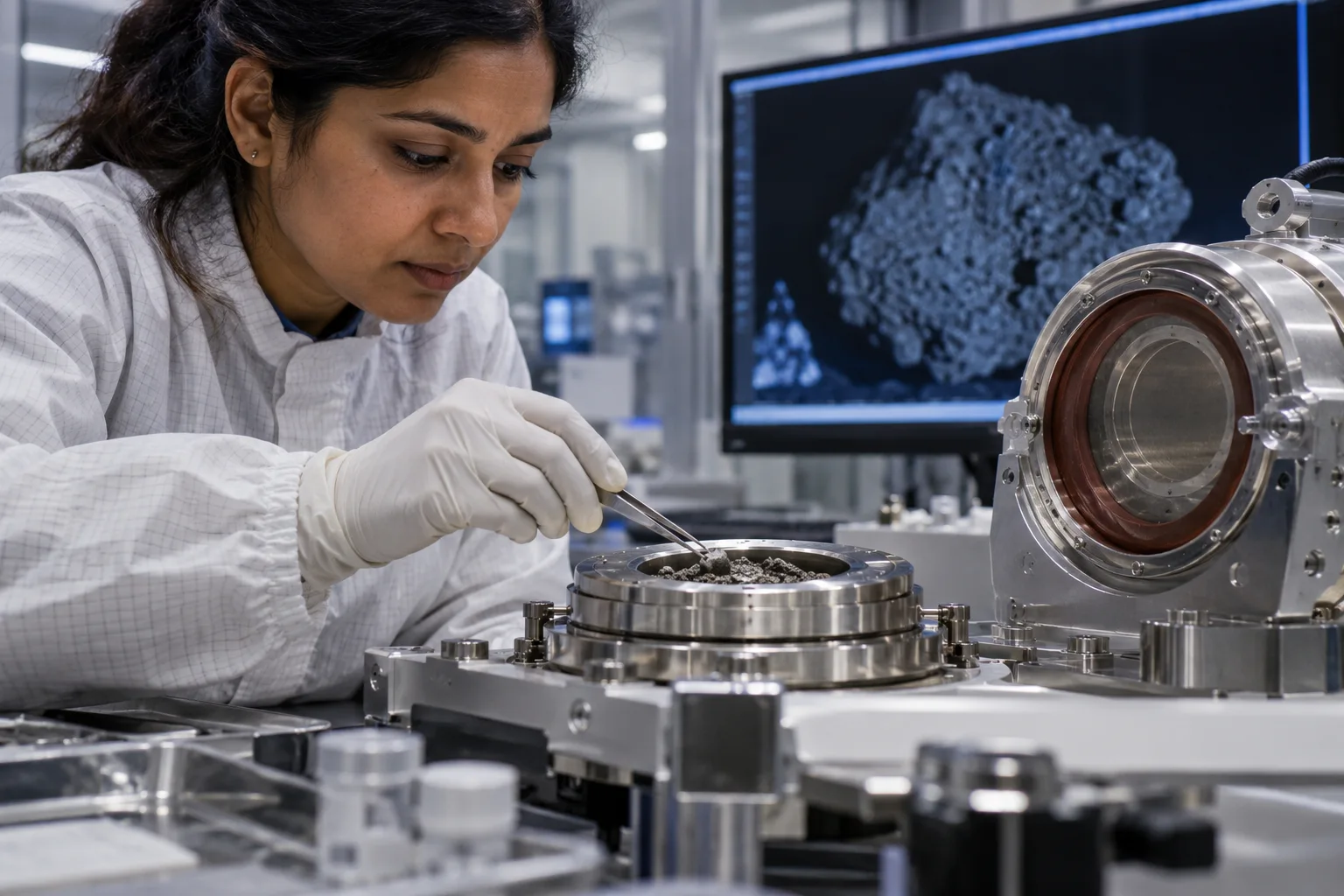
Asteroid mining
Asteroid mining would take water, metals or other useful material from small bodies in space and deliver it to a customer. No asteroid extraction, processing or delivery has yet been demonstrated, although missions have collected and returned small samples.
Asteroid sample return missions
An asteroid sample return mission collects material from an asteroid in space and brings it back to Earth for laboratory study. Hayabusa2 and NASA's OSIRIS-REx have both done this, and peer-reviewed analyses of the returned material are now being published.
Commercial lunar landers
Privately built robotic landers now carry science and technology payloads to the Moon, mainly under NASA's Commercial Lunar Payload Services (CLPS) programme. Of the four named landing attempts reviewed here, one landed and operated for about one lunar day, two landed but tipped onto their sides, and one never landed.
Commercial space stations
Privately built stations in low Earth orbit are planned to take over from the International Space Station, which NASA plans to retire around 2030. No commercial station has launched yet, and the NASA procurement that would fund follow-on work had not awarded contracts when these sources were checked.
Direct-to-phone satellite messaging
Some phones can now send texts and emergency messages straight to satellites when no mobile tower is in range. Emergency texting on iPhone has been in use since 2022, while broadband-style data to ordinary phones is still at an early stage and rests largely on company-reported figures.
Electric space propulsion
Electric space propulsion uses electrical power, usually from solar arrays, to accelerate a gas such as xenon out of a spacecraft. It uses far less propellant than chemical rockets for the same change in speed, but its thrust is very small, so it works over months or years.
Electric vertical take-off and landing aircraft
Electric vertical take-off and landing (eVTOL) aircraft use batteries and electric motors to lift off and land vertically, with short urban air taxi trips as the main goal. Developers are in late-stage testing toward regulatory certification, but the sources reviewed here do not confirm a type certificate, and battery energy and power remain the main technical limits.
In-space manufacturing
In-space manufacturing means making, repairing or recycling parts and materials in orbit rather than launching everything from Earth. Early results include optical fibre drawn on the International Space Station, a small semiconductor crystal grown on the China Space Station, and a pharmaceutical crystal form made on a commercial capsule. Most results are reported by the organisations that ran the experiments, only some have been published in peer-reviewed journals, and none has yet been shown to work as a repeatable production process.
In-space servicing and assembly
In-space servicing and assembly means building, repairing or upgrading spacecraft in orbit rather than on the ground. Assembly from launched modules is established through the International Space Station, while robotic servicing is only beginning to fly and robotic construction from raw material remains at test or proposal stage.
Laser communication links
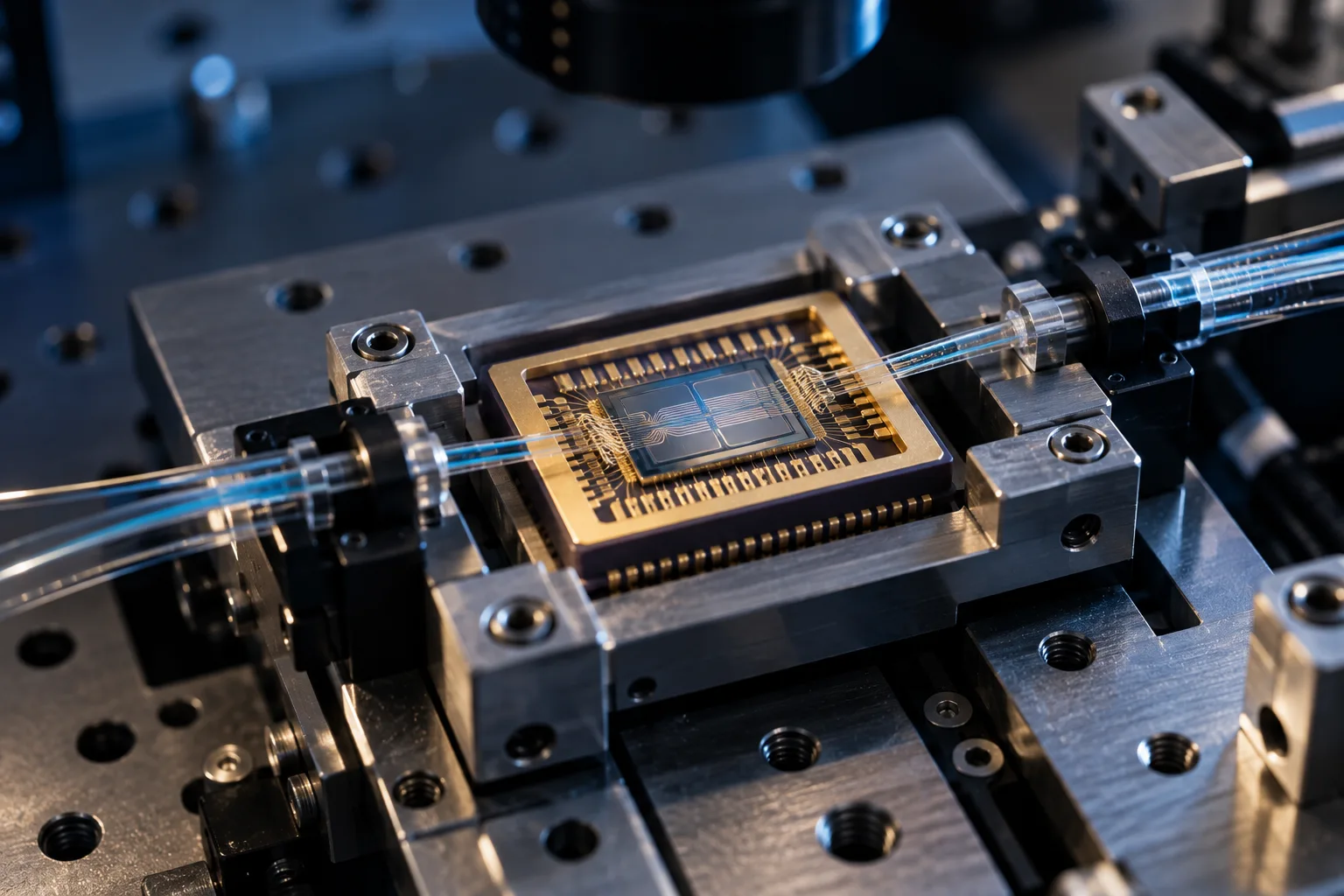
Laser communication links send data as modulated infrared light between spacecraft, aircraft and ground stations, instead of radio waves. NASA has shown 200 Gbps from a small satellite to the ground and 267 Mbps from deep space, but clouds and very precise pointing remain the main practical limits.
Lunar resource extraction
Lunar resource extraction means producing oxygen, water and metals from lunar regolith and ice, so that missions need to launch less material from Earth. Oxygen has been made from simulated lunar soil in Earth tests, and water has been detected remotely near the Moon's south pole, but no lunar extraction has yet been shown on the Moon.
Making oxygen and fuel on Mars
NASA's MOXIE instrument on the Perseverance rover made oxygen from the Martian atmosphere over 16 runs, reaching 12 grams per hour at its most efficient. Making methane fuel and extracting water on Mars, and scaling oxygen production for crewed missions, remain at model, proposal or concept stage.
Nuclear space propulsion and power
Nuclear energy already supplies electricity on some spacecraft through radioisotope generators, and one fission reactor flew in Earth orbit in 1965. Nuclear thermal and nuclear electric propulsion have been tested on the ground or planned, but have not yet flown, and NASA's planned SR-1 Freedom mission targets a launch in late 2028.
Orbital data centres
Orbital data centres are proposed computers in orbit, powered by sunlight and cooled by radiators that face deep space. A few small flight demonstrations have been reported, but no independently verified commercial orbital data centre has yet shown sustained service or a competitive cost.
Planetary defence
Planetary defence means finding asteroids that could hit Earth early enough to act, then changing their path. NASA's DART mission showed in 2022 that a spacecraft impact can measurably change the orbit of a small asteroid moon, but no system is in place yet to find and deflect a dangerous object on demand.
Reusable launch vehicles
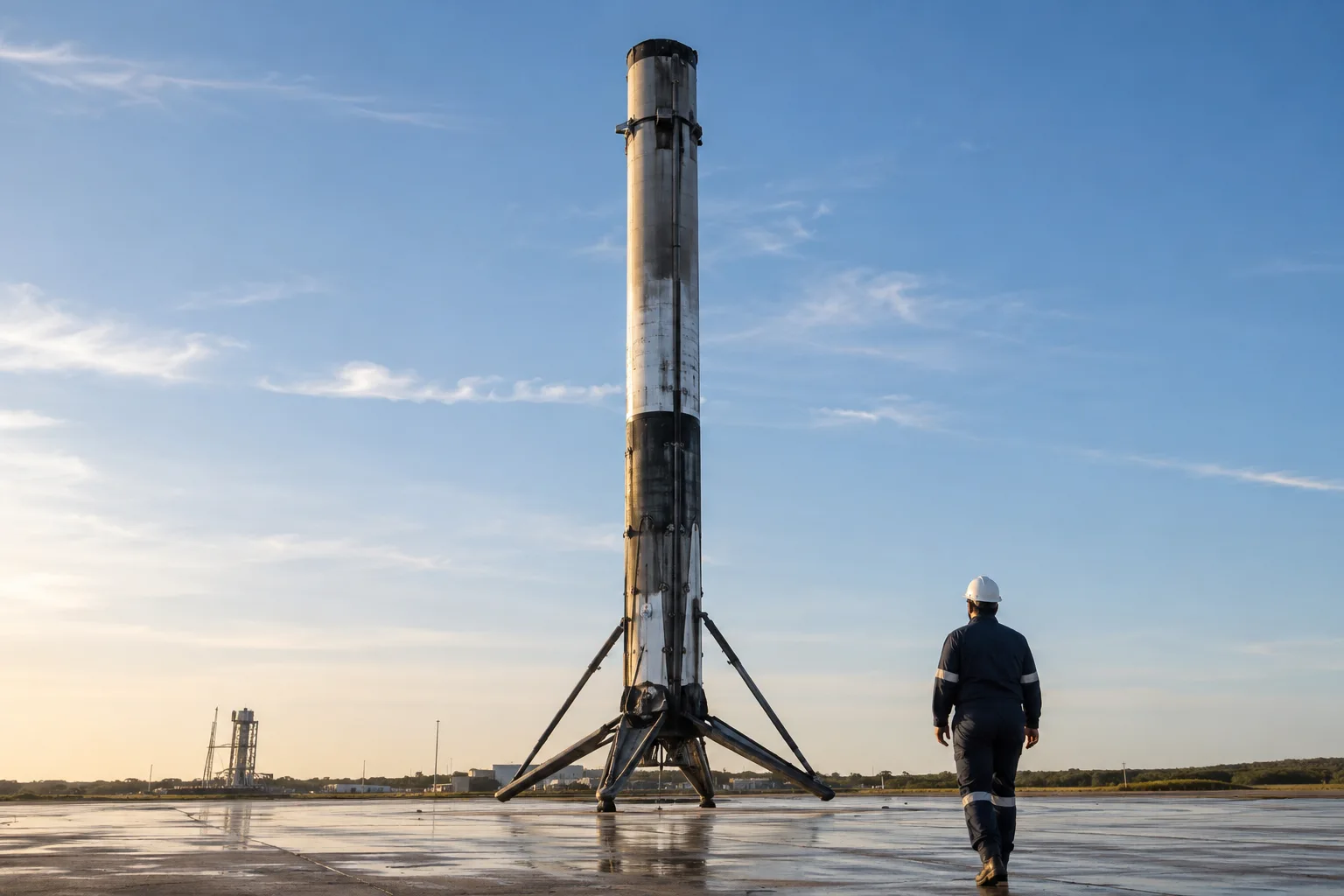
Reusable launch vehicles are rockets, or rocket stages, designed to fly more than once so that hardware is not thrown away after each launch. Whether reuse saves money depends on refurbishment costs and how often each vehicle flies, and most published cost figures come from design studies or agency estimates rather than audited accounts.
Satellite broadband constellations
Large groups of satellites in low Earth orbit now provide home and business internet, with SpaceX's Starlink the best-documented service. Regulators have approved far more satellites than are in orbit, and astronomers and debris specialists warn about sky brightness and orbital crowding.
Satellite methane detection
Satellites can spot methane plumes from large leaks at oil, gas, coal and landfill sites. Detection limits depend on instrument design, wind and surface conditions, and the sources reviewed here do not show how often detections lead to repairs.
Satellite navigation (GNSS)
Satellite navigation uses timing signals from a constellation of satellites to work out position, velocity and time almost anywhere on Earth, and it is now built into cars, phones and timing equipment. It is a mature commercial service, but its signals are weak at the ground and can be jammed or spoofed.
Solar sails
Solar sails are large, very thin reflective membranes that change a spacecraft's speed or orbit using the small, steady push of sunlight rather than fuel. Japan's IKAROS (2010) and NASA's LightSail 2 (2019) showed the method works in space, but the push is very small and the sail must unfold and survive in orbit.
Space biomanufacturing
Space biomanufacturing uses microbes in sealed reactors to turn prepared feedstocks into useful materials, such as bioplastic, for future missions. A 2026 preprint reports laboratory production of bioplastic from simulated Mars-like inputs, but this has not been shown on Mars and the work has not been peer reviewed.
Space debris removal
Space debris removal uses spacecraft to catch dead satellites and spent rocket stages and bring them down. Companies have demonstrated approach and magnetic capture in orbit, and ESA and Japan have funded removal missions, but no removal of a derelict object has been reported yet.
Space weather forecasting
Space weather forecasting predicts solar storms, such as coronal mass ejections and flares, so that satellite, power grid and navigation operators can take protective action. Forecasts are run by agencies such as NOAA's Space Weather Prediction Center and the UK Met Office, and they are only partly reliable on arrival timing.
Space-based solar power
Space-based solar power would collect sunlight with large structures in orbit and beam the energy to Earth as microwaves or laser light. A small in-orbit wireless power test has been demonstrated, but no complete orbital power system has yet delivered electricity to a grid.
How far away are we?
A permanent base on the Moon
Engineering prototypes · 2 of 6 steps done
A probe to another star
Science demonstrated · 1 of 8 steps done
A self-sustaining settlement on Mars
Science unproven · 3 of 9 steps done
A space elevator
Science unproven · 2 of 9 steps done
Bringing asteroid rock back to Earth
Science demonstrated · 3 of 5 steps done
Clearing dead satellites and space junk from orbit
Engineering prototypes · 2 of 5 steps done
Data centres in orbit
Engineering prototypes · 2 of 7 steps done
Deflecting an asteroid headed for Earth
Engineering prototypes · 4 of 9 steps done

Flying taxis in cities
Pilots · 3 of 7 steps done
Humans back on the Moon
Engineering prototypes · 1 of 7 steps done
Humans landing on Mars
Engineering prototypes · 2 of 7 steps done
Hypersonic passenger flights
Science demonstrated · 4 of 7 steps done
Laser internet between space and the ground
Pilots · 5 of 7 steps done
Life after the International Space Station
Engineering prototypes · 3 of 12 steps done
Living in a spinning space habitat
Science demonstrated · 2 of 7 steps done
Making things in orbit that can't be made on Earth
Engineering prototypes · 3 of 6 steps done
Mining water and oxygen on the Moon
Engineering prototypes · 3 of 7 steps done
Ordinary phones connected by satellite everywhere
Pilots · 4 of 9 steps done
Space holidays for ordinary people
Pilots · 2 of 6 steps done
Supersonic passenger flights returning
Engineering prototypes · 2 of 8 steps done
Terraforming Mars
Science unproven · 4 of 13 steps done
Time travel
Science demonstrated · 4 of 8 steps done
Travelling faster than light
Science unproven · 4 of 6 steps done
Breakthroughs
Starfish Space software brings an Impulse Mira to about 1.25 km of a second Mira in orbit
In a demonstration called Remora, Starfish Space's autonomous rendezvous and proximity operations software controlled an Impulse Space Mira spacecraft in low Earth orbit. Starfish and Impulse announced the demonstration on 15 December 2025, and the release says the operations were not announced before they took place. The Mira came within about 1,250 metres of a second Mira, the LEO Express 1 spacecraft. The release says a single visual-range camera was the only sensor, and that the guidance, navigation and control software ran on a peripheral flight computer.
Asteroid Bennu samples contain ribose and glucose, but no deoxyribose was detected
Analysis of samples of asteroid (101955) Bennu returned by NASA's OSIRIS-REx mission detected molecular signatures matching ribose, a five-carbon sugar, and glucose, a six-carbon sugar. Glucose was reported for the first time in an extraterrestrial sample. Deoxyribose was not found. The announcement gives no abundance figures for the sugars.
Polymer and water lenses shaped by surface tension on ISS, preprint reports
A preprint (arXiv:2510.06474, posted 7 October 2025) reports two Fluidic Shaping experiments on the International Space Station during the Ax-1 mission. Fluidic Shaping uses surface tension in microgravity to form optical components from liquid. In the first, centimetre-scale polymer lenses were formed and cured with UV light; the abstract reports sub-nanometric surface smoothness. In the second, a 172 mm diameter water lens was deployed, and image tests showed basic optical function. The abstract also reports that some polymer lenses showed unexpected thermo-chemical deformation.
Sulfides in Bennu samples point to low-temperature water alteration near 25 °C
Mineral analysis of samples from asteroid (101955) Bennu, returned by NASA's OSIRIS-REx mission, used X-ray diffraction and electron microscopy. The authors report that sulfide compositions indicate alteration at about 25 °C, similar to conditions inferred for asteroid Ryugu and Ivuna-type (CI) chondrites. They also say the altering fluid probably evolved from neutral to alkaline over time, ending with highly soluble salts.
Radio-frequency ion micropropulsion flight-tested on the Taiji-1 satellite
In-orbit tests of the radio-frequency ion micropropulsion system on Taiji-1, a satellite launched in August 2019, showed that all four thrusters passed their key performance tests. The paper reports a thrust range of about 5 to 52 μN, a thrust response time of about 20 ms, and a thrust noise of about 0.4 μN/√Hz at 50 μN thrust. The authors say the in-orbit characterisation has reached the expectations of the Taiji-1 mission.
A quantum microsatellite distributes real-time keys to portable ground stations, linking Beijing and Stellenbosch
Li, Cai, Ren, Pan, Peng, Liao and colleagues at the University of Science and Technology of China report a quantum microsatellite performing space-to-ground QKD in real time with several portable ground stations. Bidirectional optical communication is multiplexed with the quantum channel, so keys can be distilled and used for encrypted communication in real time. The satellite acted as a trusted relay for key sharing between Beijing and Stellenbosch, South Africa, about 12,900 km apart. The 2024 preprint gives a payload of about 23 kg and a portable ground station of about 100 kg. The CAS press release reports up to 1 Mbit of secure key per satellite pass.
OSIRIS-REx samples from asteroid Bennu contain salts from an evaporated ancient brine
Analysis of samples of asteroid (101955) Bennu returned by NASA's OSIRIS-REx mission found sodium-bearing phosphates and sodium-rich carbonates, sulfates, chlorides and fluorides, interpreted as forming during evaporation of a late-stage brine early in the history of Bennu's parent body.
ADRAS-J approaches a rocket upper stage to 15 metres, then aborts on attitude anomaly
Between May and November 2024, the ADRAS-J inspection spacecraft approached a spent rocket upper stage, which Astroscale describes as space debris. Astroscale reports that the spacecraft first came within about 50 metres of the stage on 23 May 2024 and came within about 50 metres again on 14 July 2024. It completed three controlled fly-around operations. Astroscale reports that on 30 November 2024 the spacecraft reached about 15 metres from the stage, which it describes as the closest approach ever achieved by a commercial company to space debris using rendezvous and proximity operations. Two fly-around operations confirmed no major damage to the payload attach fitting. After the approach to about 15 metres, the onboard collision avoidance system triggered an autonomous abort because of an unexpected relative attitude anomaly. The spacecraft moved away from the stage as designed and did not reach the capture initiation point. Astroscale Japan was still investigating the cause at the time of the announcement.
SpaceX catches a Super Heavy booster with launch tower arms on its first attempt
On Starship Flight 5, launched from Starbase near Boca Chica, Texas, on 13 October 2024, a Super Heavy booster was caught by the chopstick arms of the launch tower about seven minutes after liftoff. A SpaceX manager is quoted as saying this was the first attempt at the catch. The booster was not flown again as part of this record.
NASA's deep-space laser test reached 267 Mbps, falling as distance grew
NASA's Deep Space Optical Communications (DSOC) experiment, flown on the Psyche spacecraft, reached a system maximum of 267 Mbps when the spacecraft was about 33 million miles (53 million km) from Earth. On 24 June 2024, at about 240 million miles (390 million km), the link sustained 6.25 Mbps with a peak of 8.3 Mbps. The uplink used a 7 kW laser at JPL's Table Mountain facility, and the downlink was received by Caltech's 200-inch Hale Telescope at Palomar Observatory.
NASA reports its ACS3 solar sail deployed in orbit in August 2024
NASA reported on 29 August 2024 that the Advanced Composite Solar Sail System (ACS3), launched on 23 April 2024, was fully deployed in space after a successful test of its sail-hoisting boom system. NASA gives the unfurled sail as approximately 80 square metres (860 square feet), about 9 metres (30 feet) on a side. The NASA mission page describes two booms, each about 7 metres (23 feet) long, made from flexible polymer and carbon fibre materials. NASA says the primary objective is to deploy a new type of boom. A NASA update dated 5 September 2024 said the spacecraft was slowly tumbling, as expected, because its attitude control system was off, and that the team would re-engage that system after characterising the booms and sail.
One tracked satellite's decay rate rose more than fourfold in the May 2024 storm
Parker and Linares used the orbital decay of tracked satellites, from public two-line element (TLE) orbit data, to estimate changes in the thermosphere during the geomagnetic storm of 10 to 12 May 2024. For one tracked object (SATCAT 43180), decay was about 38 metres a day before the storm and rose more than fourfold, to about 180 metres a day, during it. The NRLMSISE-00 model gave total mass density at 400 km altitude of up to six times its baseline value 12 hours earlier. The authors report that forecasts of the geomagnetic index ap underpredicted the initial rise, and that the storm's magnitude and duration were poorly predicted even one day ahead. NOAA's Space Weather Prediction Center reported that G5 conditions were first observed at 6:54 pm EDT on 10 May 2024.
MOXIE made 122 grams of oxygen from Martian air over 16 runs
Across 16 runs aboard NASA's Perseverance rover, the MOXIE instrument produced a total of 122 grams of oxygen by separating oxygen from carbon dioxide pumped in from the thin Martian atmosphere. Its best hourly rate was 12 grams of oxygen, at 98% purity or better. NASA says MOXIE was operated under a variety of conditions across a full Mars year, but the announcement does not list those conditions for each run. The final run, on 7 August, produced 9.8 grams.
Dimorphos orbital period shortened by 33 minutes after DART impact
Earth-based lightcurve and radar observations measured the orbital period of Dimorphos around Didymos changing by -33.0 ± 1.0 minutes (3σ) after NASA's DART spacecraft struck it. Two independent methods gave identical values. A simple momentum-transfer estimate from the spacecraft alone predicted a change of about 7 minutes, so the authors infer that ejecta carried substantial additional momentum.