Laser communication links
Also known as Free-space optical communication, FSOC, Optical communications, Laser communications
Laser communication links send data as modulated infrared light between spacecraft, aircraft and ground stations, instead of radio waves. NASA has shown 200 Gbps from a small satellite to the ground and 267 Mbps from deep space, but clouds and very precise pointing remain the main practical limits.
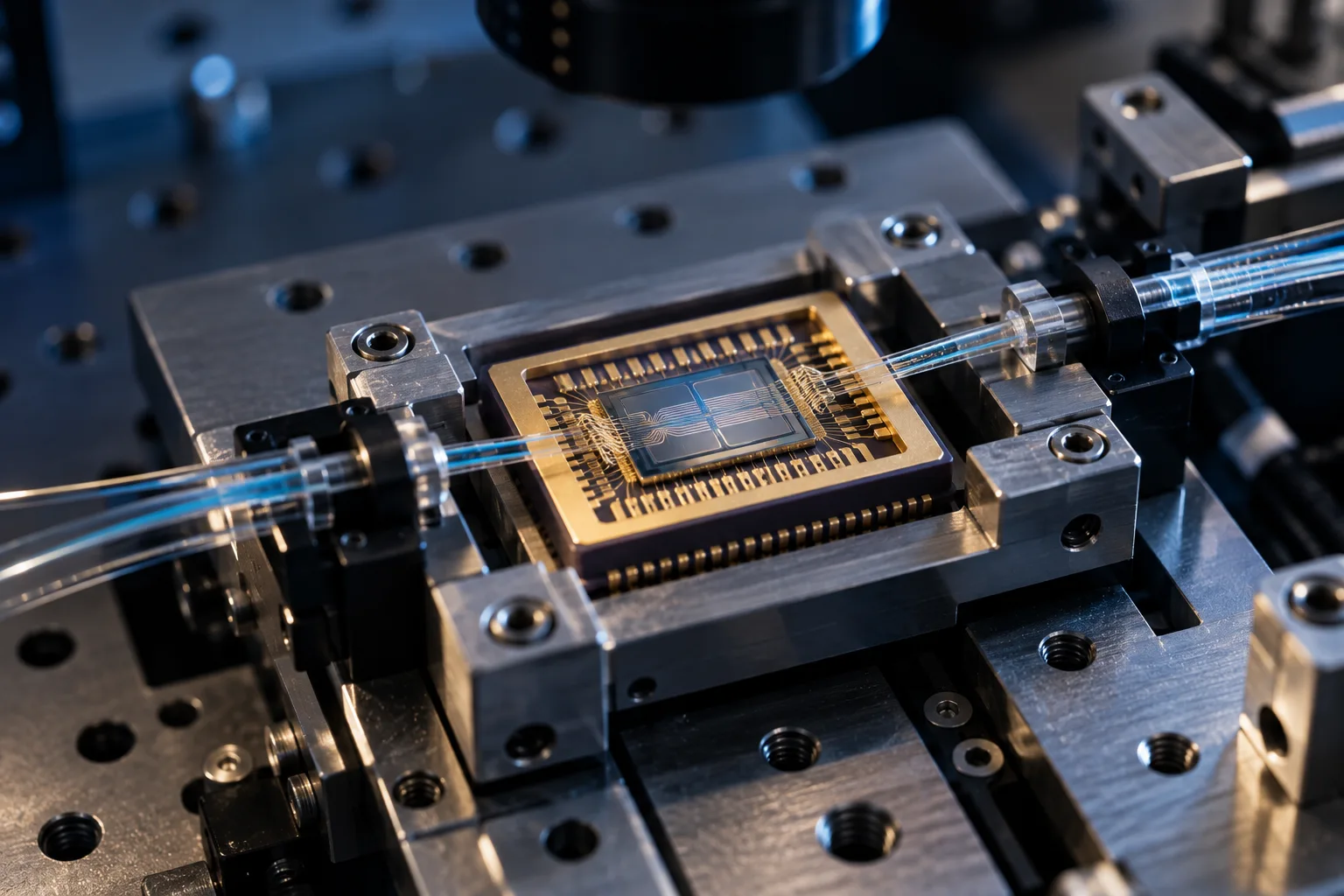
In plain language
A laser link works a bit like a very narrow, very fast torch beam. The transmitter switches an infrared laser on and off, or changes its brightness, to write digital bits onto the light. A telescope or receiver at the other end picks up the faint signal. Because the beam is so narrow, both ends have to point at each other very precisely.
Light has a much higher frequency than radio waves, so it can carry far more data. That is why space agencies and companies are testing laser links for sending large science datasets to Earth and for linking satellites in orbit. Clouds and mist are the main weak point, because they can block or weaken the beam. Practical systems therefore use several ground stations and switch between them when the sky is cloudy.
Technical explanation
The systems described here use infrared light. The SDA Optical Communications Terminal Standard version 4.0.0 (dated 28 June 2024) specifies on-off keying with non-return-to-zero or Manchester encoding. Its Table 3-2 lists baud rates from 156.25 Mbps to 2,500 Mbps. Baud rates are signalling rates, and the standard's effective data rate tables show payload rates well below the baud rate once coding and framing overhead are included. Receivers differ by mission. For NASA's Deep Space Optical Communications (DSOC) experiment, the downlink station was the 200-inch Hale Telescope at Caltech's Palomar Observatory, and the uplink station at JPL's Table Mountain facility was capable of transmitting 7 kilowatts of laser power to the spacecraft. NASA notes that space-based laser beams spread out as they travel, and that photon-counting receivers are being developed to detect single photons.
Data rate falls as distance grows. JPL's project technologist said that a key goal was to prove that the data-rate reduction was proportional to the inverse square of distance, and that the mission met that goal. DSOC reached its system maximum of 267 Mbps when Psyche was about 33 million miles away, and it sustained 6.25 Mbps (peak 8.3 Mbps) at about 240 million miles. NASA's LCRD relay in geosynchronous orbit lists an optical relay rate of 1.244 Gbps, and the TBIRD CubeSat in low Earth orbit reported 200 Gbps direct-to-Earth downlinks. JPL says laser links can transport data at rates up to 100 times higher than radio frequencies. A trade publication reported in February 2024, from a SpaceX presentation, that Starlink lasers reach a maximum of 200 Gb/s per link. That figure is secondhand and describes a peak.
Weather and pointing set the practical limits. The SDA standard treats atmospheric turbulence as causing scintillation and time-varying phase on the signal. It defines fadeout times, in which atmospheric effects reduce the signal-to-noise ratio below the required threshold, and it states that weather primarily results in reduction of throughput. NASA's main mitigations are site choice and redundancy. LCRD's two ground stations were chosen for high altitude and minimal cloud coverage, and NASA says the value of additional ground stations is redundancy, so that traffic can be redirected when one station is cloudy. NASA also says it is investigating approaches such as Delay/Disruption Tolerant Networking.
What the evidence says
Each statement is typed by the strength of its evidence and linked to the source that supports it.
Demonstrated Shown in a published experiment, test or shipping product.
NASA's LCRD demonstration launched on 7 December 2021 to geosynchronous orbit, about 22,000 miles up, and relays laser links between spacecraft and optical ground stations at Table Mountain, California and Haleakala, Hawaii.
Sources: [3] · LCRD Overview: launch, orbit and ground station sectionsNASA lists an LCRD optical relay rate of 1.244 Gbps, and the ILLUMA-T terminal on the International Space Station sent data to LCRD at 1.2 Gbps.
Sources: [4], [3] · Optical Communications timeline; LCRD Overview milestonesThe TBIRD CubeSat, launched on 25 May 2022, achieved 200 Gbps direct-to-Earth downlinks, according to NASA.
Sources: [3], [4] · LCRD Overview (TBIRD payload); Optical Communications timeline and TBIRD sectionOn 24 June 2024, when Psyche was about 240 million miles from Earth, DSOC achieved a sustained downlink of 6.25 Mbps with a peak of 8.3 Mbps, while its system maximum of 267 Mbps was reached when Psyche was about 33 million miles away.
Sources: [1] · Press release body: rates and distancesDSOC downlinked Psyche data from 307 million miles away on 3 December 2024, and its ground terminals received 13.6 terabits of data in total before the demonstration concluded on 2 September 2025.
Sources: [2] · Mission page: mission summary and datesNASA states that clouds and mist can interrupt optical links and that infrared laser links are highly sensitive to cloud cover, and the LCRD cloud experiment LCRDEX-3 maintained links through certain thin high clouds.
Sources: [3], [4] · LCRD Overview (LCRDEX-3 and weather); Optical Communications challengesNASA states that a deviation of even a fraction of a degree in pointing can make a laser miss its target entirely, that space-based laser beams spread out as they travel, and that photon-counting receivers are being developed to detect single photons.
Sources: [4] · Optical Communications challengesReported, unverified Stated by a company or team but not independently confirmed.
Advanced Television reported in February 2024, from a SpaceX presentation, that Starlink has more than 9,000 installed laser links, fleet throughput of about 42 PB of data per day, and a maximum data rate of 200 Gb/s per link.
Sources: [6] · Article body and data list · medium confidenceProposed A design or plan that has not yet been built or tested.
The SDA Optical Communications Terminal standard version 4.0.0 lists baud rates from 156.25 Mbps to 2,500 Mbps (Table 3-2), specifies on-off keying with NRZ or Manchester encoding, and states that weather primarily results in reduction of throughput.
Sources: [5] · Table 3-2; Section 2 Physical Layer; OCT-019Limitations and open problems
- Clouds and mist can interrupt a laser link. NASA's mitigation is several ground stations so that traffic can be redirected to a clear site, and NASA says the value of additional ground stations is redundancy.
- Pointing must be very precise. NASA says a deviation of even a fraction of a degree can make the laser miss its target entirely, and beams spread with distance so the received signal weakens.
- Rates fall with distance. DSOC's sustained rate at about 240 million miles was 6.25 Mbps, far below its 267 Mbps maximum, which was reached at much closer range.
- Headline figures are peaks. The 200 Gb/s Starlink figure is a maximum per link, reported secondhand from a 2024 SpaceX presentation, and SDA baud rates are signalling rates rather than net throughput.
- The deep-space and relay results are experiments. DSOC concluded in September 2025, and the sources reviewed here give no verified cost, availability or reliability figures for a full commercial service.
- Vendors need a common standard to interoperate. The SDA has revised its optical standard across several versions, so specifications are still changing.
Possible future uses
Ideas, not predictions. None of these has been demonstrated.
- Higher-rate science return from Mars and beyond, carrying high-definition imagery and large datasets that radio links would take much longer to send.
- Ground networks of many widely spaced optical stations that keep a link open through local weather, sized to match a satellite constellation.
- Optical relay links for lunar bases, using relay satellites to serve surface assets and crewed missions around the Moon, building on the Artemis II test.
Timeline
- 7 Dec 2021NASA's Laser Communications Relay Demonstration (LCRD) launches to geosynchronous orbit, forming NASA's first two-way, end-to-end optical relay. Sources: [3]
- 25 May 2022The TeraByte InfraRed Delivery (TBIRD) CubeSat launches. NASA reports 200 Gbps direct-to-Earth downlinks from it. Sources: [3], [4]
- Feb 2024A trade publication reports, from a SpaceX presentation, more than 9,000 installed Starlink laser links carrying about 42 PB of data per day. Sources: [6]
- 3 Dec 2024DSOC downlinks Psyche data from 307 million miles away, which JPL describes as surpassing the optical communications distance record. Sources: [2]
- 2 Sept 2025DSOC concludes its demonstration after the ground terminals received 13.6 terabits of data from Psyche. Sources: [2]
- 1 Apr 2026The Orion Artemis II Optical Communications System launches on Artemis II, described by NASA as the first laser communications system on a crewed deep-space mission, with video at up to 260 Mbps. Sources: [3]
Futures this could help bring about
Related breakthroughs
Glossary
- Optical intersatellite link
- A laser link between two satellites, used to route data across a constellation without going down to the ground.
- Photon-counting detector
- A receiver sensitive enough to register single particles of light, used to catch very weak signals from distant spacecraft.
- Site diversity
- Using several ground stations far enough apart that clouds rarely block all of them at once, so traffic can be moved to a clear site.
- Baud rate
- The number of signal symbols sent per second. It can be higher than the net data rate because coding and framing add overhead.
Sources
- government report
NASA's Laser Comms Demo Makes Deep Space Record, Completes First Phase
NASA Jet Propulsion Laboratory, 3 Oct 2024. Accessed 21 Oct 2026. - government report
Deep Space Optical Communications (DSOC)
NASA Jet Propulsion Laboratory, 2025. Accessed 21 Oct 2026. - government report
Laser Communications Relay Demonstration (LCRD) Overview
Loura Hall. NASA, 7 Dec 2021. Accessed 21 Oct 2026. - government report
Optical Communications
Catherine G. Manning, Katherine Schauer. NASA, 20 Sept 2023. Accessed 21 Oct 2026. - standard
Optical Communications Terminal Standard Version 4.0.0
Space Development Agency, 28 Jun 2024. Accessed 21 Oct 2026. - news
SpaceX reveals Starlink laser capacity
Advanced Television, 2 Feb 2024. Accessed 21 Oct 2026.
Revision history
3 changes since this profile was created.