Hollow-core optical fibre
Also known as Hollow-core fiber, Hollow core fibre, Air-core fibre, Antiresonant hollow-core fibre, DNANF
Hollow-core optical fibre guides light through a central air channel instead of solid glass, which can mean lower loss and lower delay per kilometre. A 2025 research paper reported a measured loss of 0.091 dB/km, and Microsoft says the technology is already in use in some Azure regions, but it is not yet a proven commercial product at scale.
In plain language
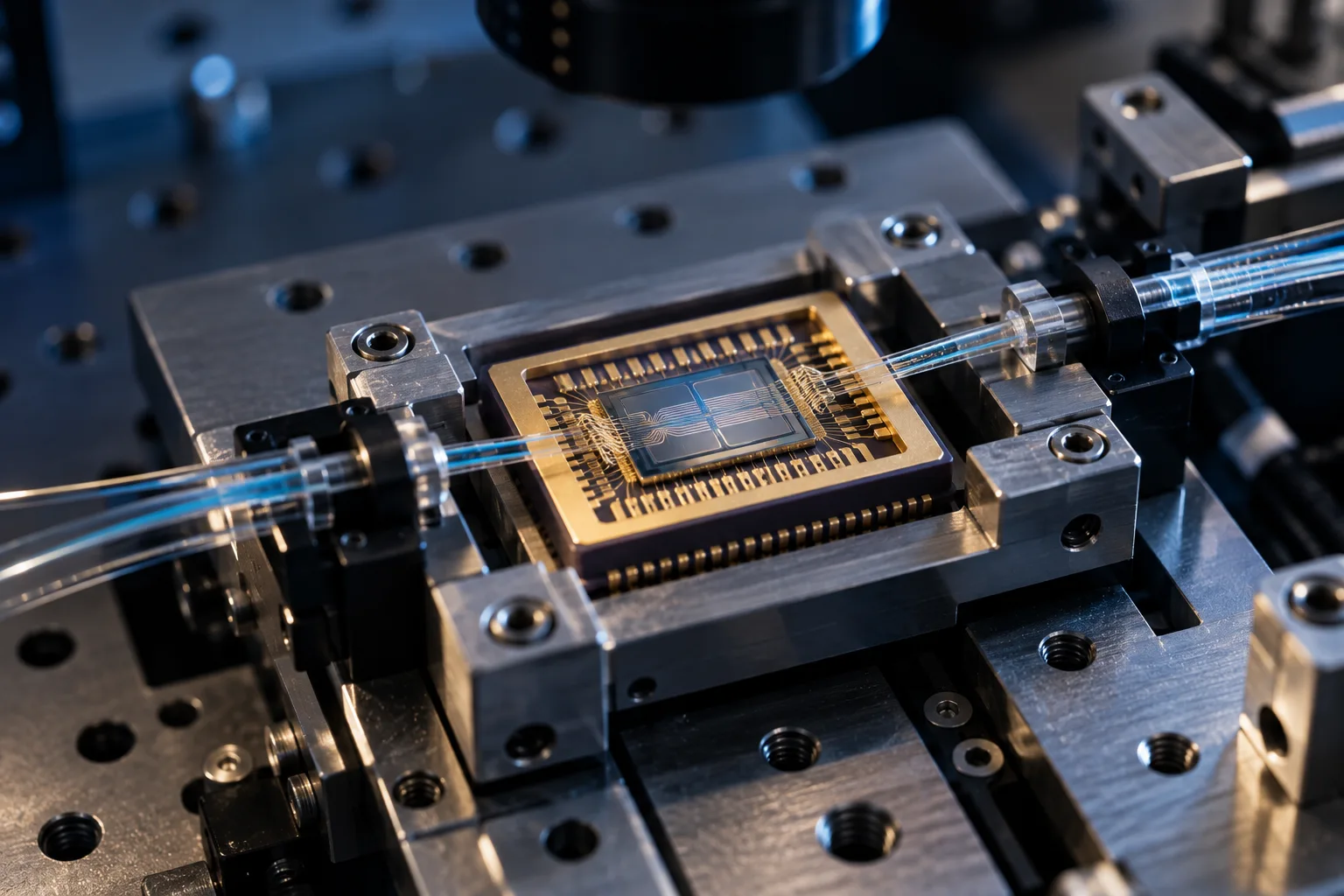
Most optical fibre is a thin strand of solid glass. Light travels along the middle of the glass, and some of the signal is always absorbed or scattered by the glass as it goes. Hollow-core fibre works differently: it guides light through a central channel filled with air, surrounded by thin glass walls.
Light travels faster through air than through glass, and less of the signal is lost to the glass. That is why researchers and Microsoft describe the fibre as a way to send data with less delay and with less signal loss over long distances. The best results so far come from laboratory measurements and company reports, and the technology is still at an early stage of commercial use.
Technical explanation
Hollow-core fibres come in two main families. Hollow-core photonic bandgap fibres, the older design, use a periodic glass lattice to block light from the cladding at the wavelengths of interest. Antiresonant hollow-core fibres use thin glass walls around the core that reflect light back into the air channel at selected wavelengths. The 2025 paper by Petrovich, Numkam Fokoua, Poletti and colleagues describes an antiresonant hollow-core fibre. In the arXiv preprint of that work, the authors report a measured loss of 0.091 dB/km at 1550 nm, with loss below 0.2 dB/km across a 66 THz window, and they compare this with 0.14 dB/km and 26 THz for existing technology. IEEE Spectrum refers to the earlier generation of the design as DNANF.
Loss in hollow-core fibres comes from different physical processes than in solid fibre. A 2023 tutorial review in Advances in Optics and Photonics analyses intrinsic loss mechanisms, including leakage, gas absorption and roughness scattering at air-glass interfaces. It also treats extrinsic losses from microbending and fabrication imperfections, and sets out scaling rules for these losses. Manufacturing is a second constraint: according to researchers quoted by IEEE Spectrum, drawing tens or hundreds of kilometres of hollow-core fibre is harder than drawing solid fibre, and a significant part of fabrication is still manual.
Deployment and latency figures come mainly from Microsoft, which acquired Lumenisity in 2022 and now uses the technology. Microsoft states that hollow-core fibre has approximately 33% lower latency than conventional single-mode fibre, citing published research, and that it is in use in some Azure regions. IEEE Spectrum describes an earlier generation of the design, installed by Microsoft, connecting two Azure data centres in Europe as a test installation, with two routes each over 20 km long.
What the evidence says
Each statement is typed by the strength of its evidence and linked to the source that supports it.
Demonstrated Shown in a published experiment, test or shipping product.
Petrovich and colleagues report a measured loss of 0.091 dB/km at 1550 nm for an antiresonant hollow-core fibre design, which they describe as the first broadband fibre with attenuation below 0.1 dB/km.
Sources: [2], [1] · AbstractThe same work reports loss below 0.2 dB/km across a 66 THz bandwidth, compared with 0.14 dB/km and 26 THz cited for existing technology.
Sources: [2] · Abstract · medium confidenceA 2023 tutorial review analyses intrinsic loss mechanisms in hollow-core fibres (leakage, gas absorption and roughness scattering) and extrinsic losses from microbending and fabrication imperfections, and sets out scaling rules for them.
Sources: [3] · Abstract · medium confidenceReported, unverified Stated by a company or team but not independently confirmed.
Reported transmission-speed gains over conventional single-mode fibre vary by source: 45% (IEEE Spectrum), 47% (Microsoft) and 50% (the 2025 preprint abstract), so no single figure should be treated as settled.
Sources: [4], [5], [2] · medium confidenceMicrosoft states that hollow-core fibre has approximately 33% lower latency than conventional single-mode fibre, citing published research.
Sources: [5] · Quote from Frank Rey · medium confidenceIEEE Spectrum describes an earlier generation of the design, installed by Microsoft, as connecting two Azure data centres in Europe through a test installation with two routes each over 20 km long. Poletti is quoted as saying 1,280 km of hollow-core fibre is deployed and carrying live traffic. Microsoft says the technology is already in use in some Azure regions.
Sources: [4], [5] · medium confidenceDrawing tens or hundreds of kilometres of hollow-core fibre is more challenging than drawing solid fibre, and a significant part of the fabrication is still manual, according to researchers quoted by IEEE Spectrum.
Sources: [4] · medium confidenceProposed A design or plan that has not yet been built or tested.
Microsoft's account says hollow-core fibre could eventually play a role inside data centres, not only in links between them.
Sources: [5] · Quote from Frank Rey · medium confidenceLimitations and open problems
- The 0.091 dB/km figure is a laboratory measurement reported in a research paper. It is not a published product specification for installed cable.
- Drawing long lengths of hollow-core fibre is harder than drawing solid fibre, and a significant part of fabrication is still manual, so scaling up production is a separate challenge (IEEE Spectrum, 2025).
- The sources reviewed do not show that connectors, splicers and amplifiers for this fibre are mature, although Microsoft says the fibre works with existing single-mode equipment (Microsoft Source, 2026).
- Extrinsic losses from microbending and fabrication imperfections are treated separately from intrinsic losses, and the 2023 review gives scaling rules for them (Numkam Fokoua and colleagues, 2023).
- Most latency and deployment figures come from Microsoft, which develops and deploys the technology. The sources reviewed here include no independent audit of those claims.
Possible future uses
Ideas, not predictions. None of these has been demonstrated.
- Longer links between data centres, which Microsoft says could extend the area that one data centre and Azure region can serve.
- Low-latency interconnects inside data centres, which Microsoft says could eventually play a role.
- Telecom links that use the wide 66 THz window, if amplifiers designed for the wavelengths involved become widely available, as the preprint authors suggest.
Timeline
- 2022Microsoft acquires Lumenisity, which further developed hollow-core fibre first developed at the University of Southampton. Sources: [5]
- 2023Numkam Fokoua and colleagues publish a tutorial review of loss mechanisms, scaling rules and limits for hollow-core optical fibres in Advances in Optics and Photonics. Sources: [3]
- 27 Mar 2025Petrovich and colleagues post a preprint reporting a measured loss of 0.091 dB/km at 1550 nm; the peer-reviewed version appears in Nature Photonics in 2025. Sources: [2], [1]
- 20 Sept 2025IEEE Spectrum reports the new loss result, Francesco Poletti's figure of 1,280 km of hollow-core fibre deployed and carrying live traffic, and a test installation linking two Azure data centres in Europe. Sources: [4]
- 17 Mar 2026Microsoft says hollow-core fibre is in use in some Azure regions, is being deployed in more, and that it has agreed to manufacturing collaborations to increase production. Sources: [5]
Futures this could help bring about
Related breakthroughs
Glossary
- Attenuation
- The loss of light power as it travels along a fibre. It is often given in decibels per kilometre (dB/km), where a smaller number means less loss.
- Antiresonance
- A way of guiding light in which thin glass walls around a hollow core reflect light back into the core at selected wavelengths.
- Latency
- The delay between sending a signal and it arriving at its destination.
- Single-mode fibre
- The standard telecom fibre, which carries light along a single path through its solid glass core.
Sources
- peer reviewed paper
Broadband optical fibre with an attenuation lower than 0.1 decibel per kilometre
Marco Petrovich, Eric Numkam Fokoua, Yong Chen et al.. Nature Photonics, 1 Sept 2025. DOI: 10.1038/s41566-025-01747-5. Accessed 21 Oct 2026. - preprint
First broadband optical fibre with an attenuation lower than 0.1 decibel per kilometre
Marco Petrovich, Eric Numkam Fokoua, Yong Chen et al.. arXiv, 27 Mar 2025. Accessed 21 Oct 2026. - review article
Loss in hollow-core optical fibers: mechanisms, scaling rules, and limits
Eric Numkam Fokoua, Seyed Abokhamis Mousavi, Gregory T. Jasion et al.. Advances in Optics and Photonics, 2023. DOI: 10.1364/AOP.470592. Accessed 21 Oct 2026. - news
Hollowing Out Fiber Speeds It Up and Keeps Signals Moving
John Boyd. IEEE Spectrum, 20 Sept 2025. Accessed 21 Oct 2026. - company announcement
Using inexpensive MicroLEDs, Microsoft networking innovation aims to make datacenters more efficient
Chris Welsch. Microsoft Source, 17 Mar 2026. Accessed 21 Oct 2026. - news
Southampton achieves 'record' low signal loss with hollow fiber
optics.org, 6 Oct 2025. Accessed 21 Oct 2026.
Revision history
3 changes since this profile was created.