Autonomous road vehicles
Also known as Self-driving cars, Automated driving systems, Robotaxis, Driverless vehicles
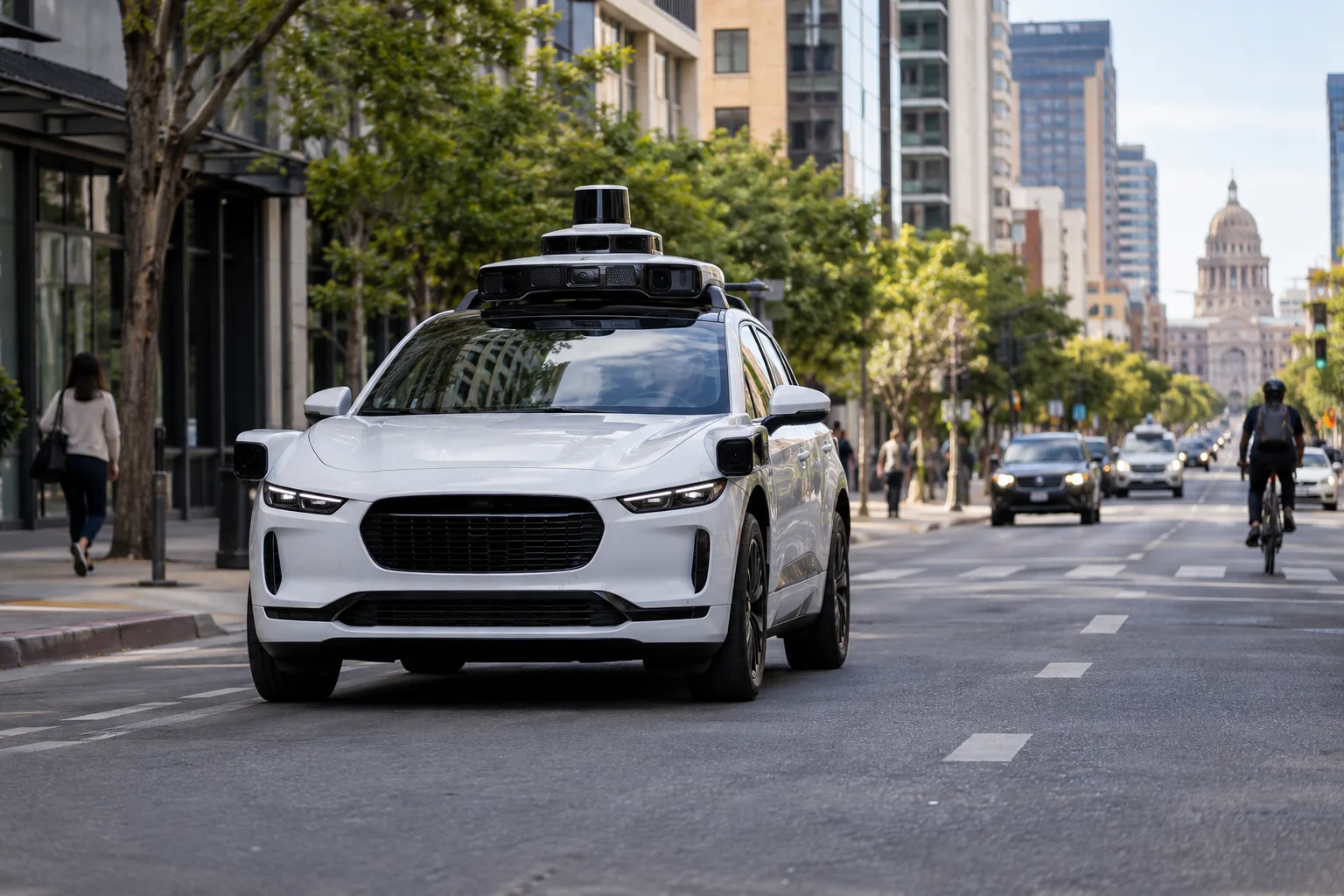
Autonomous road vehicles do some or all of the driving without a human in control. Driverless robotaxis now operate in several US cities, and independent and company data both report fewer crashes per mile than human drivers, but the evidence covers limited areas and mileage.
In plain language
An autonomous road vehicle is a car, van or taxi that does some or all of the driving itself. The SAE standard J3016 describes levels of driving automation, from Level 0 with no automation to Level 5 with full automation, so that people can say clearly what a system does and what the human still has to do.
The most advanced systems now run driverless taxis in several US cities. Waymo's own data and an independent study by the Insurance Institute for Highway Safety (IIHS) both report fewer crashes per mile than human drivers in the places they studied. The numbers come from limited areas and mileage, so they show a consistent pattern rather than a settled answer.
Automated buses and shuttles used as public transport are at an earlier stage. Singapore's Land Transport Authority (LTA) says fixed-route autonomous shuttles in Punggol began public rides in April 2026. In October 2026 LTA said it would not deploy six autonomous buses on two ordinary bus routes as originally planned, and that it would first explore narrower uses such as employee shuttles. A public bus also has to handle boarding, wheelchair securement and help for passengers, tasks a driver often performs, so accessibility and remote supervision are part of the evidence, not an afterthought.
Technical explanation
Automated driving systems use sensors and software to sense the road, predict what other road users will do, and control steering, braking and acceleration. SAE's Level 4 describes a system that performs the driving task without a human supervising it under certain conditions. IIHS's comparison covers SAE Level 4 vehicles, which drive without a human supervising them.
IIHS compared police-reportable crashes per vehicle mile for Waymo driverless vehicles with human drivers in San Francisco, Phoenix, Los Angeles and Austin, using NHTSA crash reports from 2021 to 2024. It reported a 68 per cent lower crash rate overall, 81 per cent fewer injury crashes and 85 per cent fewer single-vehicle crashes. Phoenix showed the largest gap at 76 per cent lower, while the Austin sample was small and showed a rate 4 per cent higher. The study used about 50 million driverless miles, compared with about 222 billion human-driver miles.
Waymo's Safety Impact Data Hub reports 82 per cent fewer crashes involving any injury and 95 per cent fewer crashes involving serious injury or worse than human benchmarks, across 271.3 million rider-only miles through June 2026. Waymo says there is not yet enough mileage to detect statistical significance in the areas it drives. IIHS notes that the NHTSA data system was designed to track defects and enforce recalls, not to make this kind of comparison.
What the evidence says
Each statement is typed by the strength of its evidence and linked to the source that supports it.
Demonstrated Shown in a published experiment, test or shipping product.
The SAE J3016 standard classifies driving automation from Level 0, with no automation, to Level 5, with full automation.
Sources: [1]IIHS found that Waymo driverless vehicles had about 68 per cent lower police-reportable crash rates per vehicle mile than human drivers in San Francisco, Phoenix, Los Angeles and Austin, using NHTSA crash reports from 2021 to 2024.
Sources: [3], [2] · Key results · medium confidenceIn the IIHS comparison, Waymo driverless vehicles had 81 per cent fewer injury crashes and 85 per cent fewer single-vehicle crashes per mile than human drivers, based on about 50 million driverless miles.
Sources: [3] · medium confidenceIIHS states that the NHTSA crash data system was designed mainly to track defects and enforce recalls, which makes comparing automated and human crash rates difficult.
Sources: [3], [2]Singapore's Ministry of Transport says operators must submit plans covering the safety operator's role, conditions for manual takeover or emergency braking, and incident response. LTA and CETRAN jointly evaluate these plans before the vehicles are authorised for public roads.
Sources: [9]The UK Automated Vehicles Act 2024 creates an authorised self-driving entity, responsible for a vehicle's behaviour while it is self-driving, and a no-user-in-charge operator, responsible for non-driving related tasks.
Sources: [13]The Automated Vehicles Act 2024 requires every automated passenger services permit to include a condition to publish reports on the service, in particular about the steps taken to meet the needs of older or disabled passengers.
Sources: [12]Under the UK framework, authorised automated vehicles face pre-deployment checks, in-use monitoring and an annual assessment of general performance, with conclusions published each year.
Sources: [13]FTA Report No. 0228 (August 2022) covers current accessibility practices in transit bus automation demonstrations and pilots, including how projects approach ADA compliance and the role of onboard staff.
Sources: [14] · Repository record descriptionReported, unverified Stated by a company or team but not independently confirmed.
Waymo reports 82 per cent fewer crashes involving any injury and 95 per cent fewer crashes involving serious injury or worse than human benchmarks, across 271.3 million rider-only miles through June 2026.
Sources: [4] · medium confidenceWaymo reports 96 per cent fewer injury-involving crashes at intersections, across 56.7 million miles, in a study it says has been accepted by Traffic Injury Prevention.
Sources: [5] · medium confidenceWaymo states that there is not yet enough mileage to detect statistical significance in the areas it drives.
Sources: [4] · medium confidenceLTA says fixed-route autonomous shuttles in Punggol began public rides on 1 April 2026, after more than 25,000 km of autonomous driving to 27 February 2026 and by-invite rides for about 740 riders.
Sources: [6] · Release summary, public rides and earlier by-invite rides · medium confidenceLTA says it will not deploy the six autonomous buses on Services 400 and 191 as planned, and is exploring narrower uses such as employee shuttles, within what it calls a phased and calibrated approach.
Sources: [11], [10]One of the six buses arrived in Singapore in March 2026 and passed the Milestone 1 closed-circuit test in July 2026, according to Mothership. The report does not say that any of the other five had passed.
Sources: [11] · medium confidenceSingapore's Ministry of Transport said in November 2025 that the planned pilot buses were designed with wheelchair bays and low ramps, and that onboard safety operators would assist passengers who use wheelchairs.
Sources: [8] · medium confidenceIn November 2025 the Ministry of Transport said the eight-seat Punggol shuttles can carry folded wheelchairs but do not have ramps.
Sources: [8] · medium confidenceIn November 2025 the Ministry of Transport said it was working with operators and manufacturers on accessibility for future operation without an onboard safety operator, but gave no plan or timeline.
Sources: [8] · medium confidenceProposed A design or plan that has not yet been built or tested.
IIHS says its current data collection system is not good enough to allow continuous monitoring of a large-scale expansion of driverless vehicles, and that a better monitoring system is needed.
Sources: [3] · medium confidenceIn March 2026 LTA said Punggol shuttle rides would be free for an initial period, with revenue service expected from mid-2026 at a flat fare of $4 per passenger.
Sources: [6] · medium confidenceThe UK government says it will consult further on measures to enable secondary legislation by the second half of 2027.
Sources: [13] · medium confidenceSuperseded Replaced by newer evidence.
Limitations and open problems
- The IIHS study covers only SAE Level 4 driverless vehicles in four cities, so it says nothing directly about Level 2 or Level 3 driver-assistance systems (IIHS, 2026).
- Companies are not required to report mileage, so the IIHS comparison relies on mileage supplied by Waymo (IIHS, 2026).
- The NHTSA Standing General Order data system was designed to track defects and recalls, not to compare automated and human crash rates (IIHS, 2026).
- Counts of serious-injury-or-worse crashes are small, and Waymo says there is not yet enough mileage to detect statistical significance in the areas it drives (Waymo, 2026).
- Headline safety figures come mainly from the operators themselves, and their results depend on how human benchmarks are constructed (Waymo, 2025; Waymo, 2026).
- Singapore's Punggol shuttle figures are agency-reported and describe one fixed-route shuttle programme, not performance on other routes or vehicle types (LTA, 2026).
- The announced Singapore route-bus pilot on Services 400 and 191 has not happened as planned, so public route-bus evidence in Singapore is not yet available (Mothership, 2026).
- Singapore's ministry has not given a timeline for the accessibility of automated buses and shuttles in future operation without an onboard safety operator (MOT, 2025).
- The UK permit scheme was consulted on in 2025, and the government response was not available in the text retrieved, so its final design is not confirmed here (DfT, 2026).
Possible future uses
Ideas, not predictions. None of these has been demonstrated.
- Insurance pricing for automated fleets based on per-mile crash rates, if independent reporting becomes consistent across operators.
- Driverless delivery vans on mapped urban routes, where the operating area is limited in advance.
- Automated trucking on motorway corridors, where traffic is more predictable than in cities.
Timeline
- 1 Feb 2019SAE International publishes an article on its updated J3016 automated-driving graphic, describing the scale from Level 0 (no automation) to Level 5 (full vehicle autonomy). Sources: [1]
- 27 Jan 2025LTA issues a request for proposals to buy six autonomous buses for a three-year operational pilot on public bus Services 400 and 191, with onboard bus captains as safety operators. Sources: [7]
- 1 May 2025Waymo publishes a summary of its study of injury crashes across 56.7 million miles, which it says has been accepted by Traffic Injury Prevention. Sources: [5]
- 5 Nov 2025Singapore's Ministry of Transport says the planned pilot buses are designed with wheelchair bays and low ramps, and that onboard safety operators will assist wheelchair users. Sources: [8]
- 12 Jan 2026By-invite rides begin on Singapore's fixed-route autonomous shuttles in Punggol. Sources: [6]
- 12 Feb 2026Singapore's Ministry of Transport says operators must submit plans on safety operator roles, manual takeover and emergency braking, and incident response, which LTA and CETRAN jointly evaluate before public-road deployment. Sources: [9]
- 1 Apr 2026Public rides open on Singapore's fixed-route autonomous shuttles in Punggol. Sources: [6]
- Jun 2026Waymo's Safety Impact Data Hub covers 271.3 million rider-only miles across five US cities through June 2026. Sources: [4]
- 23 Jul 2026IIHS publishes a news release on its research paper 'Rise of the machines', finding 68 per cent fewer police-reportable crashes per mile for Waymo driverless vehicles than for human drivers. Sources: [3], [2]
- Oct 2026LTA says it will not deploy six autonomous buses on Services 400 and 191 as planned, and is exploring narrower uses such as employee shuttles before considering more complex public bus services. Sources: [11]
Futures this could help bring about
Cameras that see like eyes
Pilots · 7 of 10 steps done
Cheap lidar in every car
Scaling up · 5 of 9 steps done
Flying taxis in cities
Pilots · 3 of 7 steps done
Self-driving cars on every road
Pilots · 2 of 7 steps done
Glossary
- SAE levels of driving automation
- A scale from Level 0 (no automation) to Level 5 (full automation), defined in the SAE J3016 standard, that describes what a driving system does and what the human must do.
- Level 4 automation
- A system that performs the whole driving task without a human supervising it, but only under defined conditions, such as particular cities or weather.
- Police-reportable crash
- A crash serious enough that a reasonable person would report it to the police, usually because of injury, significant damage or a vehicle being towed.
- Standing General Order
- The US federal requirement under which companies report certain automated driving crashes to NHTSA.
- Operational design domain
- The roads, speeds, weather, traffic and other conditions in which an automated system is designed to operate.
- Safety operator
- A person on board an automated vehicle who can take manual control or intervene in an emergency, used during testing and early service.
- Authorised self-driving entity
- The UK Automated Vehicles Act 2024 term for the organisation responsible for a vehicle's behaviour while it is self-driving.
- No-user-in-charge operator
- The UK Automated Vehicles Act 2024 term for the operator responsible for non-driving related tasks when a vehicle can drive itself for the whole journey.
- Automated passenger services permit
- A permit under the UK Automated Vehicles Act 2024 for commercial passenger services that run without a human driver. The government consulted on the permit scheme in 2025, before the full framework is in force.
Sources
- other
SAE updates J3016 automated-driving graphic
SAE International, 1 Feb 2019. Accessed 21 Oct 2026. - other
Rise of the machines: crash experiences of highly automated vehicles and human drivers
Eric R. Teoh, David G. Kidd, Luke E. Riexinger. Insurance Institute for Highway Safety (IIHS), Jul 2026. Accessed 21 Oct 2026. - other
Waymo's driverless cars crash less often than people
Eric R. Teoh. Insurance Institute for Highway Safety (IIHS), 23 Jul 2026. Accessed 21 Oct 2026. - company announcement
Waymo Safety Impact Data Hub
Waymo LLC, Jun 2026. Accessed 21 Oct 2026. - company announcement
New Study: Waymo is reducing serious crashes and making streets safer for those most at risk
Waymo, 1 May 2025. Accessed 21 Oct 2026. - government report
Autonomous Shuttle Services in Punggol Open for Public Rides from 1 April 2026
Land Transport Authority of Singapore, 4 Mar 2026. Accessed 21 Oct 2026. - government report
Request for Proposals for the Pilot Deployment of Autonomous Buses for Public Bus Services
Land Transport Authority of Singapore, 27 Jan 2025. Accessed 21 Oct 2026. - government report
Automated Bus Ramps and Infrastructural Upgrades for Autonomous Vehicles
Ministry of Transport, Singapore, 5 Nov 2025. Accessed 21 Oct 2026. - government report
Strengthening Safety and Handover Protocols for Deployment of Self-Driving Shuttle Buses
Ministry of Transport, Singapore, 12 Feb 2026. Accessed 21 Oct 2026. - government report
Automated & autonomous vehicles
Ministry of Transport, Singapore, 13 Oct 2026. Accessed 21 Oct 2026. - news
LTA halts pilot programme for self driving public buses to explore narrower use cases for now
Mothership, 13 Oct 2026. Accessed 21 Oct 2026. - government report
Automated passenger services (APS) permitting scheme consultation
Department for Transport and Centre for Connected and Autonomous Vehicles (UK), 21 Jul 2025. Accessed 21 Oct 2026. - government report
Automated vehicles: statement of safety principles
Department for Transport and Centre for Connected and Autonomous Vehicles (UK), 10 Jun 2025. Accessed 21 Oct 2026. - government report
Accessibility in Transit Bus Automation: Scan of Current Practices and Ongoing Research (FTA Report No. 0228)
Ian Berg, Joshua Cregger, Elizabeth Machek. Federal Transit Administration, US Department of Transportation (prepared by the John A. Volpe National Transportation Systems Center), 1 Aug 2022. DOI: 10.21949/1527641. Accessed 21 Oct 2026.
Revision history
3 changes since this profile was created.
What it took to get here
The inventions this technology was built on, oldest foundations at the top. Lines show what each one required.
- 1967Modern systemsCar electronics and engine controlCommercial Unlocked.
- 3500 BCMovementThe wheel and axleCommercial Unlocked.
- 1712PowerThe steam engineCommercialRequires: Precision machine tools and interchangeable parts. Unlocked.
- 1859PowerLead-acid batteriesCommercial Unlocked.
- 1859PowerPetroleum refiningCommercial Unlocked.
- 1816ControlVehicle steeringCommercialRequires: The wheel and axle. Unlocked.
- 1827ControlClutches, gearboxes and differentialsCommercialRequires: Precision machine tools and interchangeable parts. Unlocked.
- 1902ControlVehicle brakesCommercialRequires: Car electronics and engine control. Unlocked.
- 1901ManufacturingAssembly-line mass productionCommercialRequires: Precision machine tools and interchangeable parts. Unlocked.
- 1952Modern systemsVehicle safety systemsCommercial Unlocked.
- 1956Modern systemsCatalytic convertersCommercial Unlocked.
- 1964Modern systemsSatellite navigation (GNSS)Commercial Unlocked.
- 1750MovementSprings and vehicle suspensionCommercialRequires: The wheel and axle. Unlocked.
- 1794MovementRolling bearingsCommercialRequires: Precision machine tools and interchangeable parts. Unlocked.
- 1844MovementVulcanised rubber and pneumatic tyresCommercialRequires: The wheel and axle. Unlocked.
- 1821PowerThe electric motorCommercialRequires: Industrial steelmaking. Unlocked.
- 1860PowerThe internal combustion engineCommercialRequires: The steam engine, Petroleum refining, Precision machine tools and interchangeable parts. Unlocked.
- 1976PowerLithium-ion batteriesCommercialRequires: Lead-acid batteries. Unlocked.
- 2019Autonomous road vehiclesPilot and early commercialRequires: The motor car, Satellite navigation (GNSS). Unlocked.