Humanoid robots
Also known as Humanoid robotics, Bipedal humanoid robots
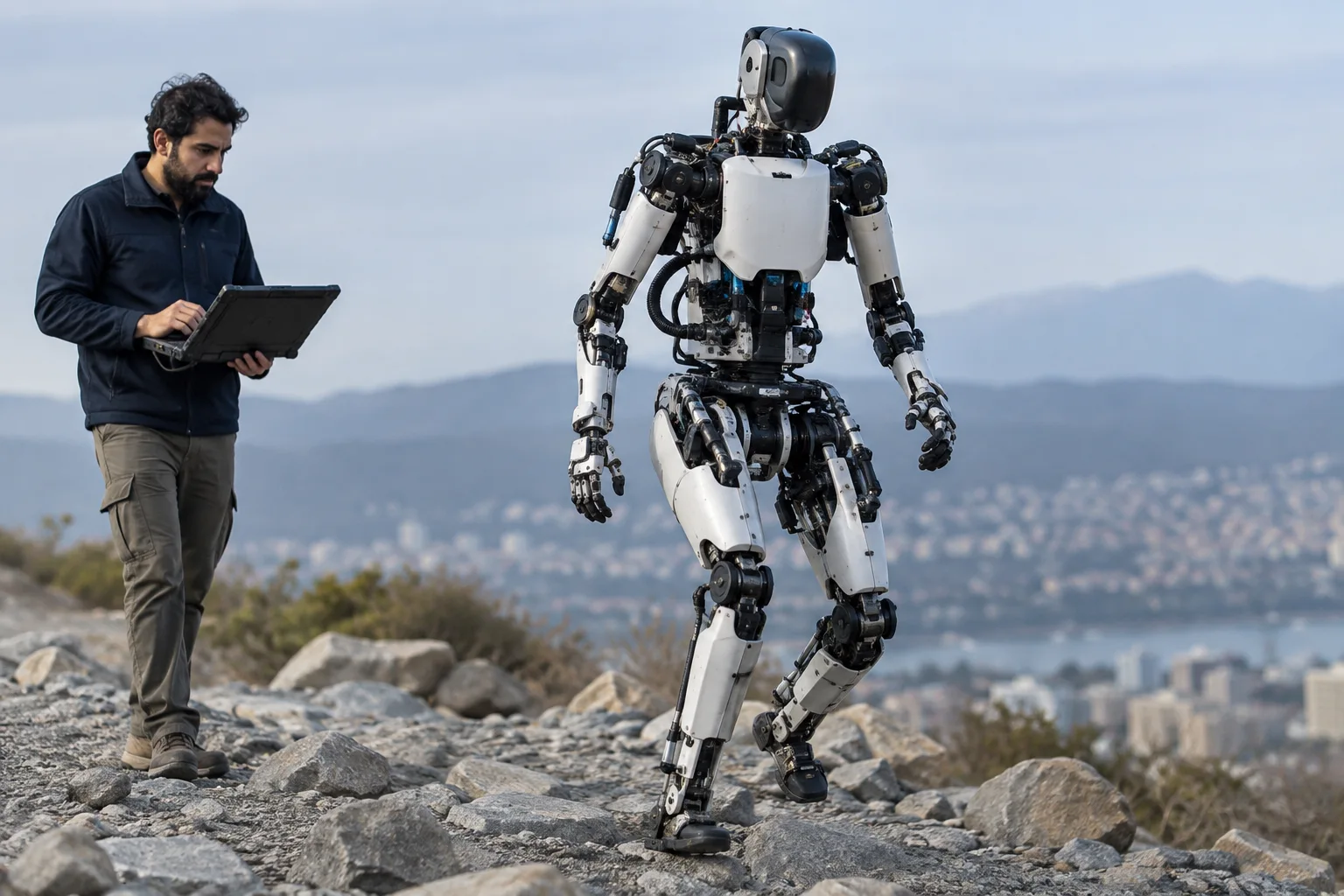
Humanoid robots are machines built roughly in the shape of a person, with two legs and two arms. Learned walking controllers have been shown outdoors, and companies plan factory use, but the sources reviewed here do not show useful work at scale.
In plain language
A humanoid robot is a machine built roughly in the shape of a person, with a head, a torso, two arms and two legs. The idea is that such a body could work in places built for people, such as factories and warehouses, without the buildings being changed. Walking on two legs is hard, because the robot has to keep its balance while it moves and reacts to bumps and pushes.
Recent progress has come from training control software through trial and error in simulation, a method called reinforcement learning. A research team under Ilija Radosavovic trained a controller that predicts the robot's next movement from its recent sensor readings. The controller was then tested on a full-sized humanoid robot walking outdoors. Companies such as Boston Dynamics have since shown all-electric versions aimed at factory work.
Technical explanation
The 2024 Science Robotics paper from Radosavovic and colleagues uses a causal transformer, a neural network that reads the recent history of sensor readings (proprioception) and actions, then predicts the next action. The policy is trained with large-scale model-free reinforcement learning in randomised simulated environments and then runs on hardware without further training, which is called zero-shot transfer. The authors report that the controller walks over varied outdoor terrain, withstands external disturbances and adapts in context.
Hardware has also moved on. In April 2024 Boston Dynamics introduced an all-electric Atlas to replace its hydraulic version, which it said would be sold as a product. IEEE Spectrum reported that the design is meant to continue heavy-object handling, and that Hyundai, which owns Boston Dynamics, is the first planned customer. The article noted that no practical tasks had yet been shown for the robot.
In January 2026 Boston Dynamics unveiled a production Atlas at CES, with Hyundai Motor Group as the named customer and Google DeepMind as a partner for integrating AI models. The Register reports plans for tens of thousands of units in Hyundai facilities. These are company plans reported in the news, and the sources reviewed here do not confirm the scale of deployment. Battery runtime, hand dexterity and safety around people are not covered by these sources.
What the evidence says
Each statement is typed by the strength of its evidence and linked to the source that supports it.
Demonstrated Shown in a published experiment, test or shipping product.
A learned controller, a causal transformer trained with large-scale model-free reinforcement learning in simulation, ran on a full-sized humanoid robot with zero-shot transfer to hardware.
Sources: [1], [2] · AbstractThe authors report that the learned controller walked over varied outdoor terrain and withstood external disturbances.
Sources: [1], [2] · Abstract · medium confidenceIn April 2024 Boston Dynamics introduced a fully electric Atlas humanoid to replace its hydraulic Atlas.
Sources: [3] · Lead paragraphsThe IEEE Spectrum article from April 2024 noted that no practical tasks had yet been shown for the electric Atlas.
Sources: [3] · Demonstration timeline · medium confidenceReported, unverified Stated by a company or team but not independently confirmed.
Boston Dynamics expected Atlas to reach a technology demonstration phase in Hyundai factories as early as 2025.
Sources: [3] · Demonstration timeline · low confidenceBoston Dynamics and Hyundai plan to deploy tens of thousands of production Atlas units in Hyundai facilities, starting at a Hyundai application centre in the coming months.
Sources: [4] · Article body · low confidenceSpeculative An idea or possible use. Not evidence of anything.
Humanoid robots built to share human workspaces may eventually take on varied factory tasks, but the 2024 article did not show practical tasks for electric Atlas.
Sources: [3] · Factory work · low confidenceLimitations and open problems
- The walking results come from a specific robot on tested terrains, and the 2024 paper does not show general-purpose work.
- The IEEE Spectrum article from April 2024 noted that no practical factory tasks had been shown for the electric Atlas.
- Battery runtime, hand dexterity and safety around people are not covered in the sources reviewed here, so their current state is not assessed.
- Factory deployment numbers are company plans reported in the news, not measured results.
- The sources reviewed do not give unit cost or total cost of ownership.
Possible future uses
Ideas, not predictions. None of these has been demonstrated.
- Heavy handling on car production lines, where a human-shaped robot could use existing workstations without redesign.
- Home help with tasks such as tidying or laundry, if safety and dexterity problems are solved.
- Work in hazardous sites such as disaster zones, where a robot could enter spaces built for people.
Timeline
- 6 Mar 2023The arXiv preprint of Radosavovic and colleagues' learned humanoid walking controller is first submitted. Sources: [2]
- 17 Apr 2024Science Robotics publishes the paper on real-world humanoid locomotion with reinforcement learning. Sources: [1]
- 17 Apr 2024Boston Dynamics introduces an all-electric Atlas humanoid to replace its hydraulic version. Sources: [3]
- Jan 2026Boston Dynamics unveils a production Atlas at CES, with Hyundai as the named customer. Sources: [4]
Futures this could help bring about
Related breakthroughs
Glossary
- Reinforcement learning
- A way of training control software through trial and error, rewarding actions that lead to better outcomes.
- Zero-shot transfer
- Running a controller on real hardware after training only in simulation, with no extra training on the real robot.
- Proprioception
- A robot's sense of its own body, such as joint positions, speeds and forces.
- Actuator
- The motor or drive that moves a joint of a robot.
Sources
- peer reviewed paper
Real-world humanoid locomotion with reinforcement learning
Ilija Radosavovic, Tete Xiao, Bike Zhang et al.. Science Robotics, 17 Apr 2024. DOI: 10.1126/scirobotics.adi9579. Accessed 21 Oct 2026. - preprint
Real-World Humanoid Locomotion with Reinforcement Learning
Ilija Radosavovic, Tete Xiao, Bike Zhang et al.. arXiv, 6 Mar 2023. Accessed 21 Oct 2026. - news
Hello, Electric Atlas
Evan Ackerman. IEEE Spectrum, 17 Apr 2024. Accessed 21 Oct 2026. - news
Optimus Schmoptimus - Boston Dynamics' humanoid robot is already in mass production
The Register, 6 Jan 2026. Accessed 21 Oct 2026.