Thin-film lithium niobate photonics
Also known as TFLN photonics, Thin-film lithium niobate, Lithium niobate on insulator, LNOI photonics
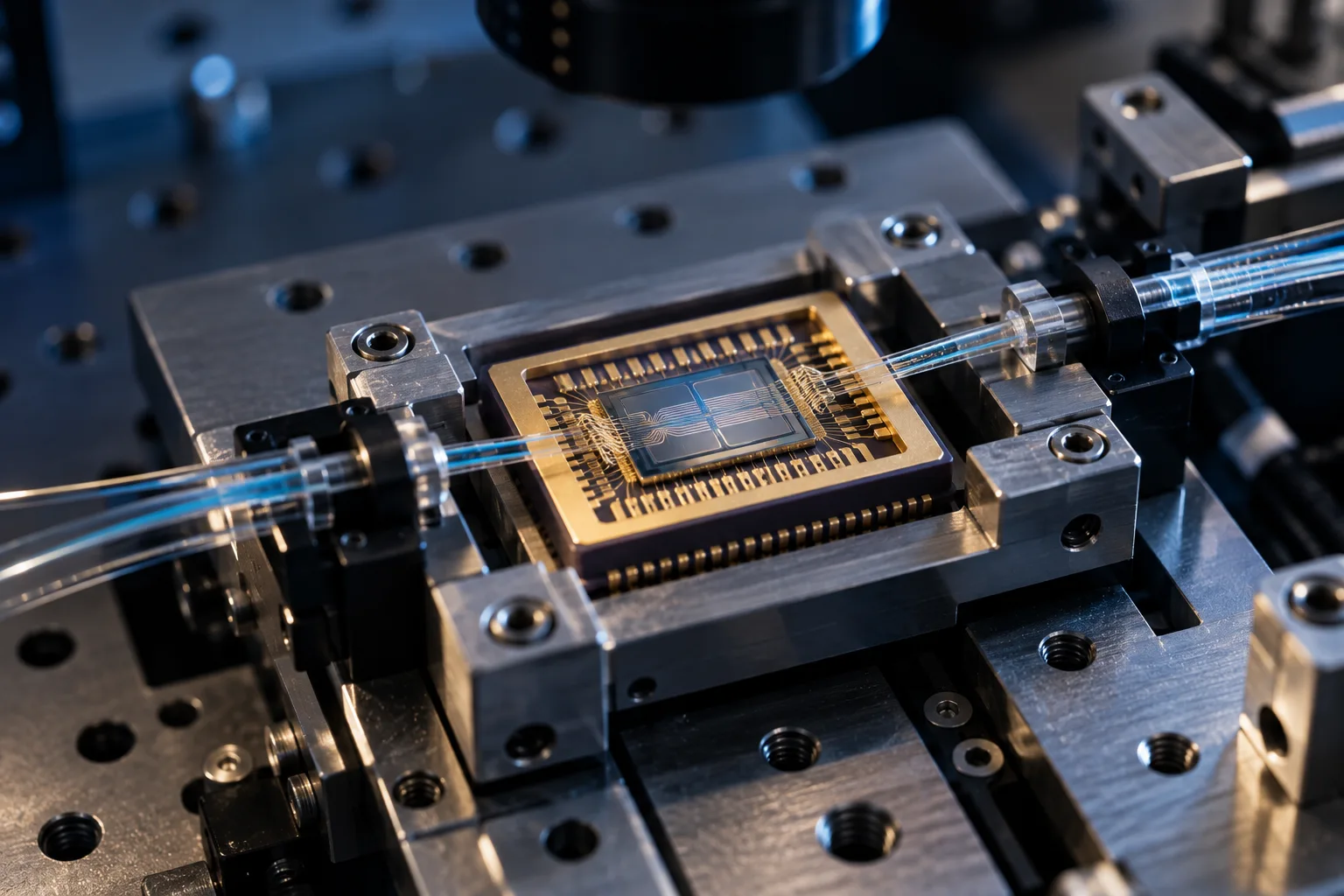
Thin-film lithium niobate is a chip platform in which light is guided and switched in a thin layer of an electro-optic crystal. Laboratory modulators have carried data at up to 210 gigabits per second, and the same platform makes frequency combs, but commercial foundry supply is only starting and most company performance figures have not been independently checked.
In plain language
Lithium niobate is a crystal whose optical properties change when a voltage is applied to it. This is called the electro-optic effect. In thin-film form, a very thin layer of the crystal is bonded onto an insulating base wafer and carved into narrow channels that guide light. An electrical signal applied to the channel can then switch the light or write data onto it.
Engineers want this platform because the switching voltage can be low enough for ordinary electronic chips to drive directly, which saves power and space. A 2018 peer-reviewed paper reported chip-scale modulators with a CMOS-compatible drive that carried data at up to 210 gigabits per second. The same thin layers also make frequency combs, which are rulers of evenly spaced colours of light used in measurement and communications. Commercial production is still early. Companies say they will supply chips in large volumes, but most of their figures have no published test conditions.
Technical explanation
Bulk lithium niobate has a strong, linear electro-optic effect and low optical loss, but bulk modulators are large because the drive voltage depends on the length of the interaction region. Thin-film lithium niobate on insulator (LNOI) confines light in a high-contrast ridge waveguide, which lets electrodes sit close to the optical mode and reduces the voltage needed for a given length. Wang and colleagues (2018) report monolithic modulators with a CMOS-compatible drive voltage, data rates up to 210 Gb/s and on-chip optical loss below 0.5 dB. The sources read here do not give the test conditions, bandwidth or device length for these figures.
Low-loss microring resonators on the same platform support frequency combs. Zhang and colleagues (2019) drove an electro-optic microring with a microwave signal and measured a comb of over 900 lines, spaced about 10 GHz apart, across the telecom L-band. Line spacing could be tuned from 10 Hz to 100 MHz by changing the modulation frequency, and the same device produced two combs at once. The authors describe an octave-spanning comb as a future goal that would need further dispersion engineering. Zhu and colleagues (2021) review the platform and report that some thin-film devices, such as modulators and wavelength converters, reportedly outperform their bulk-crystal counterparts.
The main device limits are optical and DC instability. At higher optical power, the photorefractive effect can add instability, and the operating bias of a lithium niobate modulator can drift under DC voltage. A 2024 preprint from the Lončar group reports that a quadrature-biased thin-film lithium tantalate modulator stayed within 1 dB over 46 hours at 12.1 dBm input, compared with about 5 dB for thin-film lithium niobate under the same test. The preprint abstract does not give a cause for the difference.
What the evidence says
Each statement is typed by the strength of its evidence and linked to the source that supports it.
Demonstrated Shown in a published experiment, test or shipping product.
Wang and colleagues report monolithically integrated lithium niobate modulators with a CMOS-compatible drive voltage that support data rates up to 210 Gb/s with on-chip optical loss below 0.5 dB.
Sources: [1], [2] · Laser Focus World report on the paper; Nature abstract not read · medium confidenceZhang and colleagues measured an electro-optic frequency comb with over 900 lines spaced about 10 GHz apart, covering the telecom L-band, in a thin-film lithium niobate microring resonator.
Sources: [3] · AbstractIn the same microring, comb line spacing could be tuned from 10 Hz to 100 MHz by changing the modulation frequency, and two combs were generated in one resonator.
Sources: [3] · Abstract · medium confidenceIn a 46-hour test at 12.1 dBm input, a thin-film lithium tantalate modulator showed under 1 dB of power fluctuation from quadrature bias, while equivalent thin-film lithium niobate modulators drifted about 5 dB.
Sources: [7] · Abstract · medium confidenceReported, unverified Stated by a company or team but not independently confirmed.
Conventional lithium niobate modulators need drive voltages of roughly 3 to 5 volts, while typical CMOS circuitry provides about 1 volt.
Sources: [2] · Background paragraph · medium confidenceSome thin-film lithium niobate devices, such as modulators and wavelength converters, reportedly outperform equivalents built from bulk crystal, and low-loss resonators enable optical frequency combs and quantum transducers.
Sources: [4] · Abstract · medium confidenceCCRAFT, a CSEM spin-out, plans two thin-film lithium niobate multi-project wafer runs in 2025, with a September 2025 application deadline for the first, and expects volumes of millions of chips per year, likely not before about 2028.
Sources: [5] · Company statements reported at LASER 2025 · medium confidenceHyperLight describes its thin-film lithium niobate packaged modulators as offering up to 145 GHz bandwidth and ultra-low Vπ, and its IMDD transmitter chips as delivering up to 448 Gbps per lane, without stated test conditions.
Sources: [6] · Product and platform sections · low confidenceProposed A design or plan that has not yet been built or tested.
An octave-spanning electro-optic comb on this platform would need further dispersion engineering, which the authors describe as a future goal.
Sources: [3] · Abstract · medium confidenceLimitations and open problems
- Bias drift and photorefractive effects at higher optical power can make lithium niobate modulators unstable. A 2024 preprint reports that thin-film lithium tantalate is more stable under the same test, but this is one group's comparison, and the sources reviewed do not show the approach as standard practice.
- Wafer supply is a constraint. A Lightium co-founder named volume wafer supply as the top challenge for the industry, and the lithium niobate on insulator supply chain has depended on a single commercial supplier outside the EU, according to the ELENA consortium as reported from LASER World of Photonics 2025.
- Early foundry access is through multi-project wafer runs with application deadlines, such as the September 2025 deadline for CCRAFT's first run.
- The headline figures for commercial products, such as data rates per lane and bandwidth, are given by companies without stated test conditions, and the sources reviewed did not give independent measurements.
- The strongest comb result is a single chip-scale device spanning the telecom L-band. An octave-spanning comb, which the authors describe as a future goal, has not been shown in the sources reviewed.
- Cost and yield figures for thin-film lithium niobate wafers and chips were not found in the sources reviewed, so none are quoted.
Possible future uses
Ideas, not predictions. None of these has been demonstrated.
- Low-voltage optical links between chips inside AI computing clusters, where modulators sit close to processors and electronic drivers are kept small.
- Frequency-comb sources for precise ranging, spectroscopy and microwave photonics in compact instruments.
- Quantum transducers that convert signals between microwave and optical frequencies, using the low-loss resonators that the Zhu review describes.
Timeline
- Oct 2018Wang and colleagues publish monolithic lithium niobate modulators with a CMOS-compatible drive voltage, data rates up to 210 Gb/s and on-chip loss below 0.5 dB in Nature. Sources: [1], [2]
- Mar 2019Zhang and colleagues report an electro-optic frequency comb of over 900 lines spaced about 10 GHz apart in a thin-film lithium niobate microring, in Nature. Sources: [3]
- 2021Zhu, Shao, Lončar and colleagues publish a review of integrated photonics on thin-film lithium niobate in Advances in Optics and Photonics. Sources: [4]
- 2025CCRAFT, a CSEM spin-out, announces a thin-film lithium niobate foundry and plans multi-project wafer runs, with the first application deadline in September 2025. Company volume targets are for about 2028. Sources: [5]
- Mar 2026HyperLight announces a partnership with UMC and Wavetek for high-volume foundry production of its thin-film lithium niobate chiplet platform. Sources: [6]
Glossary
- Electro-optic effect
- A change in a material's optical properties when an electric field is applied, used to switch or modulate light with an electrical signal.
- Half-wave voltage (Vπ)
- The voltage needed to shift the phase of light by half a cycle in a modulator. Lower values mean the modulator can be driven by smaller electronic circuits.
- Optical frequency comb
- A light source that emits many evenly spaced frequencies of light at once, like the marks on a ruler.
- Photorefractive effect
- A light-induced change in refractive index in some crystals, which can cause drift and instability in lithium niobate devices at higher optical power.
Sources
- peer reviewed paper
Integrated lithium niobate electro-optic modulators operating at CMOS-compatible voltages
Cheng Wang, Mian Zhang, Xi Chen et al.. Nature, Oct 2018. DOI: 10.1038/s41586-018-0551-y. Accessed 22 Oct 2026. - news
Monolithic integrated lithium niobate modulator operates at CMOS voltages of about a volt
John Wallace. Laser Focus World, Sept 2018. Accessed 22 Oct 2026. - peer reviewed paper
Broadband electro-optic frequency comb generation in a lithium niobate microring resonator
Mian Zhang, Brandon Buscaino, Cheng Wang et al.. Nature, Mar 2019. DOI: 10.1038/s41586-019-1008-7. Accessed 22 Oct 2026. - review article
Integrated photonics on thin-film lithium niobate
Di Zhu, Linbo Shao, Mengjie Yu et al.. Advances in Optics and Photonics, 2021. DOI: 10.1364/AOP.411024. Accessed 22 Oct 2026. - news
Laser 2025: CCRAFT and Lightium push thin film lithium niobate PICs
Optics.org, 2025. Accessed 22 Oct 2026. - company announcement
HyperLight Corporation homepage
HyperLight Corporation, Publication date not stated. Accessed 22 Oct 2026. - preprint
Stable electro-optic modulators using thin-film lithium tantalate
Keith Powell, Xudong Li, Daniel Assumpcao et al.. arXiv, May 2024. Accessed 22 Oct 2026.
Revision history
3 changes since this profile was created.