How far are robots from picking most of a fruit or vegetable crop commercially?
Robots now pick strawberries, apples, sweet peppers, tomatoes and mushrooms in trials and early commercial use. Field trials report success rates from 18% to 97.1%, depending on the crop, the conditions and how success is counted. The sources reviewed show no independent evidence yet that a robot picks a whole crop, over a full season, at human speed and quality. The main gaps are fruit hidden by leaves or other fruit, slow cycle times, the number of missed berries that still need hand picking, and the cost of machines. Most commercial figures come from the companies that sell the robots.
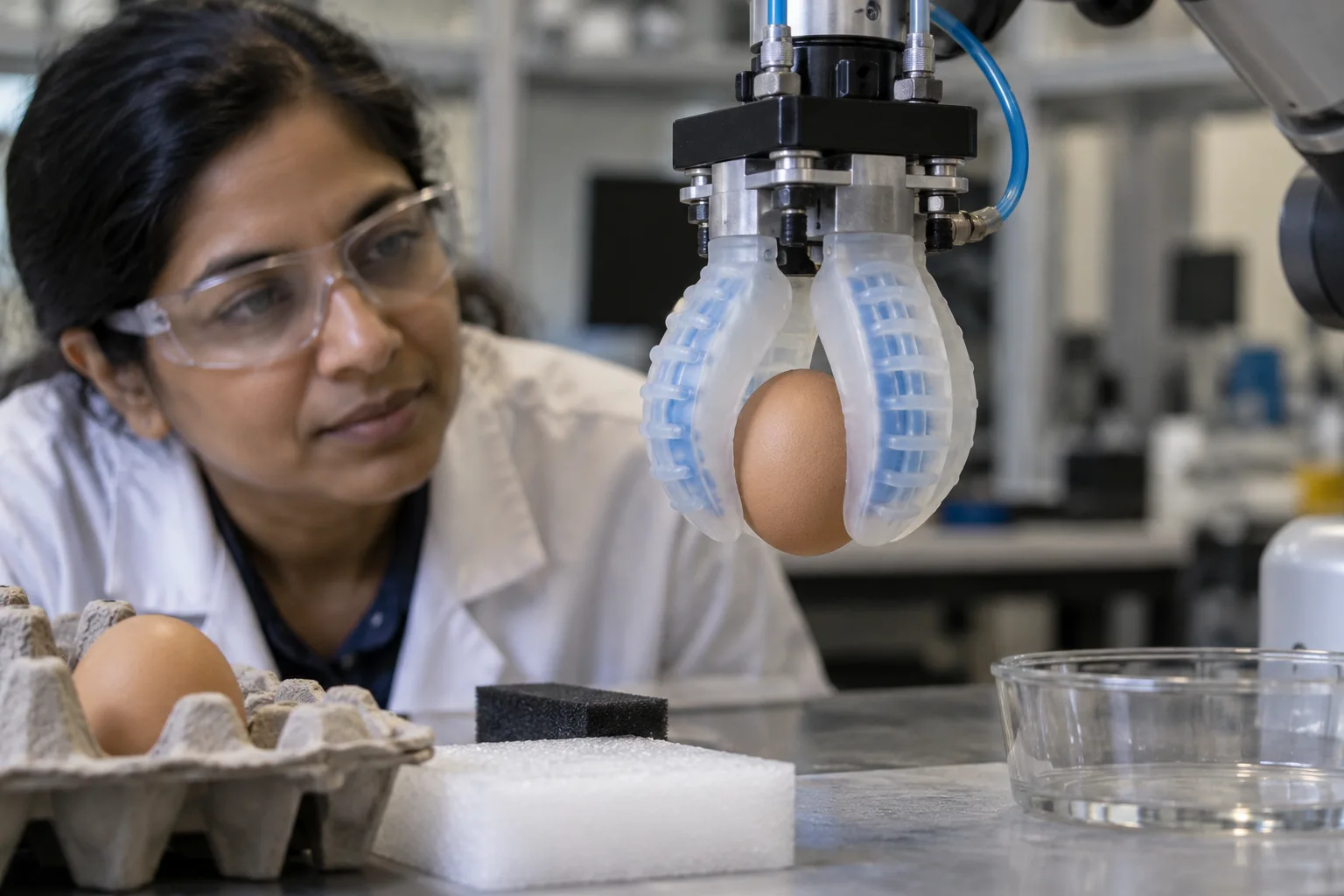
Close. Early pilots are running in the real world.
Robots have picked real crops in field and greenhouse trials, and a few growers use them commercially, mainly for strawberries, tomatoes and mushrooms. These deployments are small, most of the performance figures come from companies, and no independent trial over a full season was found in the sources reviewed. The stage is therefore pilot, not scaling or widespread.
The tech tree
Everything recorded on Vrulum that this future needs, oldest foundations at the top and the goal at the bottom. Lines show what each step requires.
- 2017Research prototypes that pick real crops in the fieldDone Unlocked.
- 2022Fresh-market apples picked across many orchardsNot started Locked.
- 2023Commercial use on real farmsDone Unlocked.
- Date not recordedPick success reported in trials on several cropsDone Unlocked.
- Date not recordedPicking speed close to a human pickerIn progress Being researched.
- Date not recordedMost ripe fruit picked without hand clean-upIn progress Being researched.
- Date not recordedPublic funding for harvest and packhouse automationIn progress Being researched.
- Date not recordedIndependent trial over a full season on one cropNot started Locked.
- GoalCrops picked by robots instead of peopleGoalRequires: Robotic fruit and vegetable harvesting, Soft robotic grippers, Research prototypes that pick real crops in the field, Pick success reported in trials on several crops, Commercial use on real farms, Picking speed close to a human picker, Most ripe fruit picked without hand clean-up, Public funding for harvest and packhouse automation, Independent trial over a full season on one crop, Fresh-market apples picked across many orchards. Locked.
The road so far
3 of 8 steps done, 3 in progress.
- Done · 2017Research prototypes that pick real crops in the field
Silwal and colleagues picked 127 of 150 apples in a commercial orchard in Washington State. Xiong and colleagues tested a strawberry robot in polytunnels. Arad and colleagues tested the SWEEPER sweet pepper robot on 262 fruit over four weeks in a commercial greenhouse. [3][1][4]
- DonePick success reported in trials on several crops
Reported success varies widely. Silwal and colleagues report 84% for apples. Xiong and colleagues report first-attempt success of 50% to 97.1% for partly surrounded or isolated strawberries, rising to 75% to 100% with one more attempt. Parsa and colleagues report 87% of detected strawberries harvested in tests on a commercial field and a research farm, with 83% for pluckable fruit. Arad and colleagues report 61% for sweet peppers under the best-fit crop conditions and 18% under current conditions. The studies define success differently, so the figures cannot be compared directly. [3][1][2][4]
- Done · 2023Commercial use on real farms
Robots are in commercial use on a small number of farms, and most reports are company statements. KentOnline reports a fleet of about 70 strawberry robots in the UK and Australia, which pick many tens of tons of fruit each season. A Chilean grower, Unifrutti, ran Tevel's flying apple robots on several varieties from March to May 2023. A FANUC case study from October 2025 describes a Dutch greenhouse, Westburg, that runs a robot tomato harvesting fleet day and night. 4AG Robotics says its mushroom robots are in use in Canada, Ireland and Australia. [5][7][8][9]
- In progressPicking speed close to a human picker
Speed is closer to human pace in some tests, but not shown across full picking cycles. Xiong and colleagues report 6.1 seconds for manipulation in one-arm mode and 4.6 seconds in two-arm mode. Silwal and colleagues report 6.0 seconds per apple. SWEEPER averaged 24 seconds per fruit, and about half of that was logistics, such as discharging fruit and moving the platform. Laboratory tests suggested 15 seconds could be possible with a faster manipulator. Dogtooth's chief executive says its fifth-generation strawberry robot can typically pick about 200 kg of fruit a day, which he says is comparable to a human picker. This is a company statement, not an independent measurement. [1][3][4][5]
- In progressMost ripe fruit picked without hand clean-up
Dogtooth says its fifth-generation robot typically picks 80% to 90% of ripe berries, against about 95% for a human picker. Berries the robot misses are still picked by hand in a clean-up operation, and the company says a high extraction rate is needed to keep that cost low. The company also says robots waste less fruit than human pickers, who waste about 2.5%, but gives no measured robot figure. Parsa and colleagues report that their perception system judged ripeness with about 95% accuracy in their own tests. [5][2]
- In progressPublic funding for harvest and packhouse automation
The UK government says it will fast-track research on robotic crop harvesters and will raise support for agri-innovation by up to £50 million, mainly for packhouse automation. It sets a target of human picking parity in three to five years. USDA Economic Research Service data from 2022 show labour as up to 38% of production cost for fruit and tree nut farms. [10][11]
- Not startedIndependent trial over a full season on one crop
The published trials cover a few weeks or a single farm. The sources reviewed include no independent trial of a commercial harvester over a full season, including cost, damage and repeat picks of the same plants. [4][2][1]
- Not started · 2022Fresh-market apples picked across many orchards
Tevel said in January 2022 that its flying apple robots were not yet available for commercial use, with pilot projects planned in Spain, the US and Italy. Silwal and colleagues said in 2017 that no mechanical apple harvester for the fresh market was then commercially available. Arad and colleagues wrote in 2020 that about 50 robotic harvesting systems had been developed and none had been commercialised. The sources reviewed do not show a robot picking fresh-market apples across many orchards. [6][3][4]
Why it matters
Harvesting is one of the largest labour costs for many fruit and vegetable growers. UK government papers describe seasonal labour as hard to recruit, and both the UK and US governments are funding automation to reduce reliance on it. Robots that pick most of a crop at a reasonable cost would change how many workers farms need, when and where crops are grown, and how fruit reaches the packhouse. Whether that happens depends on speed, damage and cost, not only on whether a robot can pick at all.
What stands in the way
- Hidden fruit. Xiong and colleagues could not pick berries that were fully enclosed by leaves or other obstacles, because of limits in vision and gripper dexterity. Parsa and colleagues needed a picking head designed to remove occlusions.
- Cycle time. Logistics take a large share of the time per fruit in greenhouse tests, so throughput depends on the whole system, not only the picking arm.
- Crop conditions. Arad and colleagues found 61% success under best-fit conditions and 18% under current conditions, so crop layout and variety need to suit the robot.
- Clean-up. Missed fruit still needs hand picking, and the cost of clean-up can make a robot unprofitable if the extraction rate is too low.
- Damage and quality. Soft-fruit damage is claimed to be low by the companies, but no independent measurement across seasons was found in the sources reviewed.
- Cost and evidence. Harvest machines are a large capital cost. 4AG says its mushroom robots deliver return on investment in under three years. That is a company claim, and the sources do not show whether it is met.
Published forecasts
What others have predicted. These are their estimates, not ours.
| Who | Forecast | Timeframe | Made |
|---|---|---|---|
| UK government (Defra) | A stated government target, not an independent forecast: robotic crop harvester prototypes to reach human picking parity in three to five years. The government's response to the labour shortage review set this out in May 2024. [10] | 2027–2029 | 9 May 2024 |
Signals to watch
- An independent trial that reports pick rate, extraction rate and fruit damage for a commercial harvester over a full season on one crop.
- Published results from Tevel's apple pilots in Spain, the US and Italy, with success rates counted on the same basis.
- Deliveries against company fleet targets, such as Dogtooth's stated plan to build about 50 more robots in six months.
- UK government harvester prototype programme results, measured against the picking parity target.
- A robot harvesting fresh-market apples or sweet peppers for several unrelated growers, not only as a trial on one farm.
- Published cycle time that includes logistics, not only the time the arm takes to pick each fruit.
Sources
- peer reviewed paper
An autonomous strawberry-harvesting robot: Design, development, integration, and field evaluation
Ya Xiong, Yuanyue Ge, Lars Grimstad et al.. Journal of Field Robotics, 7 Aug 2019. - peer reviewed paper
Modular autonomous strawberry picking robotic system
Soran Parsa, Bappaditya Debnath, Muhammad Arshad Khan et al.. Journal of Field Robotics, 26 Jul 2023. - peer reviewed paper
Design, integration, and field evaluation of a robotic apple harvester
Abhisesh Silwal, Joseph R. Davidson, Manoj Karkee et al.. Journal of Field Robotics, 28 Apr 2017. - peer reviewed paper
Development of a sweet pepper harvesting robot
Boaz Arad, Jos Balendonck, Ruud Barth et al.. Journal of Field Robotics, 27 Jan 2020. - news
Kent's growers given lesson in robotic fruit picking from Dogtooth Technologies near Cambridge
Alan Smith. KentOnline, 3 Sept 2024. - news
Fruit-picking drones may be heading for an orchard near you
Ben Coxworth. New Atlas, 31 Jan 2022. - news
Unifrutti deploys Tevel's flying robots to harvest apples
Fruit Growers News, 30 May 2023. - company announcement
Automating Agriculture: Greenhouse Turns to Robots for Tomato Harvesting
FANUC America, 27 Oct 2025. - news
4AG Robotics picks up $29M for mushroom harvesting robots
The Robot Report, 30 Jul 2025. - government report
Independent review into labour shortages in the food supply chain: government response
GOV.UK (Defra), 9 May 2024. - government report
U.S. Fruit and Vegetable Industries Try To Cope With Rising Labor Costs
Skyler Simnitt, Philip Martin. USDA Economic Research Service, Amber Waves, 28 Dec 2022.
Last reviewed 21 Oct 2026.