Robotic fruit and vegetable harvesting
Also known as Robotic harvesting, Agricultural harvesting robots, Selective harvesting robots
Robots that pick strawberries, apples, sweet peppers and other crops have moved from research prototypes into field trials and early commercial pilots. Published field trials report first-attempt success rates from about 18% to 97.1%, and occlusion, ripeness detection and picking speed remain the main limits.

In plain language
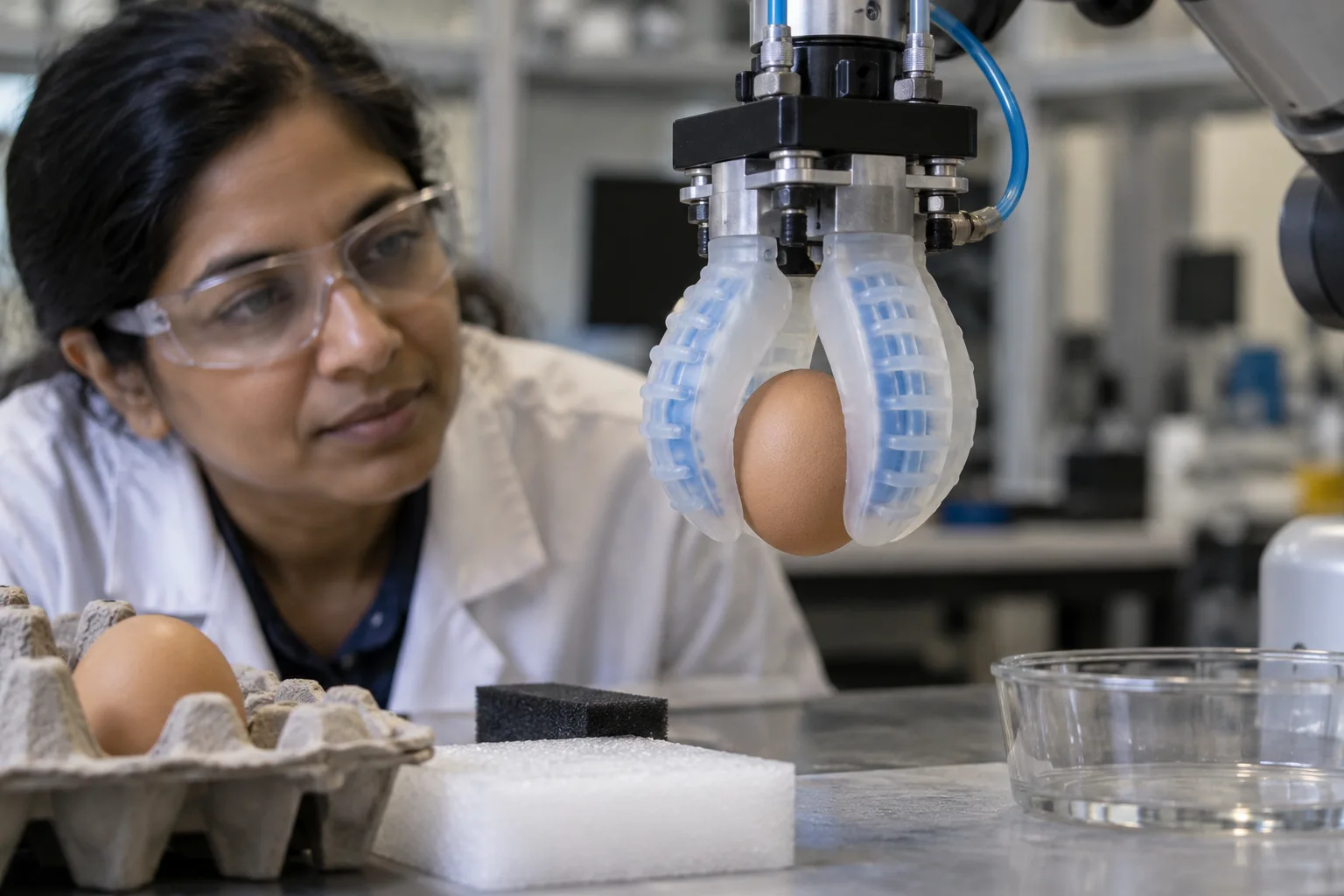
Harvesting robots have to do what a hand picker does. They must find ripe fruit among leaves, stems and other fruit, work out where to grip, and pull or cut the fruit free without bruising it. Cameras and image analysis find the fruit, and an arm and gripper reach in to pick it. Soft fruit such as strawberries is hard to handle, and the stalk can be hidden behind leaves or other berries.
The need is real. The UK government describes horticulture as one of the most labour-intensive sectors in the economy, and says many crops are still picked by hand. It states that the sector needs about 60,000 seasonal workers a year, fewer than 5% of them British. Research teams and companies have tested robots on strawberries, apples and sweet peppers in fields and greenhouses. Their success rates vary widely, from 18% to 97.1% in the published results, and most of the evidence comes from small trials. Speed is the other main problem, and the claims that robots are close to human pace are mostly made by the companies themselves.
Technical explanation
A typical system has three parts: a perception system that finds fruit and judges whether it is ready, a manipulator arm that moves the gripper, and an end effector that detaches the fruit. Arad and colleagues describe SWEEPER, a sweet pepper robot with a six-degree-of-freedom industrial arm, a custom end effector, an RGB-D camera and a GPU-equipped computer, mounted on an autonomous cart with a storage container. Parsa and colleagues use a patented picking head with 2.5 degrees of freedom that removes occlusions and cuts the peduncle without contacting the fruit flesh. Xiong and colleagues describe a low-cost dual-arm strawberry robot with an algorithm that uses the gripper to push aside leaves, berries and other obstacles before picking. Silwal and colleagues describe a seven-degree-of-freedom apple harvester tested in a commercial orchard.
Results are hard to compare. Studies define success differently. Xiong and colleagues report first-attempt success and success after one further attempt, while Parsa and colleagues report results across detected fruit and separately for pluckable fruit. Cycle time also varies in definition. In the SWEEPER study, the average of 24 seconds per fruit included about half for logistics, such as discharging fruit and moving the platform, and laboratory tests suggested that 15 seconds could be possible with a faster manipulator. In the Xiong study, manipulation took 6.1 seconds in one-arm mode and 4.6 seconds in two-arm mode. Crop conditions matter as much as the robot: Arad and colleagues report 61% success under best-fit crop conditions and 18% under current conditions.
Commercial figures are the least verified part of the evidence. In 2024, Dogtooth said its fifth-generation strawberry robot typically picks about 200 kg of fruit a day, which its chief executive said was comparable to what a human might achieve. The company gave an extraction rate, the share of ripe berries picked, of 80 to 90% for that robot, against 95% for a human. Tevel's flying autonomous robots (FAR) were described in January 2022 as not yet available for commercial use, with pilot projects planned. None of these company claims has been checked against independent trial data in the sources reviewed here.
What the evidence says
Each statement is typed by the strength of its evidence and linked to the source that supports it.
Demonstrated Shown in a published experiment, test or shipping product.
Xiong and colleagues report that their dual-arm strawberry robot, in field trials, achieved first-attempt pick success from about 50% to 97.1% for partially surrounded or isolated berries, rising to 75% to 100% with one further attempt, and could not pick berries that were completely enclosed by obstacles.
Sources: [1] · Abstract (via Crossref)Parsa and colleagues report that their modular strawberry system harvested 87% of detected strawberries in tests on a commercial field and a research farm, with 83% success for pluckable fruit, and that its perception system judged ripeness with about 95% accuracy.
Sources: [2] · Abstract (via Crossref) · medium confidenceSilwal and colleagues report that their seven-degree-of-freedom apple harvester picked 127 of 150 attempted apples in a commercial Washington orchard, an 84% success rate.
Sources: [3] · Abstract (via Crossref)In field tests on 262 sweet peppers over four weeks in a commercial greenhouse, the SWEEPER robot of Arad and colleagues reached 61% harvest success under best-fit crop conditions and 18% under current conditions, with an average cycle time of 24 seconds per fruit, about half of it logistics.
Sources: [4] · Abstract (via Crossref) · medium confidenceReported, unverified Stated by a company or team but not independently confirmed.
Dogtooth says its fifth-generation strawberry robot typically picks about 200 kg of fruit a day, which its chief executive says is comparable to what a human might achieve, and reaches an extraction rate of 80 to 90% of ripe berries, against 95% for a human.
Sources: [6] · Quoted statements from the Dogtooth CEO · low confidenceIn September 2024, Dogtooth reported a fleet of about 70 strawberry robots and said it expected to build about 50 more within six months.
Sources: [6] · Article text · low confidenceIn January 2022, Tevel's flying autonomous fruit-picking robots were reported as not yet available for commercial use, with pilot projects planned in apple orchards in Spain, the US and Italy.
Sources: [5] · Article text · medium confidenceThe UK government states that horticulture needs about 60,000 seasonal workers each year, that fewer than 5% of them are British, and that many crops are still harvested and packed by hand.
Sources: [7] · Horticulture labour and seasonal workers section · medium confidenceProposed A design or plan that has not yet been built or tested.
The UK government states that robotic crop harvester prototypes are targeted to reach human picking parity in three to five years.
Sources: [7] · Government support for automation sectionLimitations and open problems
- Published success rates come from a small number of trials, each on one or two farms or greenhouses, and the definitions differ. Some studies count first attempts, others count retries, so the rates cannot be compared directly.
- Occlusion remains a limit. Xiong and colleagues could not pick berries that were completely enclosed by obstacles, and Parsa and colleagues needed a picking head designed to remove occlusions.
- Speed is a gap. The SWEEPER greenhouse robot averaged 24 seconds per fruit, and about half of that time was logistics, so cycle time as well as picking accuracy sets throughput.
- Ripeness detection is not solved in every condition. Parsa and colleagues report 95% accuracy for their own perception system, and the sources reviewed here give no shared benchmark for ripeness detection.
- Crop conditions and variety strongly affect results. Arad and colleagues found 61% success under best-fit conditions and 18% under current conditions.
- Most commercial performance figures come from companies, in press coverage rather than peer-reviewed papers, and have not been independently verified.
Possible future uses
Ideas, not predictions. None of these has been demonstrated.
- Continuous picking in controlled polytunnels, where robots could work beyond daylight hours and pick fruit at the stage of ripeness a grower chooses.
- Using data that robots collect on fruit size, ripeness and yield to plan orchard management and packhouse sorting.
- Reducing bruising and waste in soft fruit by picking each berry at the right stage and handling it with soft grippers.
Timeline
- 28 Apr 2017Silwal and colleagues publish a field evaluation of a robotic apple harvester that picked 127 of 150 attempted apples in a commercial Washington orchard. Sources: [3]
- 7 Aug 2019Xiong and colleagues publish online their dual-arm strawberry robot, with first-attempt pick success from about 50% to 97.1% for partially surrounded or isolated berries in field tests. Sources: [1]
- 27 Jan 2020Arad and colleagues publish the SWEEPER sweet pepper robot results: 61% success under best-fit crop conditions and 18% under current conditions in a commercial greenhouse. Sources: [4]
- 31 Jan 2022Tevel's flying autonomous fruit-picking robots are reported as not yet available for commercial use, with pilot projects planned for apple orchards. Sources: [5]
- 9 May 2024The UK government states that horticulture needs about 60,000 seasonal workers a year and sets a target for robotic crop harvester prototypes to reach human picking parity in three to five years. Sources: [7]
- 3 Sept 2024Dogtooth reports a fleet of about 70 strawberry robots and says its fifth-generation robot typically picks about 200 kg of fruit a day (company statement). Sources: [6]
Futures this could help bring about
Glossary
- Peduncle
- The stalk that joins a fruit to the plant. Many harvesting robots cut or grip it rather than pulling the fruit itself.
- Occlusion
- When leaves, stems or other fruit block a camera or gripper from seeing or reaching a target.
- End effector
- The gripper or tool at the end of a robot arm that makes contact with the fruit.
- Cycle time
- The time a robot takes to harvest one fruit, including moving to it and handling it. Studies define it in different ways.
Sources
- peer reviewed paper
An autonomous strawberry-harvesting robot: Design, development, integration, and field evaluation
Ya Xiong, Yuanyue Ge, Lars Grimstad et al.. Journal of Field Robotics, 7 Aug 2019. DOI: 10.1002/rob.21889. Accessed 21 Oct 2026. - peer reviewed paper
Modular autonomous strawberry picking robotic system
Soran Parsa, Bappaditya Debnath, Muhammad Arshad Khan et al.. Journal of Field Robotics, 26 Jul 2023. DOI: 10.1002/rob.22229. Accessed 21 Oct 2026. - peer reviewed paper
Design, integration, and field evaluation of a robotic apple harvester
Abhisesh Silwal, Joseph R. Davidson, Manoj Karkee et al.. Journal of Field Robotics, 28 Apr 2017. DOI: 10.1002/rob.21715. Accessed 21 Oct 2026. - peer reviewed paper
Development of a sweet pepper harvesting robot
Boaz Arad, J. Balendonck, R. Barth et al.. Journal of Field Robotics, 27 Jan 2020. DOI: 10.1002/rob.21937. Accessed 21 Oct 2026. - news
Fruit-picking drones may be heading for an orchard near you
Ben Coxworth. New Atlas, 31 Jan 2022. Accessed 21 Oct 2026. - news
Kent's growers given lesson in robotic fruit picking from Dogtooth Technologies near Cambridge
Alan Smith. KentOnline, 3 Sept 2024. Accessed 21 Oct 2026. - government report
Independent review into labour shortages in the food supply chain: government response
GOV.UK, 9 May 2024. Accessed 21 Oct 2026.
Revision history
3 changes since this profile was created.