Vertical farming and controlled-environment agriculture
Also known as Vertical farming, Indoor vertical farming, Plant factories, Controlled-environment agriculture
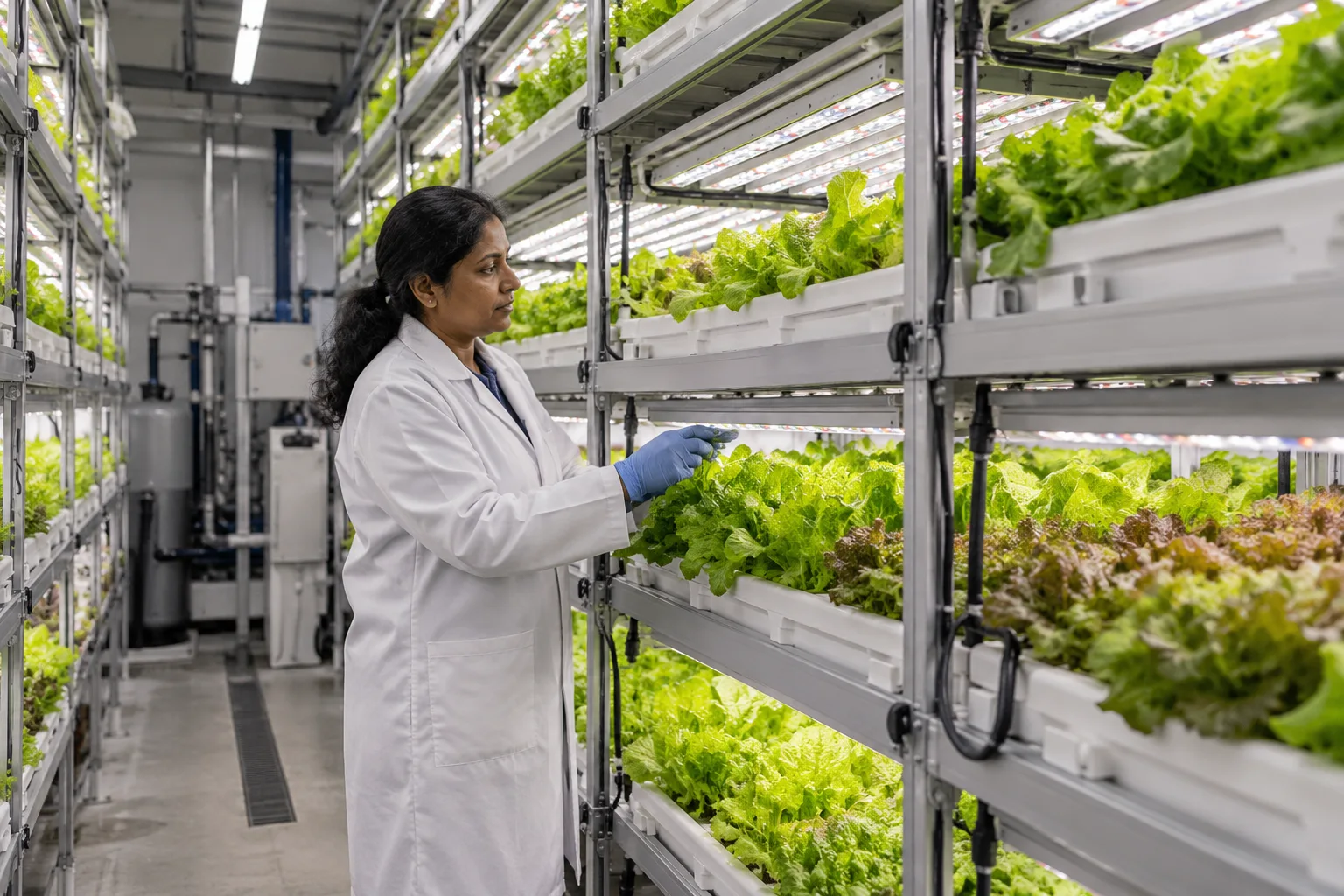
Vertical farming grows crops indoors in stacked layers under artificial light and controlled climate. It can produce high yields per floor area, but lighting and climate control require substantial energy. Life-cycle studies show that its climate impact depends strongly on the electricity supply, waste-heat recovery, crop and facility design; benefits in one category, such as land use, do not guarantee lower impacts in others.
In plain language
Vertical farms grow plants indoors, often in stacked layers, with artificial light and control over air, water and temperature. This can reduce the land needed for a given crop output and allows growers to recirculate water and nutrients. It also lets production operate independently of outdoor weather, although the building still has to create the light and climate the plants need.
Electricity is a central trade-off. LEDs provide the light used for photosynthesis, while heating, ventilation and air conditioning (HVAC) manage temperature and humidity. A modelling study of lettuce in Arizona found that hydroponic greenhouse production needed far more energy per kilogram than conventional farming, although it used less land and water. That study was about a greenhouse, not a fully indoor vertical farm, so its figures should not be used as a direct measurement of vertical-farm performance.
Recent life-cycle studies of actual or modelled farms show why there is no single environmental verdict. A UK commercial-farm assessment found that electricity and growing plugs were major impact hotspots, and that the climate result changed with the electricity source. A Finnish case study found that using renewable electricity and waste heat improved the modelled vertical farm's results, while a vertical farm using average electricity without waste-heat recovery performed worse than a greenhouse supplied with renewable energy. These comparisons concern particular lettuce systems and assumptions; they do not establish that every vertical farm is better or worse than field production.
Technical explanation
Vertical farms, also called sunless controlled-environment agriculture, combine LED lighting, climate control and water and nutrient delivery, usually in stacked growing layers. The lighting system supplies photosynthetic photon flux; HVAC removes heat from lights and plant transpiration while maintaining crop-specific temperature and humidity. A 2024 energy and cost model of lettuce production estimated that lighting accounted for 65–85% of facility energy and HVAC for 10–20% in its analysed design. Those shares are design-specific rather than a universal breakdown.
Environmental comparisons depend on the functional unit, system boundary and local energy mix. Barbosa and colleagues (2015) modelled hydroponic greenhouse lettuce in Yuma, Arizona using crop budgets, statistics and engineering equations; they estimated 11 times the yield per area but 82 times the energy per kilogram compared with conventional lettuce. This is not an indoor vertical farm measurement. By contrast, Gargaro and colleagues (2024) performed a life-cycle assessment using primary production data from a commercial UK vertical farm and compared it with literature data for field lettuce. They identified electricity and cultivation plugs as hotspots, and reported that the climate-change result was similar to or lower than field production depending on electricity source; some other categories, including freshwater eutrophication and acidification, were higher.
Joensuu and colleagues (2024) compared Finnish vertical-farm and greenhouse lettuce scenarios. In their model, renewable electricity and waste-heat use improved the vertical-farm result, while the scenario using average electricity without waste-heat recovery had a greater climate impact than greenhouse production using renewable energy. Arcasi and colleagues (2024) modelled farms in Stockholm, Naples and Riyadh and found energy consumption and energy cost varied with climate and operating conditions. Together these studies show that vertical farming outcomes depend on energy supply, waste-heat use, crop output, growing media and facility design; a high yield per square metre alone does not establish lower total environmental impact.
Aborujilah (2025) systematically reviewed 52 articles published from 2014 to early 2024. It describes efficiency improvements involving LEDs, HVAC control and irrigation automation, while identifying high capital costs, staff skills, inconsistent metrics and limited real-world data as adoption barriers. De Carbonnel and colleagues (2022) propose using knowledge of plant photobiology to shift some lighting demand in time; this is a demand-management concept, not a demonstrated grid-scale benefit.
What the evidence says
Each statement is typed by the strength of its evidence and linked to the source that supports it.
Demonstrated Shown in a published experiment, test or shipping product.
Advances in LED lighting have made vertical farming systems commercially viable, according to a 2022 review.
Sources: [3] · Abstract · medium confidenceA systematic review of 52 articles from 2014 to early 2024 found that efficient LEDs, smart HVAC control and IoT-based irrigation have reduced electricity consumption in vertical farms.
Sources: [4] · Abstract · medium confidenceEnergy savings in vertical farms vary with crop type, climate, facility layout, system design and geography, and high upfront costs and limited real-world data remain barriers (Aborujilah, 2025).
Sources: [4] · Abstract · medium confidenceA life-cycle assessment using primary data from a commercial UK vertical farm identified electricity demand and cultivation plugs as system hotspots. Its climate-change result was similar to or below field lettuce depending on electricity source, while some other impact categories were higher.
Sources: [5] · AbstractA Finnish case study found that renewable electricity and waste-heat recovery improved the modelled vertical farm's environmental results; its vertical-farm scenario using average electricity without waste-heat use had a greater climate impact than a greenhouse scenario using renewable energy.
Sources: [6] · Abstract and ResultsAn energy and cost model for a vertical-farm design estimated lighting to account for 65–85% of energy use and HVAC for 10–20%, and found energy demand depended on climate conditions.
Sources: [7] · Abstract and highlightsReported, unverified Stated by a company or team but not independently confirmed.
The high electricity use of vertical farming systems weakens their environmental case, according to de Carbonnel and colleagues (2022).
Sources: [3] · Abstract · medium confidenceIn a modelling study of lettuce grown in Yuma, Arizona, hydroponic greenhouse production gave 11 times the yield per square metre but needed 82 times more energy per kilogram than conventional production.
Sources: [1] · Abstract · medium confidenceProposed A design or plan that has not yet been built or tested.
Plant photobiology could be used to match vertical farm electricity use to grid availability, supporting demand-side energy management, as proposed by de Carbonnel and colleagues (2022).
Sources: [3] · Abstract · medium confidenceLimitations and open problems
- Electricity for lighting and climate control is a major operational demand. Its climate impact depends on the electricity mix and cannot be inferred from yield per area alone.
- Life-cycle assessments include different boundaries, comparators and environmental categories; one favourable climate result does not imply lower impact in every category.
- Energy use and costs vary with crop, climate, facility layout, energy source and waste-heat recovery, so results from one site do not transfer directly to another.
- The 2015 comparison by Barbosa and colleagues models hydroponic greenhouse production rather than an indoor vertical farm and relies on literature values and engineering equations.
- A 2024 UK commercial-farm assessment identified cultivation plugs as well as electricity as impact hotspots; replacing one input can shift the life-cycle result.
- Upfront costs, few trained staff, inconsistent reporting and limited real-world data are barriers to wider adoption (Aborujilah, 2025).
Possible future uses
Ideas, not predictions. None of these has been demonstrated.
- Vertical farms timed to use surplus renewable electricity when grid demand is low, with lighting schedules set by grid conditions.
- Urban vertical farms supplying leafy greens to city shops with short transport distances.
- Vertical farms in regions with scarce water and land, where recirculating systems could be a major source of fresh produce.
Product concepts: Vertical farm inside unused office towers, Shipping-container farm for polar stations
Timeline
- 16 Jun 2015Barbosa and colleagues publish a comparison of land, water and energy needs for hydroponic and conventional lettuce, finding far higher energy use for hydroponics. Sources: [1]
- 20 Nov 2017Benke and Tomkins publish a review of vertical farming and controlled-environment agriculture as future food-production systems. Sources: [2]
- 16 Jun 2022De Carbonnel and colleagues publish a review proposing that plant photobiology could help coordinate vertical farm energy use with grid electricity availability. Sources: [3]
- 10 Sept 2025Aborujilah publishes a systematic review of 52 articles on energy return and efficiency in vertical farming. Sources: [4]
Futures this could help bring about
Glossary
- Controlled-environment agriculture
- Growing crops in enclosed spaces where light, temperature, humidity and nutrients are controlled.
- Hydroponics
- Growing plants with their roots in nutrient-rich water instead of soil.
- Photobiology
- The study of how light affects living organisms, including how plants use light to grow.
- Demand-side energy management
- Adjusting when and how much electricity is used, so that energy demand matches the supply available on the grid.
Sources
- peer reviewed paper
Comparison of Land, Water, and Energy Requirements of Lettuce Grown Using Hydroponic vs. Conventional Agricultural Methods
Guilherme Barbosa, Francisca Gadelha, Natalya Kublik et al.. International Journal of Environmental Research and Public Health, 16 Jun 2015. DOI: 10.3390/ijerph120606879. Accessed 21 Oct 2026. - review article
Future food-production systems: vertical farming and controlled-environment agriculture
Kurt Benke, Bruce Tomkins. Sustainability: Science, Practice and Policy, 20 Nov 2017. DOI: 10.1080/15487733.2017.1394054. Accessed 21 Oct 2026. - review article
Realising the Environmental Potential of Vertical Farming Systems through Advances in Plant Photobiology
Matthieu de Carbonnel, John M. Stormonth-Darling, Weiqi Liu et al.. Biology (MDPI), 16 Jun 2022. DOI: 10.3390/biology11060922. Accessed 21 Oct 2026. - review article
Towards Sustainable Vertical Farming: A Systematic Review of Energy Return on Investment Efficiency and Optimization Strategies
Abdulaziz Aborujilah. Sustainability (MDPI), 10 Sept 2025. DOI: 10.3390/su17188142. Accessed 21 Oct 2026. - peer reviewed paper
A cradle-to-customer life cycle assessment case study of UK vertical farming
Michael Gargaro, Astley Hastings, Richard J. Murphy et al.. Journal of Cleaner Production, 10 Sept 2024. DOI: 10.1016/j.jclepro.2024.143324. Accessed 22 Oct 2026. - peer reviewed paper
Assessment of climate change impact and resource-use efficiency of lettuce production in vertical farming and greenhouse production in Finland: a case study
K. Joensuu, T. Kotilainen, K. Räsänen. The International Journal of Life Cycle Assessment, 1 Aug 2024. DOI: 10.1007/s11367-024-02343-5. Accessed 22 Oct 2026. - peer reviewed paper
Energy and cost analysis for a crop production in a vertical farm
A. Arcasi, A. W. Mauro, G. Napoli et al.. Applied Thermal Engineering, 15 Feb 2024. DOI: 10.1016/j.applthermaleng.2023.122129. Accessed 22 Oct 2026.
Revision history
4 changes since this profile was created.