Cultivated meat
Also known as Cell-cultivated meat, Cell-based meat, Lab-grown meat
Cultivated meat is produced by growing animal cells in bioreactors instead of raising whole animals. US, UK, and Australian and New Zealand regulators have started product-specific reviews, but high culture media costs and the need for structures to support thick tissue remain major hurdles.
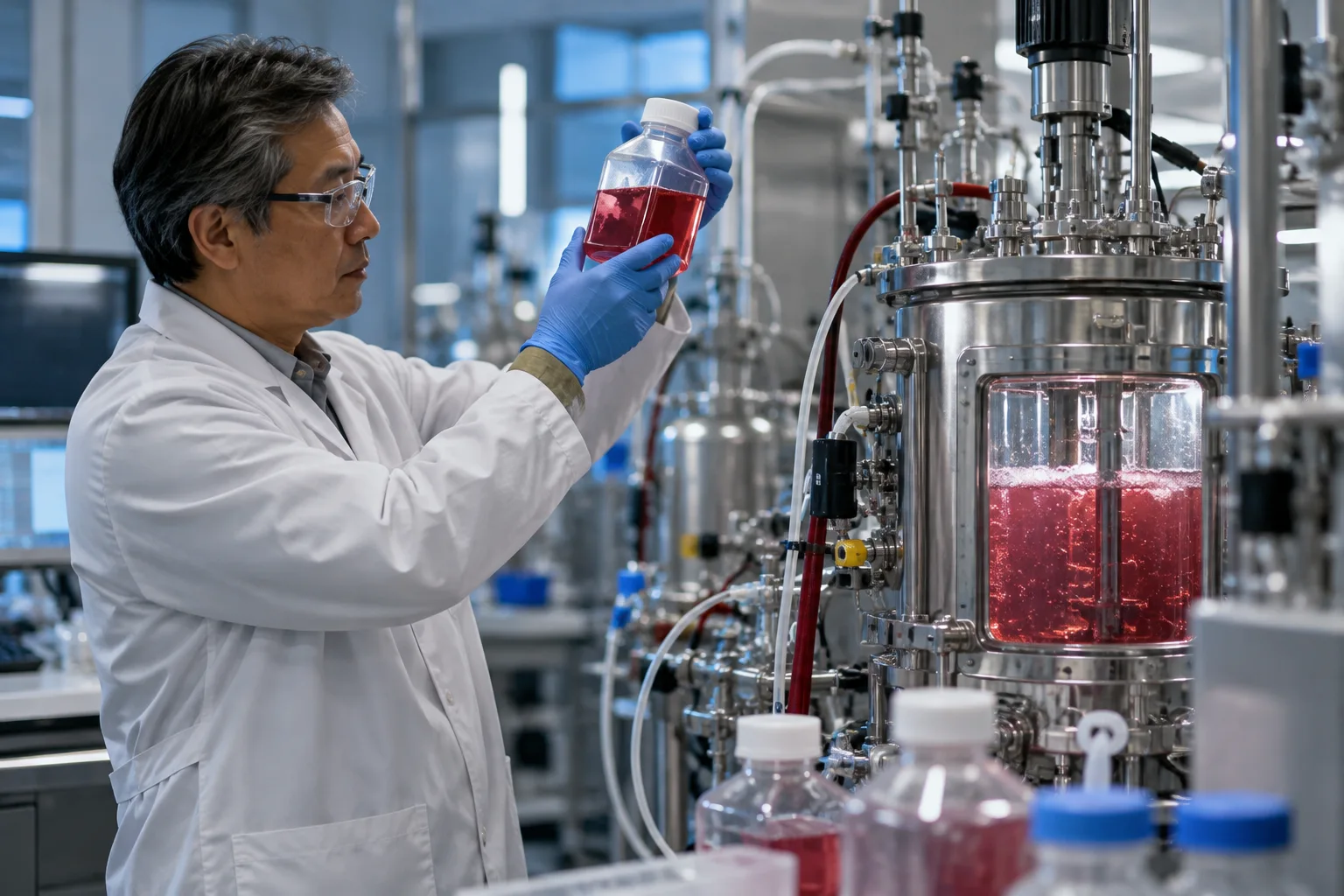
In plain language
Cultivated meat, sometimes called cell-cultivated or lab-grown meat, starts with a small sample of cells taken from an animal. The cells are fed a nutrient liquid in a large tank called a bioreactor, where they multiply and form muscle and fat tissue. That tissue is then harvested and processed into food.
Making this work at a price people would pay is hard. The nutrient liquid, known as culture medium, is expensive, and thick pieces of meat need a supporting structure or a pumping system to supply oxygen. Governments also need to check that the food is safe before it is sold. In November 2022 the US Food and Drug Administration completed its first voluntary safety consultation for a cultivated chicken product, and by February 2026 its public inventory listed five completed consultations. In June 2025 Australia and New Zealand amended their food code to allow sale of a cell-cultured quail product, and in December 2025 the UK published its first safety guidance for these foods. Each decision covers a specific product, not cultivated meat in general.
Technical explanation
Production usually starts from a cell line derived from an animal. Cells are expanded in culture medium in stirred tank or perfusion bioreactors. Kirsch and colleagues (2023) report that medical-grade culture media cost around 400 USD per litre, and that about half of the amino acids remain in spent medium. The review proposes recycling spent medium as one way to cut costs.
Oxygen diffusion into tissue is believed to be limited to about 200 micrometres, so thin products can rely on diffusion, but thicker structures need vascularised scaffolds or active perfusion (Kirsch and colleagues, 2023). Humbird (2021) models fed-batch and perfusion facilities and gives cost estimates of about 37 and 51 USD per kilogram of wet cell mass, respectively. These are model estimates, not measured plant costs. In 2024, Pasitka and colleagues ran continuous production of chicken cells in an animal-component-free medium and used those data to model a theoretical 50,000-litre facility.
Cell sourcing is a further constraint. The review reports that spontaneous immortalisation occurred in only about 2% of the cell population, and that most non-bovine livestock cell lines carry introduced TERT or SV40 genes, which creates regulatory questions. Regulatory treatment also differs by region: in the EU, non-genetically modified products fall under Novel Food rules, while genetically modified cell lines fall under GMO legislation (Kirsch and colleagues, 2023).
What the evidence says
Each statement is typed by the strength of its evidence and linked to the source that supports it.
Demonstrated Shown in a published experiment, test or shipping product.
In November 2022 the FDA completed a voluntary pre-market consultation for a cultivated chicken product from UPSIDE Foods and said it had no further questions about the company's safety conclusion; the FDA states the consultation is not an approval process.
Sources: [2]The UK's first safety guidance for cell-cultivated products, published on 4 December 2025 by Food Standards Scotland and the Food Standards Agency, defines cell-cultivated products made from animal cells as products of animal origin, so existing food safety rules apply during production; it helps businesses show their products are safe before they can be authorised for sale.
Sources: [4]Oxygen diffusion into tissue is believed to be limited to about 200 micrometres, so thick cultivated meat structures need vascularised scaffolds or active perfusion.
Sources: [1]The FDA's public inventory lists five completed pre-market consultations for human food made from cultured animal cells: cultured chicken from UPSIDE Foods (16 November 2022) and GOOD Meat (20 March 2023), cultured pork fat from Mission Barns (7 March 2025), cultured salmon from Wildtype (28 May 2025), and cultured chicken from Believer Meats (24 July 2025). The inventory was last updated in February 2026.
Sources: [5]FSANZ announced on 9 April 2025 that its Board had approved cell-cultured quail under Application A1269, and Amendment No. 239 to the Food Standards Code was gazetted on 18 June 2025. The approval covers the cultured quail product only; the FSANZ page states that cell-cultured foods must still be assessed and approved before they can be sold.
Sources: [6], [7]FSANZ concluded that the cultured quail product presents no toxicological, nutritional or allergenic concerns, and found the quail cell line genetically stable.
Sources: [7]Amendment No. 239 requires cell-cultured foods to be labelled as cell-cultured or cell-cultivated, adds food-safety controls for production and processing, and sets microbiological limits for Salmonella and Listeria in cell-cultured food products. The page does not state the numeric limits.
Sources: [7]Reported, unverified Stated by a company or team but not independently confirmed.
Medical-grade culture media for cultivated meat are reported to cost around 400 USD per litre, which the review describes as making the whole process very expensive.
Sources: [1] · medium confidenceIn Humbird's (2021) model, a fed-batch facility of 24 bioreactors of 20 cubic metres each, producing 6.8 kilotonnes per year, comes to about 37 USD per kilogram of wet cell mass, and a perfusion facility of 96 bioreactors of 2 cubic metres each, producing 6.9 kilotonnes per year, comes to about 51 USD per kilogram; these are modelled estimates, not measured production costs.
Sources: [9] · medium confidenceSpontaneous immortalisation occurred in only about 2% of the cell population, and most non-bovine livestock cell lines carry introduced genes such as TERT or SV40, which creates regulatory problems.
Sources: [1] · medium confidenceThe review reports that consumer acceptance of cultivated meat varies significantly, from 5 to 11% up to 65%, depending on country and respondent group.
Sources: [1] · low confidencePasitka and colleagues report continuous manufacturing of cultivated chicken using tangential flow filtration, reaching biomass of up to 130 million cells per millilitre with multiple harvests over more than 20 days, in an animal-component-free medium costing about US$0.63 per litre.
Sources: [8] · medium confidencePasitka and colleagues model a theoretical 50,000-litre facility using perfusion and estimate that cultivated chicken could fall to about US$6.2 per lb, within the range of organic chicken. The authors state that other variables would also affect actual market prices, so this is a modelled projection and not an observed price.
Sources: [8] · medium confidenceHumbird (2021) reports that slow animal cell growth, metabolic inefficiency, growth-inhibiting by-products such as lactate and ammonia, and shear damage limit practical bioreactor volume and cell density, and that the projected costs of amino acids and protein growth factors are high. The author concludes that improved metabolic efficiency and low-cost media are both necessary but insufficient for cultured meat to displace conventional meat.
Sources: [9] · medium confidenceNegulescu and colleagues (2023) publish a techno-economic model of cultivated meat production whose title identifies production bioreactor scale as the factor analysed. The full text was not read, so this paper is cited for its scope only and no results are reported from it.
Sources: [10] · low confidenceProposed A design or plan that has not yet been built or tested.
The review proposes a target price of no more than 50 USD per kilogram for cultivated meat and suggests that hybrid products combining plant protein and cultivated cells could help reach it.
Sources: [1] · medium confidenceLimitations and open problems
- Culture medium cost is a major cost driver; Kirsch and colleagues (2023) report medical-grade media at around 400 USD per litre.
- Thick products need vascularised scaffolds or perfusion, because oxygen diffusion is believed to be limited to about 200 micrometres (Kirsch and colleagues, 2023).
- Most non-bovine livestock cell lines need introduced genes, which creates regulatory questions (Kirsch and colleagues, 2023).
- The FDA states that its voluntary pre-market consultation is not an approval process (FDA, 2022), and the UK guidance helps businesses show their products are safe before they can be authorised for sale (FSS and FSA, 2025).
- Consumer acceptance estimates cited in the review range from 5 to 11% up to 65%, depending on country and respondent group (Kirsch and colleagues, 2023).
- The FDA inventory lists five completed consultations, each tied to a single firm and a described cell material (FDA inventory, updated February 2026).
- The Australia and New Zealand authorisation covers cell-cultured quail only, and each further cell-cultured food still needs assessment (FSANZ, 2025).
- The cost figure from Pasitka and colleagues (2024), about USD 6.20 per lb, is a model result for a theoretical 50,000-litre facility, not an observed retail price.
- Humbird (2021) concludes that improved metabolic efficiency and low-cost media are both necessary but insufficient for cultured meat to displace conventional meat.
Possible future uses
Ideas, not predictions. None of these has been demonstrated.
- Hybrid products that blend cultivated animal cells with plant proteins to bring the cost of each kilogram down, a route the review itself proposes.
- Cultivated fat as a separate ingredient for processed foods, where texture and flavour matter more than whole-cut appearance.
- Cell-based ingredients for pet food, which may face different regulatory routes from human food.
Timeline
- 16 Nov 2022FDA completes its first voluntary pre-market consultation for a human food made from cultured animal cells, a cultivated chicken product from UPSIDE Foods. Sources: [2]
- 10 Nov 2023The Food Standards Agency publishes guidance for businesses on cell-cultivated products and the authorisation process. Sources: [3]
- 20 Nov 2023Kirsch and colleagues publish a review of cultivated meat manufacturing covering media costs, scaffolds and cell sourcing in Engineering in Life Sciences. Sources: [1]
- 21 Aug 2024Pasitka and colleagues publish an empirical study of continuous manufacturing of cultivated chicken in Nature Food, with a techno-economic model for a theoretical 50,000-litre facility. Sources: [8]
- 7 Mar 2025FDA responds to a pre-market consultation for cultured pork fat from Mission Barns, the third completed US consultation for a cultivated product. Sources: [5]
- 9 Apr 2025FSANZ publishes news that its Board has approved cell-cultured quail under Application A1269, the first cell-cultured food approved in Australia and New Zealand. Food ministers then have 60 days to consider the decision. Sources: [6]
- 28 May 2025FDA responds to a pre-market consultation for cultured salmon cell material from Wildtype. Sources: [5]
- 18 Jun 2025Amendment No. 239 to the Australia New Zealand Food Standards Code is gazetted, adding labelling, food-safety and microbiological rules for cell-cultured foods. Sources: [7]
- 24 Jul 2025FDA responds to a pre-market consultation for cultured chicken cell material from Believer Meats. Sources: [5]
- 4 Dec 2025Food Standards Scotland and the Food Standards Agency publish the first UK safety guidance for cell-cultivated products. Sources: [4]
Futures this could help bring about
Glossary
- Culture medium
- The nutrient liquid that supplies sugars, amino acids, vitamins and growth factors to cells grown outside the body.
- Bioreactor
- A vessel in which cells or microorganisms are grown under controlled conditions such as temperature, oxygen and mixing.
- Scaffold
- A three-dimensional support on which cells attach and form tissue.
- Perfusion
- A method of continuously pumping fresh medium through a culture so that cells in the middle of a tissue receive nutrients and oxygen.
- Fed-batch
- A culture method in which nutrients are added during growth without removing the culture contents, so the process runs in a single batch.
- Seed train
- A series of progressively larger vessels used to expand cell numbers before cells are transferred to a production bioreactor.
Sources
- review article
Cultivated meat manufacturing: Technology, trends, and challenges
Marline Kirsch, Jordi Morales-Dalmau, Antonina Lavrentieva. Engineering in Life Sciences, 20 Nov 2023. DOI: 10.1002/elsc.202300227. Accessed 21 Oct 2026. - government report
FDA Completes First Pre-Market Consultation for Human Food Made Using Animal Cell Culture Technology
U.S. Food and Drug Administration, 16 Nov 2022. Accessed 21 Oct 2026. - government report
Cell-cultivated products - Guidance for businesses
Food Standards Agency, 10 Nov 2023. Accessed 21 Oct 2026. - government report
FSS and FSA publish first UK safety guidance on cell-cultivated products
Food Standards Scotland, 4 Dec 2025. Accessed 21 Oct 2026. - government report
Human Food Made with Cultured Animal Cells Inventory
U.S. Food and Drug Administration, Feb 2026. Accessed 21 Oct 2026. - government report
First cell-cultured food approved by FSANZ Board
Food Standards Australia New Zealand, 9 Apr 2025. Accessed 21 Oct 2026. - government report
A1269 Cultured Quail as a Novel Food
Food Standards Australia New Zealand, 18 Jun 2025. Accessed 21 Oct 2026. - peer reviewed paper
Empirical economic analysis shows cost-effective continuous manufacturing of cultivated chicken using animal-free medium
Laura Pasitka, Guy Wissotsky, Muneef Ayyash et al.. Nature Food, 21 Aug 2024. Accessed 21 Oct 2026. - peer reviewed paper
Scale-up economics for cultured meat
David Humbird. Biotechnology and Bioengineering, 2021. Accessed 21 Oct 2026. - peer reviewed paper
Techno-economic modeling and assessment of cultivated meat: Impact of production bioreactor scale
Patrick G. Negulescu, Derrick Risner, Edward S. Spang et al.. Biotechnology and Bioengineering, 2023. DOI: 10.1002/bit.28324. Accessed 21 Oct 2026.
Revision history
3 changes since this profile was created.