Organ-on-a-chip
Also known as Organ chips, Organs-on-chips, Microphysiological systems
Organ-on-a-chip devices are small plastic chips with tiny fluid channels lined with living human cells, built to copy how a tissue such as lung or liver behaves. They are used in drug research to test effects on human cells and are being considered by regulators as a partial alternative to some animal tests.
In plain language
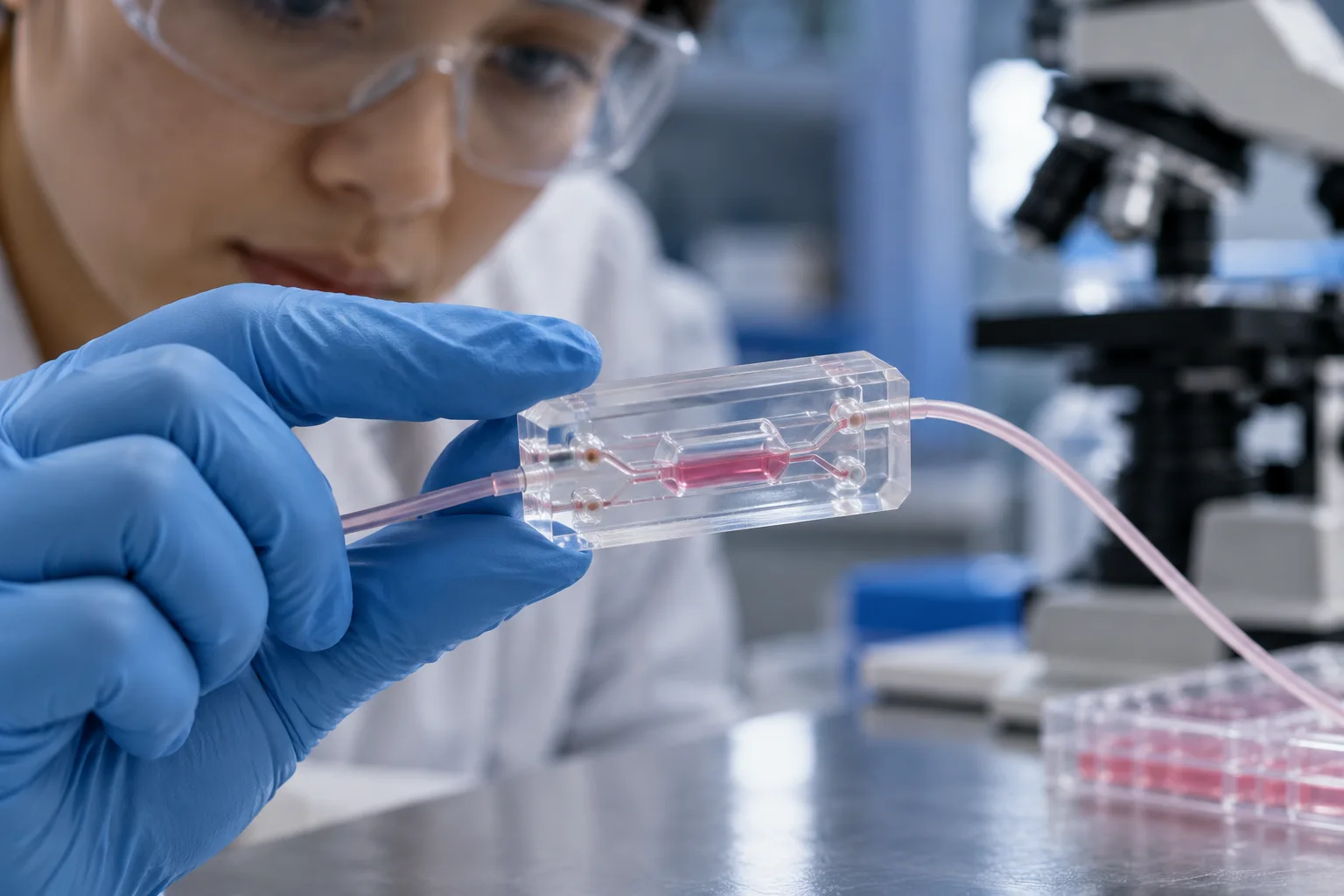
An organ chip is a small, clear plastic block. Inside are hollow channels thinner than a hair, separated by a porous membrane. Researchers grow different human cell types on each side, for example lung air-sac cells on one side and blood vessel cells on the other, and pump nutrient fluid through the channels so the cells experience flow, much as they would in the body.
Because the cells sit in a more lifelike setting than a flat dish, they can respond to drugs, toxins or infections in ways that are closer to real tissue. Drug companies use the chips to spot medicines that might damage the liver before they reach patients. The chips do not replace a whole body, and each one only models a small part of one organ.
Technical explanation
Most organ chips are microfluidic devices moulded in polydimethylsiloxane (PDMS), a soft, gas-permeable silicone. A typical two-channel design places a porous, extracellular-matrix-coated membrane between an epithelial channel and a vascular channel lined with endothelial cells. In the 2010 lung chip from the Wyss Institute, a 10 µm thick porous PDMS membrane separated alveolar epithelial and microvascular endothelial cells, and side vacuum chambers stretched the membrane cyclically (about 10% strain at 0.2 Hz) to mimic breathing. Continuous perfusion supplies nutrients and shear stress, and the transparent device allows live imaging and sampling of effluent.
The main use today is predictive toxicology and mechanism-of-action studies in drug development. A 2022 study of 870 human Liver-Chips tested 27 blinded drugs with known liver injury outcomes and reported 87% sensitivity and 100% specificity, compared with lower sensitivity for 3D hepatic spheroids in the same analysis. Separate chips can be linked by robotic fluid handling: one platform kept eight vascularised organ chips functional for three weeks while connected through a shared medium, and was used with a computational model to predict tracer distribution.
Key technical issues include absorption of small hydrophobic drugs into PDMS, which can lower the dose cells actually receive, variation between cell donors and laboratories, and low throughput compared with plate-based assays. Regulatory use is still emerging: the US FDA accepted a Liver-Chip letter of intent into its ISTAND qualification pilot in 2024, and in April 2025 announced a roadmap encouraging new approach methodologies, including organ chips, in place of some animal studies.
What the evidence says
Each statement is typed by the strength of its evidence and linked to the source that supports it.
Demonstrated Shown in a published experiment, test or shipping product.
A lung-on-a-chip with a 10 µm porous PDMS membrane and vacuum-driven cyclic stretching reproduced inflammatory responses to bacteria and cytokines, and stretching increased nanoparticle uptake and transport into the vascular channel.
Sources: [1] · Main text and figures on device design, inflammation and nanoparticle studiesIn a blinded study using 870 Liver-Chips and 27 drugs, the chip identified drug-induced liver injury with 87% sensitivity and 100% specificity when two donors and protein-binding correction were used; 3D hepatic spheroids reached 47% sensitivity under the same correction.
Sources: [3] · Results; study was led by authors employed by the chip manufacturer · medium confidenceA robotic liquid-handling platform kept eight fluidically linked, vascularised human organ chips (including gut, liver, kidney, heart, lung, skin, blood-brain barrier and brain) viable and functional for three weeks.
Sources: [2] · Abstract and ResultsPDMS absorbed some cardiac drugs from solution in a compound-dependent way, with more than 80% of bepridil lost after 3 hours, and absorption was not reliably predicted by hydrophobicity (log P).
Sources: [4] · ResultsIn April 2025 the FDA announced a roadmap to reduce, refine or replace animal testing in preclinical safety studies, starting with monoclonal antibodies, and said it would promote organ-on-a-chip systems among other new approach methodologies.
Sources: [6] · Press announcementReported, unverified Stated by a company or team but not independently confirmed.
Emulate's Liver-Chip S1 was accepted into the FDA ISTAND pilot programme at the letter-of-intent stage, for a proposed context of use in predicting small-molecule drug-induced liver injury; full qualification requires further stages.
Sources: [5] · Company article · medium confidenceProposed A design or plan that has not yet been built or tested.
The same study's economic model estimated that adopting the Liver-Chip for liver toxicity screening could add about $3 billion a year to pharmaceutical R&D productivity; this is a modelled projection, not an observed outcome.
Sources: [3] · Economic analysis section · low confidenceLimitations and open problems
- PDMS, the most common chip material, can absorb some small-molecule drugs; one study found more than 80% of bepridil lost to PDMS within 3 hours, distorting dose-response results.
- Each chip models only a small tissue unit, so whole-body effects such as metabolism across several organs need linked systems that remain complex to run.
- Results depend on the cell donor; single-donor Liver-Chip sensitivity was 73 to 77% versus 87% when two donors were combined.
- Formal regulatory qualification is not complete: the Liver-Chip accepted into the FDA ISTAND pilot was at the letter-of-intent stage, with a qualification plan and full qualification still to follow.
- Validated performance covers specific contexts, such as drug-induced liver injury for small molecules, rather than general replacement of animal or human studies.
Possible future uses
Ideas, not predictions. None of these has been demonstrated.
- Patient-specific chips built from an individual's own cells to test which drug or dose suits them before treatment begins.
- Linked multi-organ 'body-on-chips' used routinely to estimate human drug absorption and clearance before first-in-human trials.
- Chips seeded with cells from under-represented populations to check whether drug safety differs between groups before clinical trials.
Timeline
- Jun 2010Wyss Institute team publishes a breathing lung-on-a-chip in Science that reproduces inflammatory and nanoparticle responses. Sources: [1]
- Jan 2020Robotic platform links eight vascularised human organ chips and keeps them functional for three weeks. Sources: [2]
- Dec 2022Blinded study of 870 Liver-Chips across 27 drugs reports 87% sensitivity and 100% specificity for drug-induced liver injury. Sources: [3]
- 2024Emulate's Liver-Chip S1 is accepted into the FDA ISTAND pilot programme at the letter-of-intent stage. Sources: [5]
- 10 Apr 2025FDA announces a roadmap to phase out animal testing requirements for monoclonal antibodies, encouraging organ-on-a-chip and other new approach methodologies. Sources: [6]
Futures this could help bring about
Related breakthroughs
Glossary
- Microfluidics
- The handling of very small volumes of fluid in channels typically tens to hundreds of micrometres wide.
- PDMS
- Polydimethylsiloxane, a clear, flexible silicone rubber widely used to mould microfluidic chips.
- Drug-induced liver injury (DILI)
- Liver damage caused by a medicine; a leading reason drugs fail in development or are withdrawn.
- New approach methodologies (NAMs)
- Non-animal testing methods such as computer models, organoids and organ chips used to assess safety.
- ISTAND
- An FDA pilot programme for qualifying novel drug development tools, such as organ chips, for use in regulatory submissions.
Sources
- peer reviewed paper
Reconstituting organ-level lung functions on a chip
Dongeun Huh, Benjamin D. Matthews, Akiko Mammoto et al.. Science, 25 Jun 2010. DOI: 10.1126/science.1188302. Accessed 20 Oct 2026. - peer reviewed paper
Robotic fluidic coupling and interrogation of multiple vascularized organ chips
R. Novak, M. Ingram, S. Marquez et al.. Nature Biomedical Engineering, 27 Jan 2020. DOI: 10.1038/s41551-019-0497-x. Accessed 20 Oct 2026. - peer reviewed papercorrected
Performance assessment and economic analysis of a human Liver-Chip for predictive toxicology
Lorna Ewart, Athanasia Apostolou, Skyler A. Briggs et al.. Communications Medicine, 6 Dec 2022. DOI: 10.1038/s43856-022-00209-1. Accessed 20 Oct 2026. - peer reviewed paper
Small molecule absorption by PDMS in the context of drug response bioassays
B.J. van Meer, H. de Vries, K.S.A. Firth et al.. Biochemical and Biophysical Research Communications, 8 Jan 2017. DOI: 10.1016/j.bbrc.2016.11.062. Accessed 20 Oct 2026. - company announcement
Emulate Liver-Chip S1 Accepted into FDA's ISTAND Pilot Program. What's Next?
Emulate, Inc., 6 Nov 2024. Accessed 20 Oct 2026. - government report
FDA Announces Plan to Phase Out Animal Testing Requirement for Monoclonal Antibodies and Other Drugs
US Food and Drug Administration, 10 Apr 2025. Accessed 20 Oct 2026.
Revision history
3 changes since this profile was created.