Gene-edited pig organ xenotransplantation
Also known as Pig organ xenotransplantation, Pig-to-human xenotransplantation, Pig kidney xenotransplantation
Xenotransplantation means transplanting organs from one species into another, and gene-edited pigs are the main candidate source of donor kidneys. Pig kidneys have functioned for up to 61 days in brain-dead recipients and for a small number of living patients. One peer-reviewed living case reported 271 days of dialysis independence. Long-term results and controlled trials are still needed.
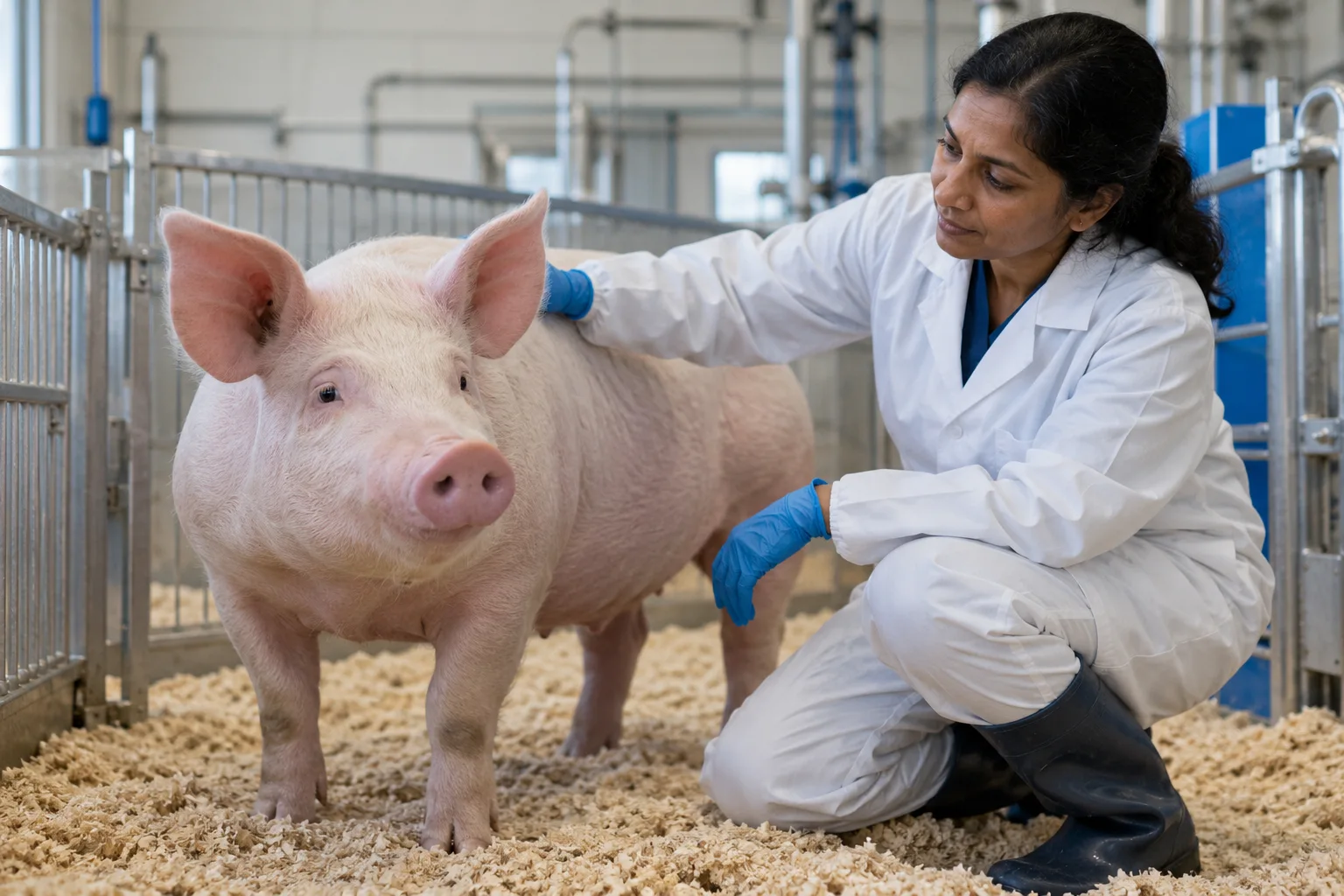
In plain language
Xenotransplantation means putting an organ from one species into a person. Pigs are the main candidate donor because their organs are of a similar size to human organs and pigs can be bred in large numbers. Without changes, a pig organ would be attacked by the human immune system, so scientists edit the pig's genes to remove or change the ones that trigger the attack.
The furthest progress has been with kidneys. Early experiments placed pig kidneys into people who had been declared brain-dead, where the organs filtered blood and made urine for a short time. Since 2024, a small number of living patients have received gene-edited pig kidneys. One living case, reported in The Lancet in September 2026, is in a peer-reviewed paper. Other living-patient results, including sponsor-reported aggregate outcomes, have not yet been published as peer-reviewed cohorts.
Technical explanation
The first generation of gene-edited donor pigs lacked one pig gene, known as GTKO. Cooper (2021) argues that GTKO kidneys are not optimal for clinical use and that a triple-knockout kidney would be more relevant. Later designs remove or change several genes. Anand and colleagues (Nature, 2023) describe a donor pig with 69 genomic edits, tested in cynomolgus monkeys rather than people.
In a 2022 New England Journal of Medicine report, Montgomery and colleagues transplanted gene-edited pig kidneys into two brain-dead human recipients. Biopsies taken at 6, 24, 48 and 54 hours showed no signs of hyperacute or antibody-mediated rejection, and estimated kidney filtration rose in both recipients during the 54-hour study. The study was short and the recipients were brain-dead, so it shows early function rather than long-term survival.
A 61-day decedent study reported in Nature (online November 2025, 2026 volume) transplanted a minimally gene-edited GGTA1-knockout pig kidney, with a pig thymic graft, into a brain-dead, nephrectomised recipient. Kidney function and dialysis independence were stable early. On day 33, an abrupt rise in creatinine was associated with antibody-mediated rejection, and plasma exchange, C3 and C3b inhibition and rabbit anti-thymocyte globulin reversed it. A companion multi-omics analysis (Schmauch and colleagues, Nature, 2026 volume) reported that human T cells increased from day 14 and that CXCL9-positive macrophages were the most abundant human immune population in the graft on day 33.
The living-recipient evidence is at an earlier stage. Beyer (2025) describes a third genetically modified pig kidney transplanted into a living human, and Fishman and Mohiuddin (2024) review gene-edited pig kidney transplants into living recipients. In a Lancet report published in September 2026, a living recipient of a gene-edited pig kidney, transplanted as a bridge to a human kidney, had 271 days of sustained dialysis independence. The graft later failed as thrombotic microangiopathy progressed, and the patient later received a human kidney. The authors reported that the graft could be discontinued without clinically significant allosensitisation or zoonotic infection. Institution-reported cases add further detail. At NYU Langone, a gene-edited pig kidney transplanted on 12 April 2024 was removed on 29 May 2024, about 47 days later, after the kidney failed; the hospital linked the failure to an inability to wean the patient off blood-pressure medicines. Another NYU graft, transplanted on 25 November 2024, functioned for 130 days before removal on 4 April 2025, after acute rejection followed a reduction in immunosuppression given to treat an infection.
Liu, Rui and Liu (2026) comment on the 61-day decedent study and argue that xenograft rejection differs from rejection of human kidney transplants in immune hierarchy, timing and the dominant role of innate and humoral immunity, and that these differences should shape trial design, immunosuppression and monitoring as the field moves to living recipients.
Heart xenotransplantation has one peer-reviewed living case. In a 2022 New England Journal of Medicine report, a 57-year-old man received a pig heart with 10 gene edits. The graft functioned after he was weaned from ECMO, but it failed on day 49, and life support was withdrawn on day 60. Autopsy did not show typical rejection.
What the evidence says
Each statement is typed by the strength of its evidence and linked to the source that supports it.
Demonstrated Shown in a published experiment, test or shipping product.
In a 2022 New England Journal of Medicine report, gene-edited pig kidneys in two brain-dead human recipients produced urine and filtered blood for 54 hours, with no signs of hyperacute or antibody-mediated rejection in biopsies.
Sources: [1] · AbstractIn a Lancet report published in September 2026, one living recipient of a gene-edited pig kidney, transplanted as a bridge to a human kidney, had 271 days of sustained dialysis independence. The graft later failed as thrombotic microangiopathy progressed, and the patient later received a human kidney. The authors reported that the graft could be discontinued without clinically significant allosensitisation or zoonotic infection.
Sources: [6] · Abstract (Europe PMC record); single case · medium confidenceIn a 61-day study published online in November 2025 in Nature, a minimally edited pig kidney in a brain-dead, nephrectomised recipient kept stable function and dialysis independence early on. Antibody-mediated rejection on day 33 raised creatinine, and treatment reversed it. The study ran for a planned period and does not show outcomes in a living person.
Sources: [7] · Abstract (Europe PMC record)A multi-omics analysis of the same 61-day decedent study reported that human T cells increased from day 14, and that biopsy-confirmed antibody-mediated rejection occurred on day 33, when CXCL9-positive macrophages were the most abundant human immune population in the graft.
Sources: [8] · Abstract (Europe PMC record) · medium confidenceIn a 2022 New England Journal of Medicine report, a 57-year-old man received a pig heart with 10 gene edits. The graft functioned after he was weaned from ECMO, but failed on day 49, and life support was withdrawn on day 60. Autopsy did not show typical rejection.
Sources: [10] · AbstractAnand and colleagues (Nature, 2023) describe a donor pig with 69 genomic edits. In cynomolgus monkeys, kidneys with only glycan antigen knockouts survived poorly, while kidneys that also expressed human transgenes survived significantly longer. The study is preclinical and does not test the donor in humans.
Sources: [9] · Abstract (Europe PMC record)The FDA issued guidance in December 2016 on source animal, product, preclinical and clinical issues for xenotransplantation products, including preventing the introduction and spread of infectious agents of animal origin into the human population.
Sources: [15] · Guidance pageReported, unverified Stated by a company or team but not independently confirmed.
The 2021 NYU Langone pig kidney transplant into a brain-dead person was announced to the media rather than peer-reviewed, and the experiment was stopped after 54 hours.
Sources: [2] · Commentary text · medium confidenceA third genetically modified pig kidney has been transplanted into a living human, as reported in January 2025.
Sources: [4] · Abstract · medium confidenceGene-edited pig kidneys have been transplanted into living recipients, as reviewed by Fishman and Mohiuddin in 2024.
Sources: [3] · Title · medium confidenceA 2026 commentary by Liu, Rui and Liu on a 61-day multi-omics study of a pig kidney in a brain-dead decedent argues that xenograft rejection differs from rejection of human kidney transplants in immune hierarchy, timing and the dominant role of innate and humoral immunity.
Sources: [5] · Abstract · medium confidenceA September 2026 eGenesis sponsor update reported five patients who received EGEN-2784 kidneys under expanded access since March 2024, with three having sustained kidney function for more than eight months without dialysis. These are sponsor-reported outcomes and not a peer-reviewed cohort analysis.
Sources: [11] · Update dated 3 September 2026 · medium confidenceThe FDA has cleared RESTORE, a Phase 1/2/3 trial of EGEN-2784 in 33 patients aged 50 to 70 on the waiting list for a human kidney, with a sponsor-expected start in the first quarter of 2027. Clearance to test a product is not evidence that it works.
Sources: [11] · Update dated 3 September 2026 · medium confidenceNYU Langone reported that a gene-edited pig kidney in Towana Looney functioned for 130 days without dialysis before its removal in April 2025. Acute rejection followed a reduction in immunosuppression given to treat an infection.
Sources: [12] · Update dated 11 April 2025 · medium confidenceNYU Langone reported that a gene-edited pig kidney transplanted on 12 April 2024, after a mechanical heart pump was implanted, was removed on 29 May 2024, about 47 days later, after the kidney failed. The hospital linked the failure to an inability to wean the patient off blood-pressure medicines.
Sources: [13] · Article dated 24 April 2024; update dated 9 July · medium confidenceMassachusetts General Hospital reported in March 2024 the transplant of a gene-edited pig kidney into a living patient, which functioned after surgery. The hospital stated that there was no indication that his later death resulted from the transplant.
Sources: [14] · Article dated 21 March 2024; May 2024 update · medium confidenceDisputed Contested by other credible sources.
Cooper (2021) argues that brain-dead subjects can be maintained in a stable state only briefly, so experiments in them have very limited value, and that retaining the native kidneys makes it hard to tell whether the graft could support life.
Sources: [2] · Commentary text · medium confidenceLimitations and open problems
- Brain-dead recipient studies show early kidney function over hours to weeks, and Cooper (2021) notes that brain-dead subjects can be kept stable only briefly, so these experiments have very limited value for judging living-patient outcomes.
- The number of living recipients is small. Only one living case is in a peer-reviewed paper (The Lancet, 2026). Other living outcomes come from hospitals or sponsors and have not been checked against a peer-reviewed cohort.
- Immune rejection remains the central problem, and Liu, Rui and Liu (2026) note that xenograft rejection differs from rejection of human kidney transplants.
- Living-recipient grafts have been lost after rejection, vascular injury or blood-pressure problems. A 271-day course is one reported outcome and not a typical one.
- Long-term survival, infection risk and the effect of the immunosuppressive drugs needed are not established by the sources reviewed here.
- Controlled trials are only starting. Regulatory clearance and planned trials are not evidence that the treatment works.
- Access, cost and the number of animals and facilities needed to supply donor organs at scale are not addressed by the sources reviewed here.
Possible future uses
Ideas, not predictions. None of these has been demonstrated.
- Gene-edited pig livers or hearts used as a temporary bridge for patients waiting for a human donor organ.
- Pig islet cells transplanted to treat type 1 diabetes without the need for donor insulin-producing cells from humans.
- Organ supply from pigs bred in controlled facilities to reduce waiting times for transplant patients.
Timeline
- Sept 2021Surgeons at NYU Langone Health transplant a gene-edited pig kidney into a brain-dead person; the case is later reported as lasting 54 hours. Sources: [2]
- 19 May 2022New England Journal of Medicine publishes results of two pig-to-human kidney xenotransplants in brain-dead recipients. Sources: [1]
- 22 Jun 2022New England Journal of Medicine publishes a report of a gene-edited pig heart transplanted into a living man. Life support was withdrawn about 60 days after surgery. Sources: [10]
- 16 Mar 2024Massachusetts General Hospital transplants a gene-edited pig kidney into a living patient, Richard Slayman. The hospital later reported his death and said there was no indication it resulted from the transplant. Sources: [14]
- 12 Apr 2024NYU Langone transplants a gene-edited pig kidney into a living patient, Lisa Pisano, after a mechanical heart pump was implanted on 4 April. The kidney is removed on 29 May 2024, and the patient dies in July 2024. Sources: [13]
- 3 Jun 2024Fishman and Mohiuddin review gene-edited pig kidney transplants into living recipients. Sources: [3]
- 25 Nov 2024NYU Langone transplants a gene-edited pig kidney into a living patient, Towana Looney. The graft functions for 130 days and is removed on 4 April 2025 after acute rejection. Sources: [12]
- 10 Jan 2025Beyer reports the third genetically modified pig kidney transplant into a living human. Sources: [4]
- 13 Nov 2025Nature publishes online the 61-day decedent kidney study (Montgomery and colleagues) and its multi-omics analysis (Schmauch and colleagues). Sources: [7], [8]
- 15 Apr 2026Liu, Rui and Liu publish a commentary on the 61-day decedent kidney study. Sources: [5]
- 3 Sept 2026The Lancet publishes the first-in-human report of a living recipient of a gene-edited pig kidney as a bridge to a human kidney transplant. On the same day eGenesis reports five expanded-access recipients and FDA clearance for the RESTORE trial. Sources: [6], [11]
Futures this could help bring about
Glossary
- Xenotransplantation
- Transplanting living cells, tissues or organs from one species into another, such as from a pig into a person.
- GTKO pig
- A pig in which the gene for alpha-1,3-galactosyltransferase has been knocked out, removing one trigger for rapid antibody rejection in humans.
- Brain-dead recipient
- A person whose brain has irreversibly stopped functioning but whose body is kept alive on ventilators, used in early xenotransplant studies.
- Immunosuppression
- Drugs that reduce the activity of the immune system so that it does not reject a transplanted organ.
- Expanded access
- A regulatory route that can allow an investigational product to be used for a patient with serious disease outside a clinical trial, under specified conditions.
- Antibody-mediated rejection
- Graft injury caused when recipient antibodies bind donor tissue and activate damaging immune pathways.
- Thrombotic microangiopathy
- Injury to small blood vessels associated with clot formation and damage to blood cells and organs.
Sources
- peer reviewed paper
Results of Two Cases of Pig-to-Human Kidney Xenotransplantation
Robert A. Montgomery, Jeffrey M. Stern, Bonnie E. Lonze et al.. New England Journal of Medicine, 19 May 2022. DOI: 10.1056/NEJMoa2120238. Accessed 21 Oct 2026. - other
Genetically engineered pig kidney transplantation in a brain-dead human subject
David K. C. Cooper. Xenotransplantation (Wiley), 20 Nov 2021. DOI: 10.1111/xen.12718. Accessed 21 Oct 2026. - review article
Historic progress in xenotransplantation with successful transplantation of genetically-edited pig kidneys into living recipients
Jay A. Fishman, Muhammad M. Mohiuddin. Xenotransplantation (Wiley), 3 Jun 2024. DOI: 10.1111/xen.12864. Accessed 21 Oct 2026. - other
Third Genetically Modified Kidney Xenotransplantation in Living Human Recipient
Maria C. Beyer. Artificial Organs, 10 Jan 2025. DOI: 10.1111/aor.14945. Accessed 21 Oct 2026. - other
Clinical Pig Kidney Xenotransplantation Rewrites the Rules of Renal Graft Rejection
Wen-bin Liu, Hong-liang Rui, Bao-li Liu. Xenotransplantation (Wiley), 15 Apr 2026. DOI: 10.1111/xen.70130. Accessed 21 Oct 2026. - peer reviewed paper
Porcine kidney xenotransplantation as a bridge to allotransplantation: a first-in-human study
L. V. Riella, T. Kawai. The Lancet, 3 Sept 2026. DOI: 10.1016/S0140-6736(26)01295-X. Accessed 21 Oct 2026. - peer reviewed papercorrected
Physiology and immunology of a pig-to-human decedent kidney xenotransplant
R. A. Montgomery, M. Sykes. Nature, 13 Nov 2025. DOI: 10.1038/s41586-025-09847-6. Accessed 21 Oct 2026. - peer reviewed paper
Multi-omics analysis of a pig-to-human decedent kidney xenotransplant
E. Schmauch, B. J. Keating. Nature, 13 Nov 2025. DOI: 10.1038/s41586-025-09846-7. Accessed 21 Oct 2026. - peer reviewed paper
Design and testing of a humanized porcine donor for xenotransplantation
R. P. Anand, W. Qin. Nature, 11 Oct 2023. DOI: 10.1038/s41586-023-06594-4. Accessed 21 Oct 2026. - peer reviewed paper
Genetically Modified Porcine-to-Human Cardiac Xenotransplantation
B. P. Griffith, M. M. Mohiuddin. The New England Journal of Medicine, 22 Jun 2022. DOI: 10.1056/NEJMoa2201422. Accessed 21 Oct 2026. - company announcement
eGenesis Announces Clinical Update in Ongoing Expanded Access Study of EGEN-2784 in Patients with Kidney Failure
eGenesis, 3 Sept 2026. Accessed 21 Oct 2026. - university press release
Gene-Edited Pig Kidney Gives Living Donor New Lease on Life
NYU Langone Health, 17 Dec 2024. Accessed 21 Oct 2026. - university press release
First-Ever Combined Heart Pump & Gene-Edited Pig Kidney Transplant Gives New Hope to Patient with Terminal Illness
NYU Langone Health, 24 Apr 2024. Accessed 21 Oct 2026. - university press release
In a First, Genetically Edited Pig Kidney Is Transplanted Into Human
Harvard Medical School, 21 Mar 2024. Accessed 21 Oct 2026. - government report
Source Animal, Product, Preclinical, and Clinical Issues Concerning the Use of Xenotransplantation Products in Humans: Guidance for Industry
US Food and Drug Administration, Dec 2016. Accessed 21 Oct 2026.
Revision history
6 changes since this profile was created.