How far are we from a quantum internet?
Quantum nodes have been linked to each other in laboratories and over deployed optical fibre. A three-node network with entanglement swapping was shown in Delft in 2021, and a metropolitan-scale link between two nodes 10 km apart was reported in 2024. No network yet carries quantum traffic between cities as a service, and the sources reviewed show that long-distance links still depend on losses that have not been overcome.
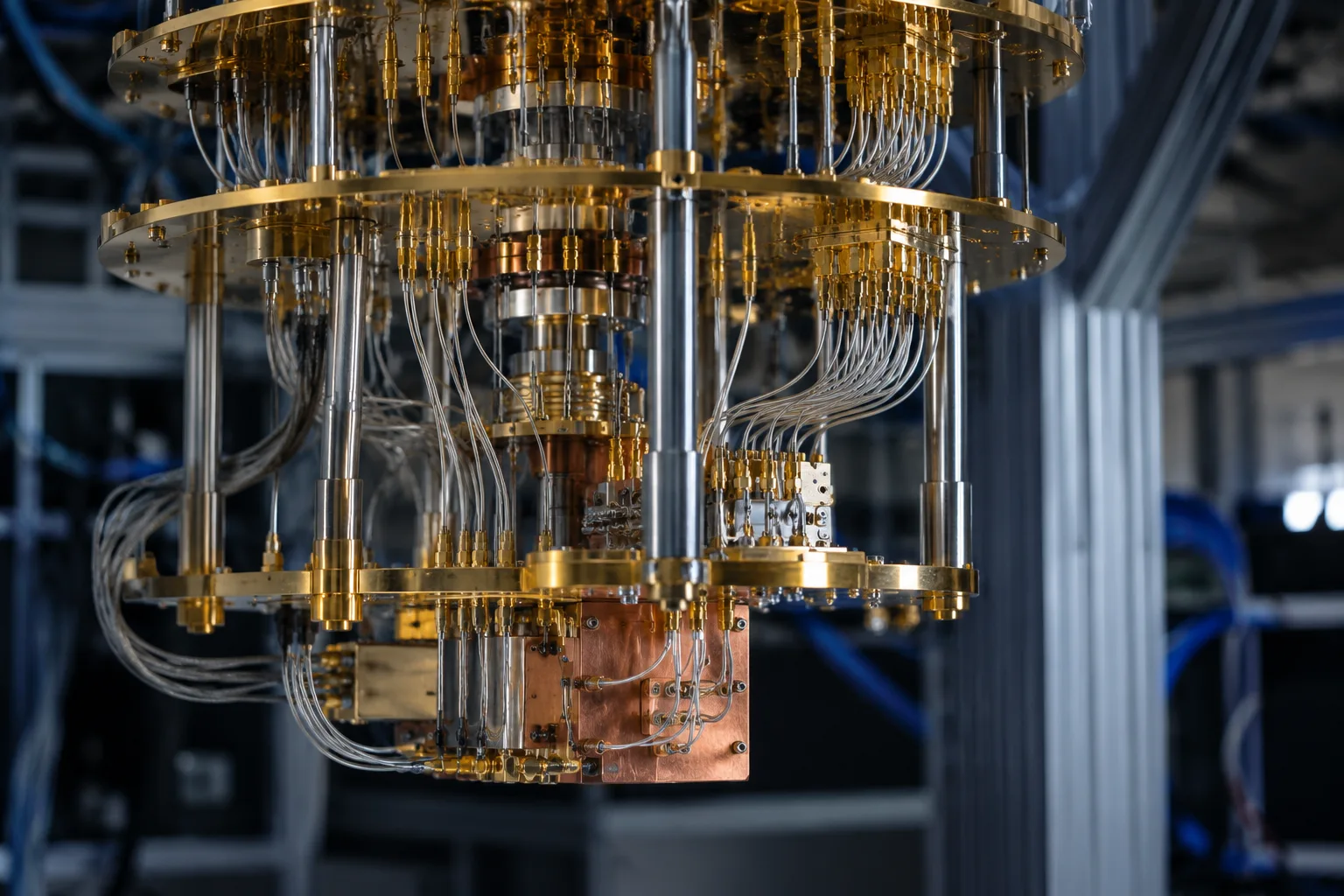
Getting closer. Prototypes exist, but not in real-world use.
Working multi-node links exist as prototypes. In Delft, three diamond-based nodes distributed genuine multipartite entanglement and demonstrated entanglement swapping, both without postselection, as reported in Science in 2021. In 2024 the same group linked two nodes 10 km apart through a midpoint station over 25 km of deployed fibre, but the fully heralded result reached a fidelity of 0.534, which is well short of what a useful network would need. None of these is an operational network. The stage is engineering-prototype rather than science-demonstrated because the demonstrations involve several nodes and real fibre, but they remain laboratory-scale systems with low rates, and no repeater chain has been shown in the sources reviewed.
The tech tree
Everything recorded on Vrulum that this future needs, oldest foundations at the top and the goal at the bottom. Lines show what each step requires.
- 2001Quantum memoriesLab demonstration Being researched.
- 2018Topological qubitsLab demonstration Being researched.
- 1995Quantum error correctionLab demonstrationRequires: Topological qubits. Being researched.
- 2009Quantum key distributionPilot and early commercial Unlocked.
- 2021Quantum repeaters and quantum networksResearch and prototypesRequires: Quantum memories. Being researched.
- 2021Three-node quantum network with entanglement swappingDone Unlocked.
- 2024Entanglement across deployed fibre in three locationsDone Unlocked.
- 2024Heralded entanglement over metropolitan fibreDone Unlocked.
- 2025Entanglement between remote quantum nodesDone Unlocked.
- Date not recordedQuantum repeater link beyond direct fibre distancesIn progress Being researched.
- Date not recordedDistributed quantum computation across networked processorsNot started Locked.
- Date not recordedEntanglement over 1,000 km of fibre in routine useNot started Locked.
- GoalA quantum internetGoalRequires: Quantum repeaters and quantum networks, Quantum key distribution, Quantum error correction, Entanglement between remote quantum nodes, Three-node quantum network with entanglement swapping, Heralded entanglement over metropolitan fibre, Entanglement across deployed fibre in three locations, Quantum repeater link beyond direct fibre distances, Distributed quantum computation across networked processors, Entanglement over 1,000 km of fibre in routine use. Locked.
The road so far
4 of 7 steps done, 1 in progress.
- Done · Mar 2025Entanglement between remote quantum nodes
A Nature paper reports a two-node network in which several rare-earth ions in each node were coupled to nanophotonic cavities. The authors entangled remote ion pairs, achieved multiplexed entanglement between two remote ion pairs, and prepared three-ion W-states. [4]
- Done · Apr 2021Three-node quantum network with entanglement swapping
Diamond-based nodes at Delft distributed genuine multipartite entanglement across three nodes and showed entanglement swapping through a middle node. The Hanson lab describes this as a proof-of-principle demonstration of two network protocols, and both protocols were run without postselection. [1][2]
- Done · Oct 2024Heralded entanglement over metropolitan fibre
Two solid-state qubit nodes 10 km apart were linked through a midpoint station over 25 km of deployed fibre. The fully heralded result reached a fidelity of 0.534 at about 0.022 entangled states per second, with a 15 ns window. The authors report a postselected rate of 0.48 Hz. [3]
- Done · May 2024Entanglement across deployed fibre in three locations
Three 2024 studies reported entanglement between quantum memories linked by fibre in Hefei, China, and between Delft and The Hague over about 25 km. A third study at Harvard entangled two devices in the same building over a fibre loop around the Boston area, so the link was not confined to one building. [5]
- In progressQuantum repeater link beyond direct fibre distances
The 2024 Delft link uses a midpoint station, which is a step towards repeater-style links. No source reviewed shows a repeater chain extending entanglement beyond the few tens of kilometres that fibre losses allow. [3][5]
- Not startedDistributed quantum computation across networked processors
No source reviewed reports a computation split across networked quantum processors. The goal is for a small algorithm to run across linked nodes, and this has not yet been shown.
- Not startedEntanglement over 1,000 km of fibre in routine use
Pan Jian-Wei, whose group works at USTC, is quoted as saying the team should be able to establish entanglement over 1,000 km of optical fibre by the end of the decade. No source reviewed shows a quantum network in routine service for users. [5]
Why it matters
A quantum internet would link quantum processors and sensors so that they can share entanglement. Each intended use depends on distributing entanglement reliably over distance, which is the step the current experiments have not yet solved.
What stands in the way
- Photon losses in optical fibre limit entanglement to a few tens of kilometres before the link becomes impractical without repeaters.
- Entanglement rates are low: the fully heralded Delft link reached a fidelity of 0.534 at about 0.022 entangled states per second.
- Photons must arrive at exactly the same time, which the 2024 coverage names as one of the main challenges.
- No quantum repeater chain has been shown in the sources reviewed, and repeaters are needed for links over long distances.
- Environmental effects such as temperature changes, and wind for aerial fibre, affect the links, according to the 2024 coverage.
Published forecasts
What others have predicted. These are their estimates, not ours.
| Who | Forecast | Timeframe | Made |
|---|---|---|---|
| Pan Jian-Wei, University of Science and Technology of China | Entanglement over 1,000 km of optical fibre by the end of the decade, as quoted in the Nature news item reproduced by Scientific American. [5] | Not given | 15 May 2024 |
Signals to watch
- A peer-reviewed demonstration of a repeater link that extends entanglement beyond a single fibre span.
- Peer-reviewed entanglement rates and fidelities for fibre links between nodes 10 km or more apart, compared with the 0.534 fidelity in the 2024 Delft link.
- Demonstrations of a computation split across networked quantum processors.
- Independent reports of a multi-node quantum network running on deployed fibre in a city, with the link length and conditions stated.
- Published progress towards 1,000 km of entanglement distribution, with a timeline, funding and independent review.
Sources
- peer reviewed paper
Realization of a multinode quantum network of remote solid-state qubits
M. Pompili, S. L.N. Hermans, S. Baier et al.. Science, 15 Apr 2021. - university press release
Multinode Quantum Network
QuTech, Delft University of Technology, 15 Apr 2021. - peer reviewed paper
Metropolitan-scale heralded entanglement of solid-state qubits
Arian J. Stolk, Kian L. van der Enden, Marie-Christine Slater et al.. Science Advances, 30 Oct 2024. - peer reviewed paper
Multiplexed entanglement of multi-emitter quantum network nodes
A. Ruskuc, C.-J. Wu, E. Green et al.. Nature, Mar 2025. - news
Quantum Internet Milestone Takes Entanglement Out of the Lab and into Cities
Davide Castelvecchi. Scientific American (republished from Nature), 20 May 2024.
Last reviewed 21 Oct 2026.