Quantum repeaters and quantum networks
Also known as Quantum repeaters, Quantum networks, Entanglement distribution networks
Quantum repeaters use quantum memories to store entanglement while it is passed along a chain of links, so that entanglement can reach beyond the distance that a single optical fibre allows. Small laboratory networks with two or three nodes, some linked over deployed fibre, have now been reported, but the sources reviewed here show no repeater chain yet working over long distances.
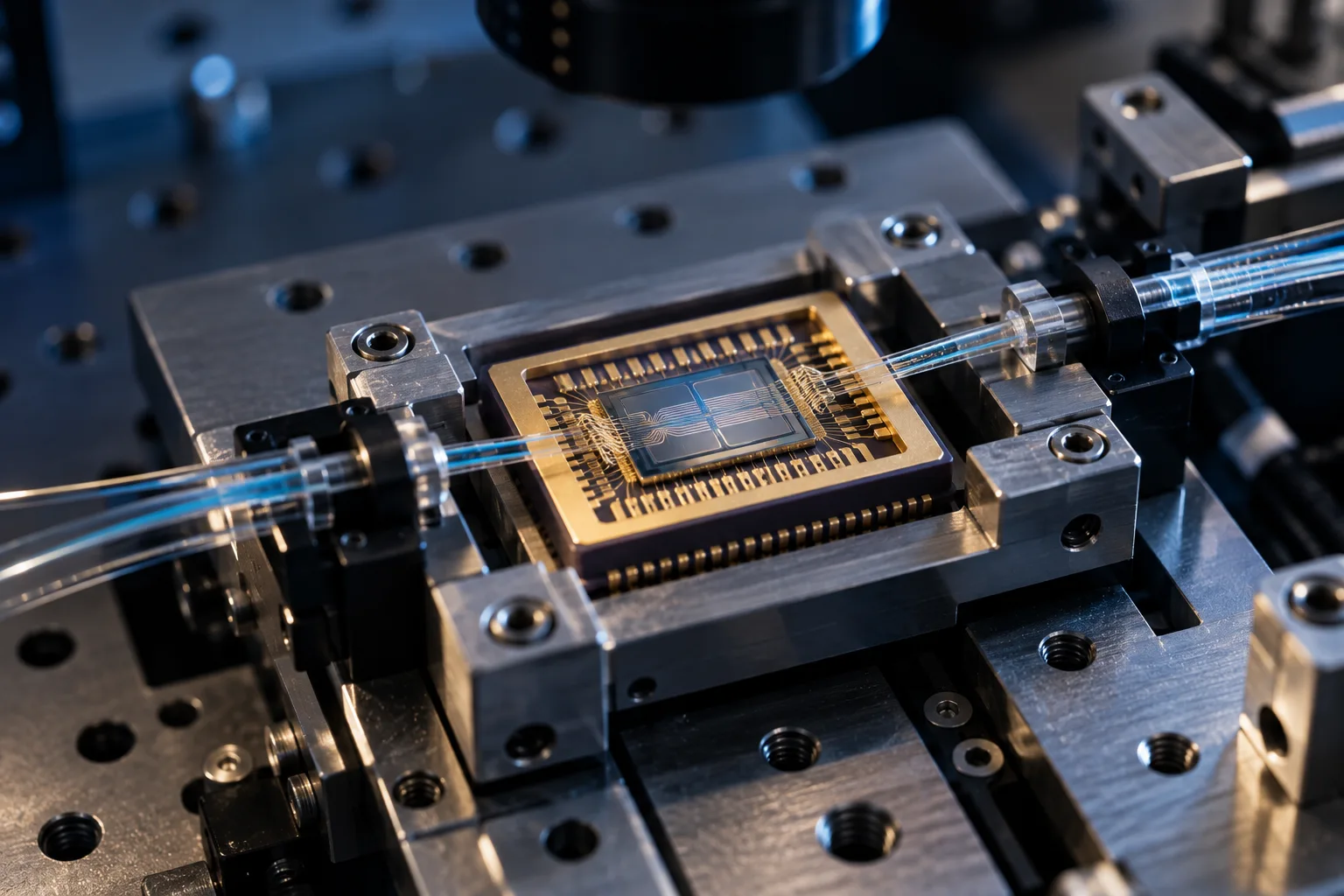
In plain language
A quantum network links small quantum devices, called nodes, so that they share entanglement, a special link between quantum particles that can be used for secure communication and for linking quantum computers. The signal is carried by single photons in optical fibre, and photons are lost as they travel. Over long distances, too many photons disappear for a direct link to work, so the signal cannot simply be boosted the way a normal internet signal is.
A quantum repeater works around this by splitting a long link into shorter pieces. Each node keeps its quantum memory, a device that holds the quantum state while the neighbouring link is set up. When the pieces are joined, the entanglement is passed along the chain. Researchers have shown the first steps of this in laboratories, using nodes made from diamond, rare-earth ions and other solid-state systems, but a full chain that works over long distances has not yet been shown.
Technical explanation
The main building blocks are heralded entanglement between two nodes, entanglement swapping at a middle node, and quantum memories that hold their state long enough for the next link to succeed. In the 2024 Delft work, two diamond nodes each sent photons to a midpoint station over fibre, and a detection at that station heralded that entanglement had been created. The authors reduced photon loss by converting the photons to the telecom L-band, and used feedback on the long-lived qubits so that a predefined entangled state was delivered whatever the detection pattern. The fully heralded result reached a fidelity of 0.534 at about 0.022 entangled states per second with a 15 ns window, while a postselected analysis gave 0.48 Hz with a 20 ns window. The authors note that the heralded rate is much lower because of the added communication delay.
A separate line of work uses memories with nuclear spins as the storage element. In a 2024 Harvard-led experiment, two nodes built from silicon-vacancy centres in nanophotonic diamond cavities were linked through telecom fibre. Photons were converted to 1350 nm and two nuclear-spin memories were entangled over 40 km of fibre spools and a 35 km loop deployed in the Boston area. Nuclear-spin storage lasted about a second, which the authors describe as an enabling step towards practical repeaters. A paper from another group, published in Nature in 2025, used several rare-earth ion qubits per node to multiplex entanglement across two remote ion pairs, and to prepare three-ion W states. The paper names bottlenecks in the entanglement distribution rate as a limitation that multiplexing is designed to address.
The gap to a working quantum internet is in rate, fidelity and scale. The sources reviewed give fidelities and rates for only one fibre link, the 2024 Delft link, and that link is a two-node system. A repeater chain would need several links to work together, with memories and swapping steps running reliably. None of the sources reviewed reports a repeater chain that extends entanglement beyond a single fibre span, or a network that carries traffic for users.
What the evidence says
Each statement is typed by the strength of its evidence and linked to the source that supports it.
Demonstrated Shown in a published experiment, test or shipping product.
In 2024, QuTech researchers linked two diamond-based quantum network nodes, 10 km apart, through a midpoint station connected by 25 km of deployed optical fibre, and heralded entanglement between them.
Sources: [3] · AbstractThe fully heralded Delft link reached a fidelity of 0.534 at about 0.022 entangled states per second with a 15 ns window; the postselected analysis gave 0.48 Hz with a 20 ns window, and the authors say the heralded rate is much lower because of the added communication delay.
Sources: [3] · Main textThe authors identify the signal-to-noise ratio as the factor limiting entangled-state fidelity in the 2024 Delft link, and estimate that false heralding events account for about 30% of the infidelity.
Sources: [3] · Main text · medium confidenceA three-node network of remote diamond-based solid-state qubits distributed genuine multipartite entanglement across all three nodes and performed entanglement swapping through a middle node, with both protocols run without postselection.
Sources: [1] · AbstractResearchers at Harvard entangled two nuclear-spin memories in nanophotonic silicon-vacancy diamond nodes over 40 km of fibre spools and a 35 km fibre loop deployed in the Boston area, with nuclear-spin storage lasting about a second.
Sources: [2] · AbstractA 2025 Nature paper reports a two-node network of several rare-earth ion qubits in nanophotonic cavities that entangles two remote ion pairs and aims to prepare three-ion W states, and names bottlenecks in the entanglement distribution rate as a problem that multiplexing is meant to address.
Sources: [4] · Abstract · medium confidenceProposed A design or plan that has not yet been built or tested.
The authors of the Harvard-led silicon-vacancy study describe their result as an enabling step towards practical quantum repeaters and large-scale quantum networks.
Sources: [2] · AbstractLimitations and open problems
- No quantum repeater chain that extends entanglement beyond a single fibre span is reported in the sources reviewed; the 2024 Harvard-led result is described by its authors as an enabling step towards practical repeaters.
- Entanglement rates are low: the fully heralded Delft link reached about 0.022 entangled states per second, and the authors say heralding delay makes the rate much lower than the postselected figure.
- Fidelity is limited by signal-to-noise ratio, and the authors estimate that false heralding events account for about 30% of the infidelity.
- The 2024 fibre results involve two nodes, and the three-node network is a laboratory-scale proof of principle.
- The abstracts of the Harvard-led and rare-earth ion papers do not report fidelities or entanglement rates, so their performance cannot be compared directly with the Delft figures.
Possible future uses
Ideas, not predictions. None of these has been demonstrated.
- Linking quantum processors across a city, so that a computation can be split between machines in different buildings.
- Connecting quantum sensors on a campus or across a region so that they share entanglement for more precise measurements.
- Long-distance secure communication based on entanglement, extending the reach of today's fibre-based quantum key distribution.
Timeline
- 16 Apr 2021Delft/QuTech reports a three-node network of remote solid-state qubits that distributes genuine multipartite entanglement and performs entanglement swapping without postselection, published in Science. Sources: [1]
- 15 May 2024Nature publishes the Harvard-led two-node network of silicon-vacancy memory nodes, which entangles nuclear-spin memories over 40 km of fibre spools and a 35 km Boston-area loop. Sources: [2]
- 30 Oct 2024Science Advances publishes heralded entanglement between two diamond-qubit nodes 10 km apart, linked via a midpoint station over 25 km of deployed fibre. Sources: [3]
- 26 Feb 2025Nature publishes two-node entanglement between rare-earth ion qubits in nanophotonic cavities, with multiplexed entanglement and three-ion W states (first posted as a preprint in February 2024). Sources: [4]
Futures this could help bring about
Glossary
- Entanglement
- A link between quantum particles in which measuring one affects the outcome of measuring the other, even when they are far apart.
- Quantum memory
- A device that stores a quantum state for a time, so that it can be used once a neighbouring link is ready.
- Entanglement swapping
- Creating entanglement between two distant nodes by using entanglement that each one already shares with a middle node.
- Heralded entanglement
- Entanglement whose creation is signalled by a detection event, so that the successful attempts are known.
- Quantum repeater
- A node in a chain that stores and passes on entanglement, so that it can extend across distances that direct photon transmission cannot reach.
Sources
- peer reviewed paper
Realization of a multinode quantum network of remote solid-state qubits
M. Pompili, S. L. N. Hermans, S. Baier et al.. Science, 16 Apr 2021. DOI: 10.1126/science.abg1919. Accessed 21 Oct 2026. - peer reviewed paper
Entanglement of nanophotonic quantum memory nodes in a telecom network
C. M. Knaut, A. Suleymanzade, Y.-C. Wei et al.. Nature, 15 May 2024. DOI: 10.1038/s41586-024-07252-z. Accessed 21 Oct 2026. - peer reviewed paper
Metropolitan-scale heralded entanglement of solid-state qubits
Arian J. Stolk, Kian L. van der Enden, Marie-Christine Slater et al.. Science Advances, 30 Oct 2024. DOI: 10.1126/sciadv.adp6442. Accessed 21 Oct 2026. - peer reviewed paper
Multiplexed Entanglement of Multi-emitter Quantum Network Nodes
A. Ruskuc, C.-J. Wu, E. Green et al.. Nature, 26 Feb 2025. DOI: 10.1038/s41586-024-08537-z. Accessed 21 Oct 2026.
Revision history
4 changes since this profile was created.
What it took to get here
The inventions this technology was built on, oldest foundations at the top. Lines show what each one required.
- 2021Quantum repeaters and quantum networksResearch and prototypesRequires: Quantum memories. Being researched.