How far are we from quantum memories that can hold entanglement long enough for a quantum internet?
Quantum memories have been linked over deployed fibre in peer-reviewed experiments. In the Delft and The Hague link reported in 2024, two solid-state nodes 10 km apart were heralded into entanglement through a midpoint station. The fully heralded result reached a fidelity of 0.534 at about 0.022 entangled states per second. A two-node network reported in Nature stored nuclear-spin entanglement in a memory described as holding it for second-long times, and a two-node experiment with two remote ion pairs showed multiplexed entanglement. No source reviewed shows a memory-based repeater chain, and no source reviewed reports storage time, memory efficiency and entanglement rate together for a link long enough to matter.
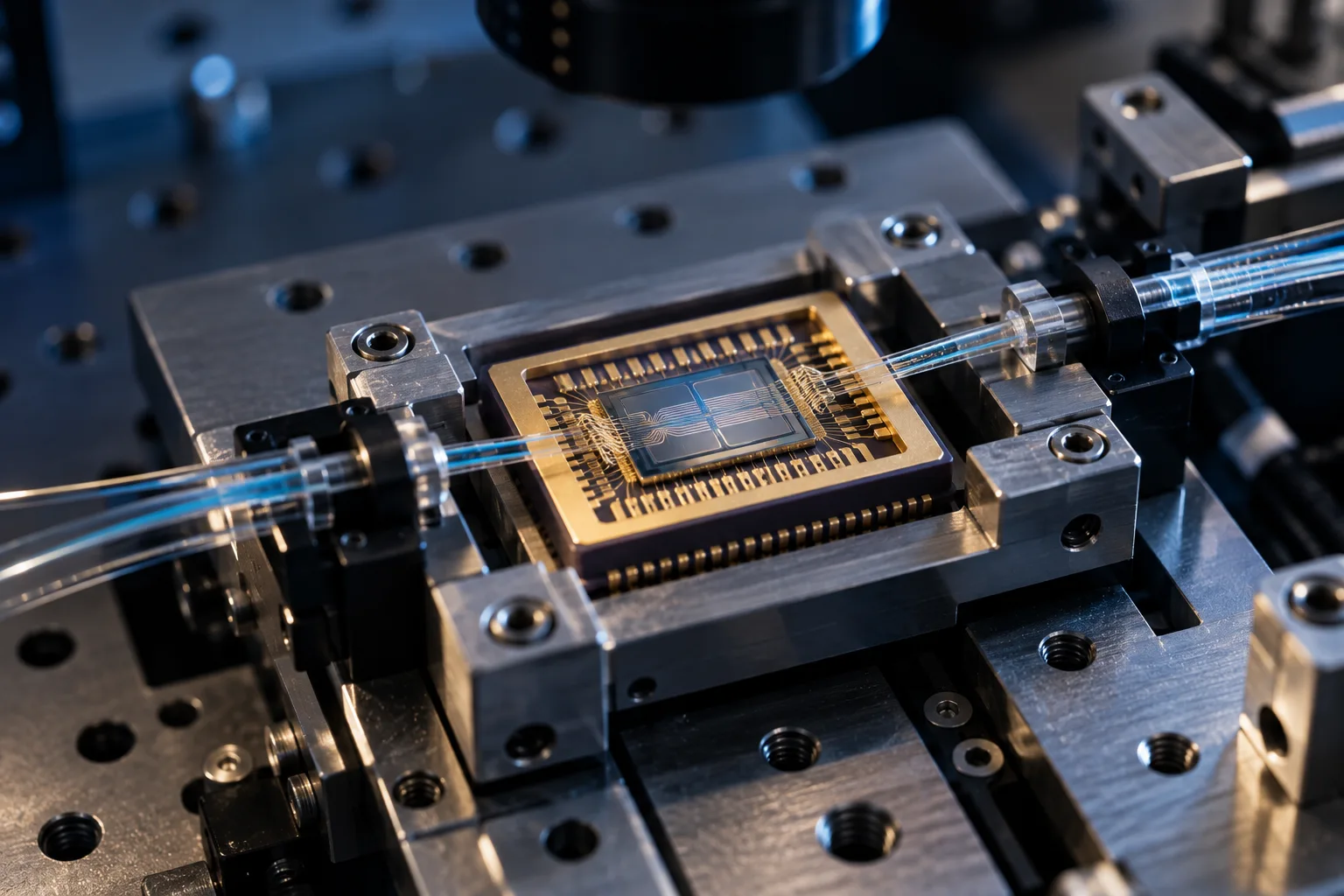
Getting closer. Prototypes exist, but not in real-world use.
Memory nodes have been entangled with one another over deployed fibre, and fidelity and rate have been reported for one two-node link. Multiplexed entanglement and second-long nuclear-spin storage have each been shown in two-node systems. These are working laboratory and field-linked prototypes. No repeater chain has been shown that uses memories at several nodes, and the sources reviewed do not report memory efficiency, storage time and entanglement rate together for a link long enough to matter. That places the stage at engineering prototype rather than pilot.
The tech tree
Everything recorded on Vrulum that this future needs, oldest foundations at the top and the goal at the bottom. Lines show what each step requires.
- 2020Entanglement between atomic-ensemble memories over tens of kilometres of fibreDone Unlocked.
- 2020Memory-enhanced quantum communication using a single spin memoryDone Unlocked.
- 2024Entanglement stored in nuclear-spin memories and sent across a telecom networkDone Unlocked.
- 2024Heralded entanglement between two memory nodes over deployed fibreDone Unlocked.
- 2025Multiplexed entanglement across several memory emitters per nodeDone Unlocked.
- Date not recordedEntanglement swapping between memories in a repeater chainNot started Locked.
- Date not recordedMemory storage time and efficiency together at repeater-relevant link lengthsNot started Locked.
- GoalStoring quantum information long enough for a quantum internetGoalRequires: Quantum memories, Quantum repeaters and quantum networks, Heralded entanglement between two memory nodes over deployed fibre, Entanglement between atomic-ensemble memories over tens of kilometres of fibre, Entanglement stored in nuclear-spin memories and sent across a telecom network, Memory-enhanced quantum communication using a single spin memory, Multiplexed entanglement across several memory emitters per node, Entanglement swapping between memories in a repeater chain, Memory storage time and efficiency together at repeater-relevant link lengths. Locked.
The road so far
5 of 7 steps done.
- Done · 30 Oct 2024Heralded entanglement between two memory nodes over deployed fibre
Two solid-state qubit nodes 10 km apart were linked through a midpoint station over 25 km of deployed fibre. The fully heralded result reached a fidelity of 0.534 at about 0.022 entangled states per second, with a 15 ns window. The authors report a postselected rate of 0.48 Hz with a 20 ns window. The qubit coherence was protected during the heralding wait by a refocusing pulse. [1]
- Done · Feb 2020Entanglement between atomic-ensemble memories over tens of kilometres of fibre
Two atomic ensembles acting as quantum memories were entangled in one laboratory by sending photons through fibre. The paper reports entanglement over 22 km of field-deployed fibre using two-photon interference, and over 50 km of coiled fibre using single-photon interference. The authors state that the previous maximum separation between two nodes was 1.3 km. The memory lifetime, fidelity and rate are not given in the abstract. [3]
- Done · 15 May 2024Entanglement stored in nuclear-spin memories and sent across a telecom network
Two nodes built from silicon-vacancy centres in nanophotonic diamond cavities were linked through telecom fibre, with photons converted to 1350 nm. Nuclear-spin memories were entangled across 40 km of fibre spools and a 35 km fibre loop in the Boston area. The abstract describes the nuclear spins as long-lived memories and describes second-long storage of entanglement. The abstract gives no fidelity or rate. [2]
- Done · Mar 2020Memory-enhanced quantum communication using a single spin memory
A single solid-state spin memory in a nanophotonic diamond resonator was used for asynchronous Bell-state measurements. The authors report a fourfold higher secret key rate for measurement-device-independent quantum key distribution than direct transmission at equal loss, at megahertz clock rates. The paper presents this as a step towards practical quantum repeaters. It gives no storage time or fidelity figures in the abstract. [5]
- Done · 26 Feb 2025Multiplexed entanglement across several memory emitters per node
A two-node network built from several rare-earth ions coupled to nanophotonic cavities entangled two remote ion pairs in multiplexed form and prepared three-ion W states. The abstract gives no fidelity, rate or storage time, so the multiplexing gain cannot yet be compared with a repeater target. [4]
- Not startedEntanglement swapping between memories in a repeater chain
A repeater needs a middle memory to hold one link's entanglement while the next link is made, and then swaps the two. The Delft link uses a midpoint station, but no source reviewed shows entanglement swapped between stored memories across a chain of links. [1]
- Not startedMemory storage time and efficiency together at repeater-relevant link lengths
The Delft authors state that qubit systems must store quantum information for extended times. They report that the nitrogen-vacancy coherence time can be extended towards a second with established pulse sequences, but that this is a prospective statement and not a result from their experiment. No source reviewed reports storage time, memory efficiency and entanglement rate together for a link beyond the two-node systems described above. [1][2]
Why it matters
A quantum repeater can only extend entanglement past the distance that fibre losses allow if each memory holds its state while the neighbouring link succeeds. Storage time, the chance that a stored photon is read out again, and the number of memory channels that can run in parallel set the rate of the whole chain. These three numbers decide whether a quantum internet can carry useful traffic. The wider network picture is covered in the separate quantum internet horizon.
What stands in the way
- The one fidelity and rate figure reported for a memory-to-memory link over deployed fibre is 0.534 at about 0.022 entangled states per second, far from what a multi-link chain would need to deliver useful entanglement.
- The nitrogen-vacancy coherence time of about a second is a projection with pulse sequences, not a result shown in the Delft experiment, so storage time at link scale remains unmeasured in that system.
- Memory efficiency, meaning the chance that a stored photon is read out again, is not reported in the abstracts reviewed, so link success rates cannot be checked against repeater targets.
- Multiplexing has been shown only in two-node systems with two remote ion pairs, so it has not been shown at network scale.
- No source reviewed shows entanglement swapped between stored memories across a chain of links, which a repeater needs.
Signals to watch
- Peer-reviewed fidelity and rate for memory-to-memory links 10 km or more apart, reported alongside the storage time used in each experiment.
- Memory efficiency and retrieval success reported with heralded entanglement, not in a separate experiment.
- Entanglement swapping between stored memories in a chain of two or more links.
- Multiplexed memory networks with three or more nodes, with fidelity and rate stated.
- Storage times of seconds or more measured in the same experiment that creates the entanglement link.
Sources
- peer reviewed paper
Metropolitan-scale heralded entanglement of solid-state qubits
Arian J. Stolk, Kian L. van der Enden, Marie-Christine Slater et al.. Science Advances, 30 Oct 2024. - peer reviewed paper
Entanglement of nanophotonic quantum memory nodes in a telecom network
Can M. Knaut, Aziza Suleymanzade, Yan-Cheng Wei et al.. Nature (arXiv preprint), 15 May 2024. - peer reviewed paper
Entanglement of two quantum memories via fibres over dozens of kilometres
Yong Yu, Fei Ma, Xi-Yu Luo et al.. Nature (arXiv preprint), Feb 2020. - peer reviewed paper
Multiplexed Entanglement of Multi-emitter Quantum Network Nodes
Andrei Ruskuc, Chun-Ju Wu, Emanuel Green et al.. Nature (arXiv preprint), 26 Feb 2025. - peer reviewed paper
Experimental demonstration of memory-enhanced quantum communication
Mihir K. Bhaskar, Ralf Riedinger, Bartholomeus Machielse et al.. Nature (arXiv preprint), Mar 2020.
Last reviewed 22 Oct 2026.