Atmospheric water generators
Also known as Atmospheric water generator (AWG), Air-to-water machines, Water-from-air machines
Atmospheric water generators are compact machines that turn moisture in the air into drinking water, usually by chilling the air below its dew point. Energy use per litre rises in dry or cold conditions, and the performance figures checked for this profile come from a small number of studies.
In plain language
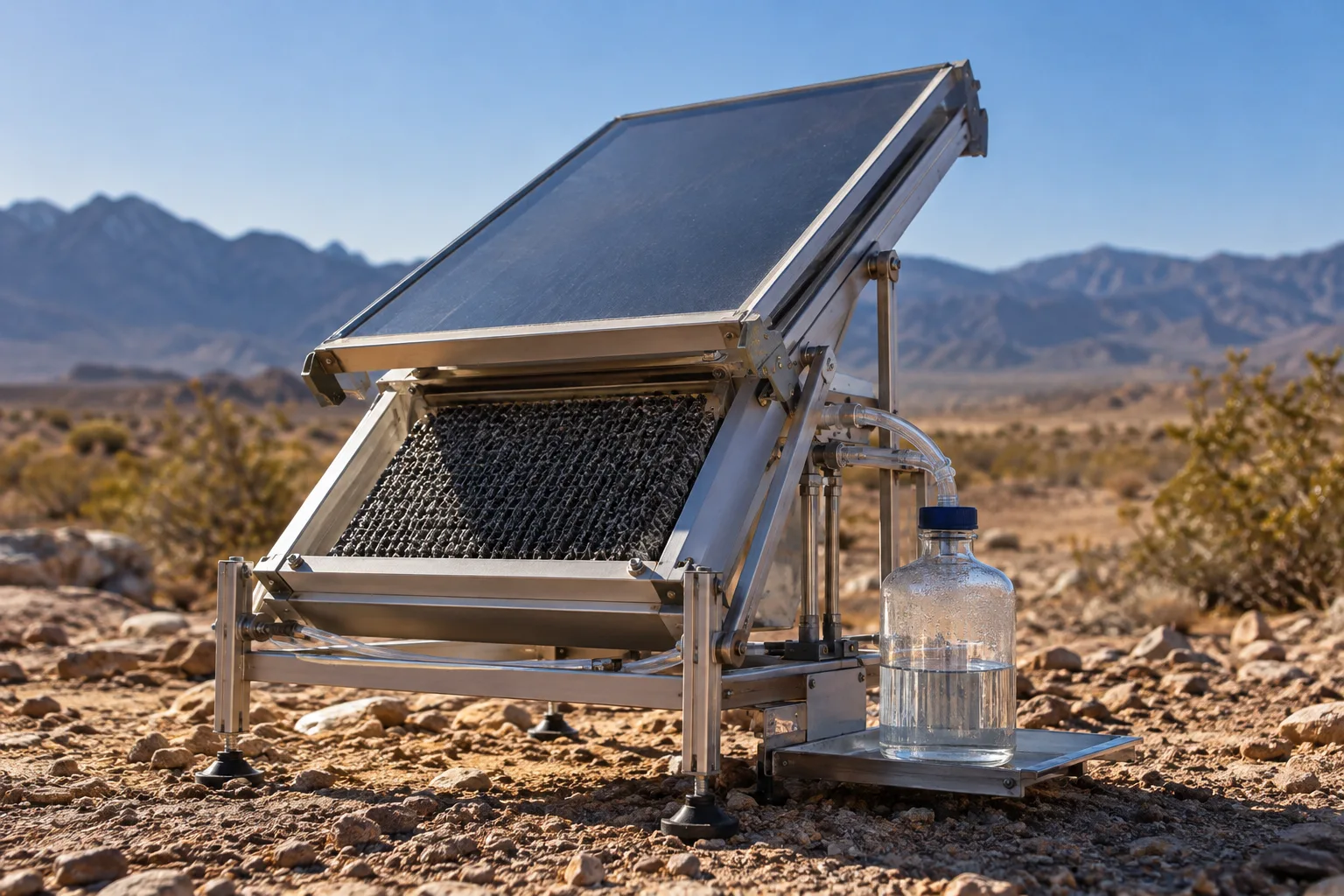
An atmospheric water generator pulls water out of the air around it. Refrigeration-based machines work a little like a small air conditioner: a fan draws in air, a cold surface chills it, and the water vapour in the air condenses into droplets that drip into a tank. The air has to be cooled below its dew point, the temperature at which its moisture starts to condense, before any water forms.
The main cost is energy. Cooling air takes power, and the drier and colder the air, the less water it holds, so the machine has to work harder for each litre it makes. That is why the energy figures checked for this profile vary so widely. The sources checked do not describe how the SOURCE Hydropanel works, so this profile does not assume a mechanism for it. Sorbent materials that capture water from air are covered in the separate atmospheric water harvesting profile.
Technical explanation
Refrigeration-based generators chill the incoming air below its dew point, so water condenses and drains to a collection tank. Brenes and Chini (2023) report energy use separately for refrigeration-based generators and for solar-driven sorption generators.
Energy per litre, often written as specific energy consumption (SEC), varies widely. Brenes and Chini report SEC for refrigeration units from 0.02 to 3.64 kWh per litre across the United States, using three commercial devices and weather records from 1985 to 2019. They find that energy and water production depend heavily on relative humidity and temperature, and that arid climates need more energy for each litre produced. Khalaf and colleagues (2024) and Patel and colleagues (2020) examine related questions, but their abstracts were not accessible for this profile, so no results from those two papers are used here.
Water quality rules are general rather than specific to these machines. The World Health Organization's Guidelines for drinking-water quality, fourth edition incorporating the first and second addenda (2022), are an authoritative basis for setting national regulations and standards. ASSE 1090-2020 is an American National Standard for drinking-water atmospheric water generators. A trade summary says its water must be safe to consume and treats energy efficiency, measured as electrical energy per litre, as a factor in cost. The standard text itself was not read for this profile.
What the evidence says
Each statement is typed by the strength of its evidence and linked to the source that supports it.
Demonstrated Shown in a published experiment, test or shipping product.
Brenes and Chini (2023) report energy use separately for refrigeration-based atmospheric water generators and for solar-driven sorption generators.
Sources: [1] · AbstractFor three commercial devices tested against 1985 to 2019 weather records for the United States, specific energy consumption for refrigeration units ranged from 0.02 to 3.64 kWh per litre.
Sources: [1] · AbstractEnergy and water-production efficiency of atmospheric water generators depend heavily on relative humidity and temperature, and arid climates require more energy per litre of water produced.
Sources: [1] · AbstractPatel and colleagues (2020) published an experimental study of an atmospheric water extraction device under different climatic conditions. The results were not checked, so this profile reports none.
Sources: [2] · Title and article recordKhalaf and colleagues (2024) published a long-term performance evaluation of vapour-compression atmospheric water generation in arid climates. The results were not checked, so this profile reports none.
Sources: [3] · Title and article recordThe WHO Guidelines for drinking-water quality (fourth edition, incorporating the first and second addenda, 2022) have formed an authoritative basis for setting national regulations and standards; the WHO page does not mention atmospheric water generators.
Sources: [4] · OverviewReported, unverified Stated by a company or team but not independently confirmed.
A university news release dated 16 August 2023 says 400 SOURCE Hydropanels were being installed across four villages in the Eastern Cape, South Africa, and names two schools among the sites; the project launched in March 2023 and was funded by the Chan Soon-Shiong Family Foundation.
Sources: [5] · Article body · medium confidenceThe partner release describes the Hydropanel as generating clean water from atmospheric vapour, but it gives no output volumes and does not describe any test or independent verification.
Sources: [5] · Article body · medium confidenceASSE 1090-2020, Performance Requirements for Drinking Water Atmospheric Water Generators, has been designated an American National Standard by ANSI. A trade summary says its water must be safe to consume and that cost depends on energy efficiency, measured as electrical energy per litre produced.
Sources: [6] · Article body · medium confidenceLimitations and open problems
- Energy per litre rises in dry or cold air. Brenes and Chini (2023) report 0.02 to 3.64 kWh per litre for refrigeration units across the United States, with arid climates needing more energy.
- The sources checked are few. One peer-reviewed analysis of three commercial devices was read through its abstract. Two other peer-reviewed papers were checked by title and metadata only, because their abstracts were not accessible, so this profile reports no figures from them. The sources checked do not include a controlled test of one machine across a full range of humidity and temperature.
- None of the sources checked gives a cost per litre, so this profile does not state one.
- The text of ASSE 1090-2020 was not read. The summary used here does not confirm specific contaminant limits or the certification of any particular product.
- Maker claims about output and reliability could not be checked against independent test data. The partner release for the Eastern Cape project gives no output volumes and no verification statements.
Possible future uses
Ideas, not predictions. None of these has been demonstrated.
- Solar-powered units in schools in water-scarce regions, where a unit can run on the same site it serves.
- Hybrid machines that use refrigeration in humid months and sorbent capture in dry months, which could limit the energy cost in each season.
- Connecting generators to building cooling systems so that cooling the building also condenses water from the air.
Timeline
- Apr 2020Patel and colleagues publish an experimental study of an atmospheric water extraction device under different climatic conditions. Sources: [2]
- 27 Jul 2020A trade article reports that ASSE 1090-2020, a performance standard for drinking-water atmospheric water generators, has been designated an American National Standard by ANSI. The designation date is not given. Sources: [6]
- Mar 2023The University of Johannesburg and SOURCE Global launch a project to install Hydropanels in villages in the Eastern Cape, South Africa. Sources: [5]
- 28 Apr 2023Brenes and Chini publish an analysis of energy intensity for three commercial atmospheric water generators, using United States weather records. Sources: [1]
- 16 Aug 2023A university news release reports that 400 Hydropanels are being installed across four villages. Two schools are named among the sites. Sources: [5]
- Dec 2024Khalaf and colleagues publish a long-term performance evaluation of vapour-compression atmospheric water generation in arid climates. Sources: [3]
Futures this could help bring about
Glossary
- Dew point
- The temperature at which the water vapour in air starts to condense into liquid water when the air is cooled.
- Relative humidity
- The amount of water vapour in air as a percentage of the most it could hold at that temperature.
- Specific energy consumption
- The energy used to produce one litre of water, usually given in kilowatt-hours per litre (kWh/L). Lower is better.
- Vapour compression cycle
- The refrigeration cycle used in air conditioners and fridges, in which a compressor and refrigerant move heat out of a cold space.
Sources
- peer reviewed paper
Temporal and spatial variability of energy intensity for atmospheric water generators
Anthony T. Brenes, Christopher M. Chini. Environmental Research: Infrastructure and Sustainability, 28 Apr 2023. DOI: 10.1088/2634-4505/accec9. Accessed 22 Oct 2026. - peer reviewed paper
Experimental investigations of atmospheric water extraction device under different climatic conditions
Jatin Patel, Krunal Patel, Anurag Mudgal et al.. Sustainable Energy Technologies and Assessments, Apr 2020. DOI: 10.1016/j.seta.2020.100677. Accessed 22 Oct 2026. - peer reviewed paper
Long-term performance evaluation of VCRS-based atmospheric water generation in arid climates
Batool Taher Khalaf, Nicolas Lopez Ferber, Mathieu Martins et al.. Case Studies in Chemical and Environmental Engineering, Dec 2024. DOI: 10.1016/j.cscee.2024.100855. Accessed 22 Oct 2026. - government report
Guidelines for drinking-water quality: fourth edition incorporating the first and second addenda
World Health Organization, 21 Mar 2022. Accessed 22 Oct 2026. - university press release
UJ PEETS/SOURCE Global launch groundbreaking initiative to provide clean drinking water to families in Eastern Cape
University of Johannesburg News, 16 Aug 2023. Accessed 22 Oct 2026. - news
New guidance for atmospheric water generators
Cati O'Keefe. Green Builder Media, 27 Jul 2020. Accessed 22 Oct 2026.
Revision history
3 changes since this profile was created.