Atmospheric water harvesting (MOF/sorbent based)
Also known as Sorption-based atmospheric water harvesting, SAWH, MOF water harvesting, Water from air
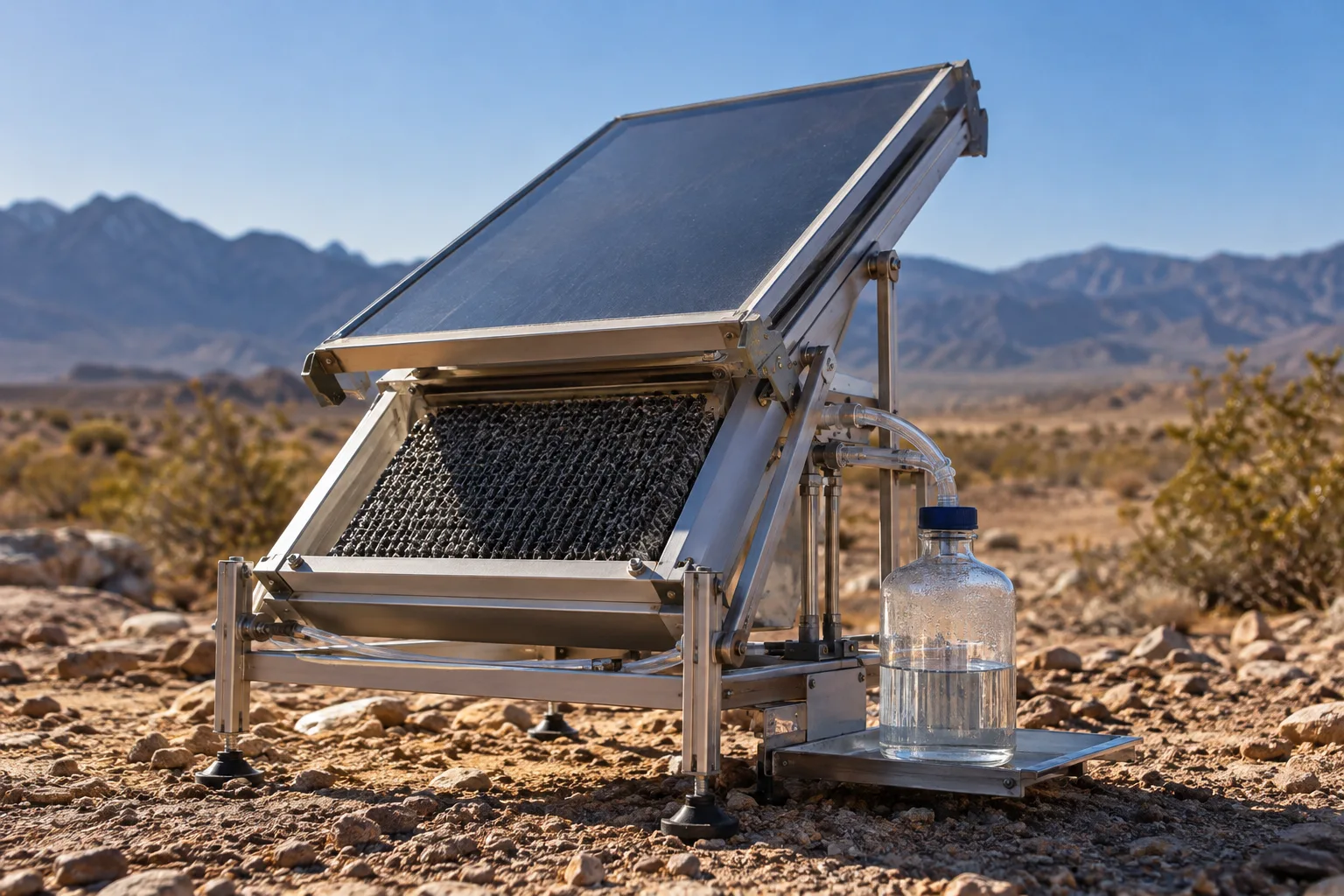
Sorbent-based atmospheric water harvesting captures water vapour in porous materials such as metal-organic frameworks, then releases it for collection as liquid water. Prototypes have operated in desert conditions, including at very low humidity, but measured output depends on sorbent mass, climate and device design. A key bottleneck is moving released vapour to a condenser cool enough to collect it.
In plain language
Air contains water vapour even in deserts. A sorbent is a material that takes up and holds vapour. In one common cycle, air passes over a relatively cool sorbent and water molecules attach to its internal surfaces. Later, heat, often from sunlight, drives the water back out as vapour. The vapour must then reach a cooler surface and condense before it can be collected.
Metal-organic frameworks (MOFs) are crystalline materials with regular pores that can be tuned to take up and release water. Field prototypes have operated in Arizona and the Mojave Desert. Their results show that water can be collected in dry conditions, but they do not yet establish a compact, durable and cost-effective source of substantial daily water. Output figures are often stated per kilogram of sorbent, and should not be read as litres per device or as a guarantee for a different climate.
The condenser is as important as the sorbent. In the 2018 Arizona field study, early tests failed to yield liquid water because the hot daytime air also heated the condenser, leaving too little temperature difference for condensation. The team modified the system and later produced water. That finding illustrates why material capacity alone does not determine whether a complete harvester works.
Technical explanation
Sorption-based atmospheric water harvesting (SAWH) cycles a sorbent between adsorption, when it takes up vapour from air, and desorption, when heat drives the water out for condensation. Performance depends on the sorption isotherm, uptake and release kinetics, air flow, heat transfer and condenser temperature. Sorbents studied include zeolites, silica gels, hygroscopic salts, hydrogels and MOFs such as MOF-801 and aluminium-based MOF-303.
Kim and colleagues (2017) reported a MOF-801 device driven by natural sunlight at relative humidity as low as 20%, with a stated capability of 2.8 L per kg of MOF per day. Fathieh and colleagues (2018) tested a prototype with up to 1.2 kg of MOF-801 in Arizona. After addressing condenser heating that had prevented early tests from collecting liquid, they reported about 100 g per kg of MOF per day-and-night cycle using natural cooling and ambient sunlight; MOF-303 produced more than twice as much in that study. Hanikel and colleagues (2019) demonstrated MOF-303 cycles within minutes under a mild temperature swing. Their harvester yielded 1.3 L per kg of MOF per day indoors at 32% relative humidity and 0.7 L per kg per day in the Mojave Desert, with ambient humidity reaching 10%. The Mojave device used a fan-equipped exchanger and batteries charged by a photovoltaic module, so its field result should not be described as a passive, no-electricity system.
A separate dispute highlights the need for comparable system boundaries. Bui, Chua and Gordon (2017) argued that the original MOF-801 approach was less efficient than existing alternatives; Kim and colleagues replied that the comparison used different operating conditions. The exchange does not establish a single efficiency ranking across climates and device types. Reviews likewise identify energy demand, condenser and heat management, material stability and inconsistent performance metrics as system-level challenges. A solar-driven zeolite harvester has also been demonstrated at MIT, but its title or stated scalability aim alone should not be treated as proof of commercial-scale supply.
What the evidence says
Each statement is typed by the strength of its evidence and linked to the source that supports it.
Demonstrated Shown in a published experiment, test or shipping product.
A MOF-801 device captured water from ambient air at relative humidity as low as 20%, using low-grade heat from natural sunlight below 1 kW per square metre; the authors reported a capability of 2.8 L per kg of MOF per day under those conditions. A later published comment disputed the efficiency comparison with conventional technologies, and the original authors replied that the comparison used different operating conditions.
Sources: [4], [1], [2] · Abstract · medium confidenceA prototype holding up to 1.2 kg of MOF-801 was tested in the Arizona desert. After initial tests failed to collect liquid because the hot daytime conditions heated the condenser, the team reported about 100 g of water per kg of MOF per day-and-night cycle using natural cooling and ambient sunlight.
Sources: [5] · AbstractThe aluminium-based MOF-303 produced more than twice as much water as MOF-801 in the same desert prototype study.
Sources: [5] · AbstractMOF-303 completes an adsorption-desorption cycle within minutes under a mild temperature swing. A harvester yielded 1.3 L per kg of MOF per day indoors (32% relative humidity, 27°C) and 0.7 L per kg of MOF per day in the Mojave Desert at humidity as low as 10%; the field system used a fan and photovoltaic-charged batteries.
Sources: [6] · AbstractResearchers at MIT developed a dual-stage, solar-driven, adsorption-based harvester using zeolite as the sorbent, aimed at scalable water production.
Sources: [7] · Title; keywords listed on MIT J-WAFS publication page · medium confidenceA recent review links future development of atmospheric water harvesting to the relationship between water and energy, including energy driving and conversion; it notes that emerging sorption and bio-inspired fog-harvesting methods have high requirements for materials, and says their commercial application still needs to be promoted.
Sources: [9] · Abstract · medium confidenceA thermodynamic comparison of atmospheric water harvesting methods identifies trade-offs between energy consumption and water yield and notes the lack of a common basis for comparing technologies.
Sources: [3] · AbstractReported, unverified Stated by a company or team but not independently confirmed.
A microwave-sized harvester from a company spun out of Yaghi's lab can capture up to 5 L of water per day in arid environments.
Sources: [10] · low confidenceProposed A design or plan that has not yet been built or tested.
Fast water uptake and release by the sorbent matters as much as high water capacity for producing useful amounts of water, according to the MOF-303 study.
Sources: [6] · Abstract (conclusion) · medium confidenceBeyond drinking water, sorption-based harvesting has been proposed for agriculture, fuel and electricity production, building thermal management, electronic devices and textiles.
Sources: [8] · Abstract · medium confidenceDisputed Contested by other credible sources.
A published comment argued that the 2017 MOF-801 approach compared unfavourably with existing technologies; the original authors responded that the comparison used different operating conditions. The exchange records a disagreement and does not establish a universal efficiency ranking.
Sources: [1], [2] · AbstractsLimitations and open problems
- Yields are modest: published MOF-303 field results are about 0.7 L per kg of MOF per day in the Mojave Desert, so meaningful volumes need large amounts of sorbent.
- Water output depends strongly on local humidity, temperature and sunlight. Many output numbers are per kilogram of sorbent, not per complete device or user, and assisted systems may use fans, batteries or other components.
- Heat rejection can prevent collection even when a sorbent releases vapour: the 2018 Arizona study reports early tests where daytime conditions heated the condenser and no liquid water was collected.
- A later MOF-303 field harvester used a fan and batteries charged by a photovoltaic module; it was not a passive device with no electrical components.
- A 2017 exchange between researchers disputed how the efficiency of MOF-801 harvesting should be compared with existing technologies, in part because the compared operating conditions differed.
- Releasing water needs heat; a recent review ties the future development of the field to energy driving and conversion (Wang and colleagues, 2024).
- Emerging methods place demanding requirements on materials, and their commercial application is still limited according to recent reviews.
- Many headline numbers are reported per kilogram of sorbent under specific test conditions, which makes like-for-like comparison between studies difficult.
Possible future uses
Ideas, not predictions. None of these has been demonstrated.
- Off-grid drinking water units for remote homes, clinics or disaster relief camps in arid regions.
- Combining harvesters with passive radiative cooling surfaces to condense water without electricity.
- Small-scale irrigation of high-value crops or tree seedlings in dry areas.
- Building facades that harvest water and help manage indoor humidity at the same time.
Product concepts: Solar-regenerated water cartridge for remote homes
Timeline
- 13 Apr 2017MIT and UC Berkeley team reports a MOF-801 water harvester powered by natural sunlight at humidity as low as 20%. Sources: [4]
- 8 Jun 2018MOF-801 prototype tested in the Arizona desert produces water using only ambient sunlight and natural cooling; MOF-303 more than doubles the yield. Sources: [5]
- 27 Aug 2019Rapid-cycling MOF-303 harvester yields 0.7 L per kg of MOF per day in the Mojave Desert, roughly ten times earlier devices. Sources: [6]
- Jan 2021MIT publishes a dual-stage, solar-driven zeolite water harvester designed for scalable production. Sources: [7]
- 8 Oct 2025Omar Yaghi shares the Nobel Prize in Chemistry for metal-organic frameworks, with harvesting water from desert air cited as a potential use. Sources: [10]
Futures this could help bring about
Related breakthroughs
Glossary
- Metal-organic framework (MOF)
- A crystalline material built from metal clusters linked by organic molecules, forming regular pores that can capture gases such as water vapour.
- Sorbent
- A material that takes up and holds another substance, here water vapour from air.
- Relative humidity (RH)
- How much water vapour air holds compared with the most it could hold at that temperature, given as a percentage.
- Adsorption-desorption cycle
- One full round of the sorbent loading up with water and then releasing it, usually by warming.
- Dew point
- The temperature at which air becomes saturated and water starts to condense.
Sources
- peer reviewed paper
Comment on ‘Water harvesting from air with metal-organic frameworks powered by natural sunlight’
Duc Thuan Bui, Kian Jon Chua, Jeffrey M. Gordon. Science, 1 Dec 2017. DOI: 10.1126/science.aao0791. Accessed 22 Oct 2026. - peer reviewed paper
Response to Comment on ‘Water harvesting from air with metal-organic frameworks powered by natural sunlight’
Hyunho Kim, Sameer R. Rao, Shankar Narayanan et al.. Science, 1 Dec 2017. DOI: 10.1126/science.aao3139. Accessed 22 Oct 2026. - peer reviewed paper
Thermodynamic limits of atmospheric water harvesting
Akshay K. Rao, Andrew J. Fix, Yun Chi Yang et al.. Energy & Environmental Science, 28 Sept 2022. DOI: 10.1039/D2EE01071B. Accessed 22 Oct 2026. - peer reviewed paper
Water harvesting from air with metal-organic frameworks powered by natural sunlight
H. Kim, S. Yang, S. R. Rao et al.. Science, 13 Apr 2017. DOI: 10.1126/science.aam8743. Accessed 20 Oct 2026. - peer reviewed paper
Practical water production from desert air
Farhad Fathieh, Markus J. Kalmutzki, Eugene A. Kapustin et al.. Science Advances, 8 Jun 2018. DOI: 10.1126/sciadv.aat3198. Accessed 20 Oct 2026. - peer reviewed paper
Rapid Cycling and Exceptional Yield in a Metal-Organic Framework Water Harvester
Nikita Hanikel, Mathieu S. Prévot, Farhad Fathieh et al.. ACS Central Science, 27 Aug 2019. DOI: 10.1021/acscentsci.9b00745. Accessed 20 Oct 2026. - peer reviewed paper
Dual-Stage Atmospheric Water Harvesting Device for Scalable Solar-Driven Water Production
Alina LaPotin, Yang Zhong, Lenan Zhang et al.. Joule, Jan 2021. DOI: 10.1016/j.joule.2020.09.008. Accessed 20 Oct 2026. - review article
Sorption-Based Atmospheric Water Harvesting: Materials, Components, Systems, and Applications
Akram Entezari, Oladapo Christopher Esan, Xiaohui Yan et al.. Advanced Materials, 30 Jul 2023. DOI: 10.1002/adma.202210957. Accessed 20 Oct 2026. - review article
Towards a better understanding of atmospheric water harvesting (AWH) technology
M. Wang, E. Liu, T. Jin et al.. Water Research, 22 Dec 2023. DOI: 10.1016/j.watres.2023.121052. Accessed 20 Oct 2026. - university press release
UC Berkeley's Omar Yaghi shares 2025 Nobel Prize in Chemistry
Robert Sanders. UC Berkeley News, 8 Oct 2025. Accessed 20 Oct 2026.
Revision history
4 changes since this profile was created.
What it took to get here
The inventions this technology was built on, oldest foundations at the top. Lines show what each one required.
- 2017Atmospheric water harvesting (MOF/sorbent based)Research and prototypesRequires: Passive daytime radiative cooling. Being researched.