Aerogels
Also known as Silica aerogel, Aerogel insulation, Ceramic aerogels
Aerogels are extremely porous, very low-density solids made by removing the liquid from a gel while keeping its solid network intact. Silica aerogels are already used as high-performance thermal insulation and in space missions, but they are brittle and need careful drying to make.
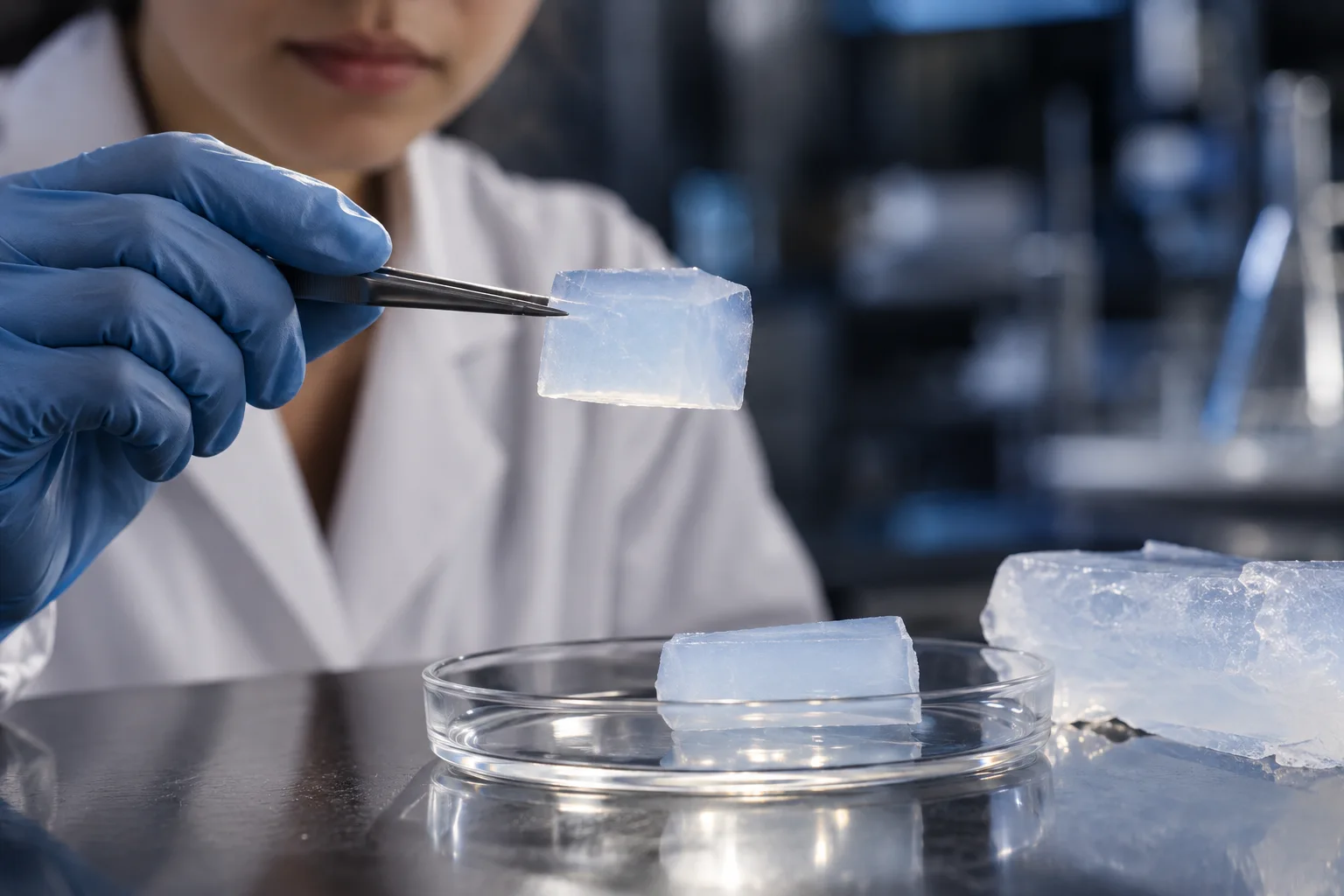
In plain language
An aerogel starts life as a wet gel, like a jelly, in which a fine solid network is filled with liquid. If you simply let the liquid evaporate, the network collapses. Aerogel makers dry the gel in special ways so that the network survives and the liquid is replaced by air, leaving a solid that is mostly empty space.
The result is a very light material that is excellent at blocking heat, because heat struggles to pass through the tiny, tangled pores. NASA used silica aerogel to insulate the Mars Pathfinder rover and to catch comet dust on the Stardust mission. Aerogel blankets and panels are sold as insulation, but plain silica aerogel is fragile and expensive, which limits wider use.
Technical explanation
Silica aerogels are typically made by sol-gel chemistry: silicon-containing precursors hydrolyse and condense into a three-dimensional network of nanoparticles that traps the solvent. Drying is the critical step. Conventional evaporation creates capillary forces that crush the nanoscale pores, so the liquid must be removed without letting these forces act on the network. The first aerogels were reported by S. S. Kistler in Nature in 1931. Later, Prakash, Brinker and colleagues showed in 1995 that silica aerogel films could be made at ambient pressure by chemically modifying the pore surfaces so that drying shrinkage was reversible, avoiding the high-pressure equipment that supercritical drying needs.
The resulting solids can be more than 99% empty space by volume. NASA's Jet Propulsion Laboratory describes its silica aerogel as 99.8% empty space and about 1,000 times less dense than glass. The fine pore structure strongly limits gas conduction and convection, giving very low thermal conductivity; a 2011 review reports commercial aerogel insulation products reaching values as low as about 13 mW per metre-kelvin, lower than traditional insulation. The same openness let Stardust's aerogel slow comet particles travelling at about six times the speed of a rifle bullet, which JPL described as stopping them gradually without damaging them.
The main drawback of silica aerogel is brittleness, so commercial products often combine it with fibres or polymers. Research has also moved beyond silica: Xu and colleagues (2019) reported ceramic aerogels with a double-pane nanolayered wall structure that are superelastic, resist severe thermal shock, and reach thermal conductivity of about 2.4 mW per metre-kelvin in vacuum and about 20 mW per metre-kelvin in air.
What the evidence says
Each statement is typed by the strength of its evidence and linked to the source that supports it.
Demonstrated Shown in a published experiment, test or shipping product.
JPL's silica aerogel is 99.8% empty space by volume and about 1,000 times less dense than glass.
Sources: [3] · Aerogel factsOn the Stardust mission, aerogel was used to capture comet dust particles arriving at about six times the speed of a rifle bullet; JPL described the aerogel as slowing particles gradually to a stop without damaging them, each leaving a track up to 200 times the particle's length.
Sources: [3], [4]JPL used aerogel to insulate the electronics box of the Mars Pathfinder Sojourner rover, which explored Mars in 1997.
Sources: [3]Commercial aerogel insulation products reach thermal conductivity as low as about 13 mW per metre-kelvin, and aerogels offer the possibility of high transmittance in the solar spectrum, which is of interest for buildings.
Sources: [5] · AbstractSilica aerogel films can be prepared at ambient pressure by chemically modifying the pore surfaces so that drying shrinkage is reversible.
Sources: [2] · Title · medium confidenceSilica aerogel is brittle, and polymer modification or fibre additives are among the approaches studied to address this weakness.
Sources: [6] · AbstractCeramic aerogels with a double-pane nanolayered structure reached densities as low as about 0.1 mg per cubic centimetre, superelasticity up to 95%, near-zero strength loss after thermal shocks of 275 C per second and exposure to 1400 C, and thermal conductivity of about 2.4 mW per metre-kelvin in vacuum and 20 mW per metre-kelvin in air.
Sources: [7] · AbstractProposed A design or plan that has not yet been built or tested.
The authors of the ceramic aerogel study propose the material for thermal superinsulation in extreme conditions such as spacecraft.
Sources: [7] · Abstract · medium confidenceLimitations and open problems
- Silica aerogel is brittle, and reducing brittleness with fibres or polymers is a central research problem (Ślosarczyk, 2017).
- Traditional production relies on supercritical drying, which needs high-pressure equipment; ambient-pressure routes such as that of Prakash and colleagues (1995) need extra surface-modification chemistry.
- Conventional ceramic aerogels suffer from poor mechanical stability and degrade under thermal shock (Xu and colleagues, 2019).
- Cost compared with conventional insulation is a barrier to wide use in buildings; the sources reviewed here did not give verified cost figures.
Possible future uses
Ideas, not predictions. None of these has been demonstrated.
- Thin aerogel layers for retrofitting insulation into older buildings where wall thickness cannot be increased.
- Translucent aerogel glazing that lets daylight in while cutting heat loss.
- Thermal protection for electric vehicle battery packs to slow the spread of heat between cells.
- Lightweight insulation for future lunar or Martian habitats and rovers.
Timeline
- 16 May 1931S. S. Kistler publishes 'Coherent expanded aerogels and jellies' in Nature, the work credited with the discovery of aerogels. Sources: [1], [3]
- Mar 1995Silica aerogel films made at ambient pressure using surface derivatisation, avoiding supercritical drying. Sources: [2]
- 1997JPL silica aerogel insulates the electronics box of the Mars Pathfinder Sojourner rover on Mars. Sources: [3]
- 2 Jan 2004NASA's Stardust spacecraft flies through the dust of Comet Wild 2, capturing particles in aerogel. Sources: [4], [3]
- Apr 2011Review reports commercial aerogel insulation products with thermal conductivity as low as 13 mW per metre-kelvin. Sources: [5]
- Feb 2019Superelastic, thermal-shock-resistant ceramic aerogels reported in Science. Sources: [7]
Futures this could help bring about
Glossary
- Gel
- A material made of a loose solid network that is filled with liquid, like a jelly.
- Sol-gel process
- A chemical route in which small particles in a liquid link up to form a gel network.
- Supercritical drying
- Removing liquid from a gel above the liquid's critical point, where there is no surface tension to collapse the pores.
- Thermal conductivity
- How easily heat flows through a material, measured in watts (or milliwatts) per metre-kelvin; lower means better insulation.
Sources
- peer reviewed paper
Coherent Expanded Aerogels and Jellies
S. S. Kistler. Nature, 16 May 1931. DOI: 10.1038/127741a0. Accessed 20 Oct 2026. - peer reviewed papercorrected
Silica aerogel films prepared at ambient pressure by using surface derivatization to induce reversible drying shrinkage
Sai S. Prakash, C. Jeffrey Brinker, Alan J. Hurd et al.. Nature, Mar 1995. DOI: 10.1038/374439a0. Accessed 20 Oct 2026. - government report
Ideas that Gel
NASA Jet Propulsion Laboratory, 11 Feb 2002. Accessed 20 Oct 2026. - university press release
Stardust nears end of epic journey; researchers await its treasure
Vince Stricherz. University of Washington News, 3 Jan 2006. Accessed 20 Oct 2026. - review article
Aerogel insulation for building applications: A state-of-the-art review
Ruben Baetens, Bjørn Petter Jelle, Arild Gustavsen. Energy and Buildings, Apr 2011. DOI: 10.1016/j.enbuild.2010.12.012. Accessed 20 Oct 2026. - review article
Recent Advances in Research on the Synthetic Fiber Based Silica Aerogel Nanocomposites
Agnieszka Ślosarczyk. Nanomaterials, 16 Feb 2017. DOI: 10.3390/nano7020044. Accessed 20 Oct 2026. - peer reviewed paper
Double-negative-index ceramic aerogels for thermal superinsulation
Xiang Xu, Qiangqiang Zhang, Menglong Hao et al.. Science, Feb 2019. DOI: 10.1126/science.aav7304. Accessed 20 Oct 2026.
Revision history
3 changes since this profile was created.